
Improved survival among young patients with hematologic malignancies has brought greater attention to long-term quality-of-life outcomes, including fertility. Women treated for leukemia or lymphoma may experience reduced reproductive function and diminished ovarian reserve.
Fortunately, hematologic malignancies during pregnancy are not common. Yet, their diagnosis leads to complex medical and ethical dilemmas that require a multidisciplinary approach.
This review discusses the impact of blood cancer treatment on female fertility, together with current approaches to managing hematologic malignancies during pregnancy.
Why Blood Cancers Present Unique Reproductive Challenges
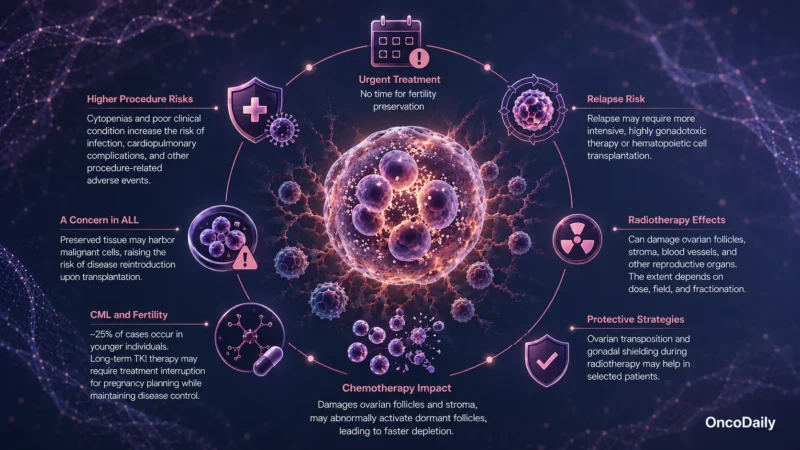
Most patients with acute leukemia or lymphoma require urgent cytotoxic therapy and cannot delay treatment long enough to undergo fertility preservation. In addition, cytopenias and poor clinical condition may increase the risks of infection, cardiopulmonary complications, and other procedure-related adverse events.
Hematologic malignancies carry a substantial risk of relapse. Although permanent amenorrhea is uncommon after initial treatment, relapse may require more intensive chemotherapy or hematopoietic cell transplantation. These treatments often involve highly gonadotoxic agents or total body irradiation, both of which frequently cause acute ovarian failure. Therefore, discussions about future fertility are important even after completion of initial cancer therapy.
A concern with ovarian tissue cryopreservation in hematologic malignancies is the risk of malignant cell contamination. This is particularly relevant in ALL, where preserved tissue may harbor leukemic cells, raising concerns about disease reintroduction upon transplantation, despite being the only fertility preservation option for prepubertal girls.
Although CML most commonly occurs after the age of 50 years, approximately one-quarter of cases are diagnosed in younger individuals. CML often requires years of continuous tyrosine kinase inhibitor therapy, which creates unique challenges, as pregnancy planning may require treatment interruption while maintaining adequate disease control.
How Cancer Treatment Affects Future Fertility
Chemotherapy drugs are designed to target rapidly dividing cells, making the ovaries particularly vulnerable to damage, which may manifest as apoptosis of primordial follicles, ovarian atrophy, and cortical fibrosis.
Paradoxically, chemotherapy can also accelerate the depletion of seemingly dormant primordial follicles. Under normal conditions, activation of several signaling pathways promotes follicular growth and maturation, leading to ovulation or atresia. During chemotherapy, however, dormant primordial follicles may be abnormally activated and transition prematurely into more vulnerable growing stages, where they are more likely to be destroyed.
The extent of radiotherapy-induced gonadotoxicity depends on the radiation field, total dose, and fractionation schedule. It can directly damage ovarian follicles as well as the surrounding stromal, vascular tissues and other reproductive organs. Ovarian transposition, and gonadal shielding during radiotherapy, may be used in selected patients.
Which Hematologic Therapies Carry the Greatest Fertility Risk?
The risk of premature ovarian failure depends on the type and stage of disease, the type and dose of anticancer therapy, and the patient’s age at the beginning of treatment.
Among conventional therapies, alkylating agents and high-dose radiation are associated with the highest risk of permanent infertility. Agents such as cyclophosphamide and busulfan can often cause irreversible damage to ovarian reserve, particularly when administered at higher cumulative doses.
Other commonly used therapies carry an intermediate risk. Platinum-based agents have been associated with reduced reproductive potential, while anthracyclines and vinca alkaloids have a relatively low intrinsic gonadotoxicity.
Impact of Modern Therapies: What We Still Do Not Know
For antibody-drug conjugates and CAR T-cell therapies, available evidence is largely restricted to preclinical studies, case reports, and small observational datasets. In the case of CAR T-cell therapy, any impact may be influenced as much by the preceding lymphodepleting chemotherapy as by the cellular therapy itself. Given these uncertainties, FP should be discussed before treatment initiation whenever feasible, particularly for patients expected to receive combination regimens or subsequent transplantation.
Similarly, the effects of immune checkpoint inhibitors and tyrosine kinase inhibitors remain largely speculative. Some ICIs have been associated with endocrine toxicities, but the long-term consequences are uncertain. Monoclonal antibodies such as rituximab and blinatumomab, as well as newer bispecific antibodies, have not demonstrated substantial direct reproductive toxicity, though they are often administered alongside known gonadotoxic agents.
Does the Type of Blood Cancer Matter?
Preserving fertility in ALL can be particularly challenging. More than half of ALL cases occur before the age of 20. Treatment typically involves prolonged multi-agent chemotherapy administered over 2-3 years, and many patients are diagnosed before puberty, when oocyte cryopreservation is not feasible.
In CML, treatment-free remission possible for selected patients, might be an opportunity for pregnancy without fetal exposure to TKIs with monthly monitoring of BCR-ABL transcript. In some situations, interferon-α may be used as an alternative during conception attempts and early pregnancy.
In lymphoma, the risk of ovarian insufficiency depends primarily on treatment intensity, particularly exposure to alkylating agents. While some patients with Hodgkin lymphoma may have time for FP before treatment, it’s often not feasible in other aggressive non-Hodgkin lymphomas.
After Stem Cell Transplantation
The conditioning regimens used for HSCT involve high-dose chemotherapy, often combined with total body irradiation. Consequently, most women receiving myeloablative conditioning experience permanent ovarian failure. Besides, previous exposure to cytotoxic therapies may impair oocyte quality at the time of preservation.
The Real Question Is About Ovarian Reserve
Many women resume menstruation after cancer therapy despite having a substantially reduced ovarian reserve, placing them at increased risk of subfertility. Biomarkers such as anti-Müllerian hormone (AMH) levels and antral follicle count (AFC) can provide a more accurate estimate. Assessment after treatment should also include endocrine function and reproductive counseling.
Is Pregnancy Safe After Leukemia or Lymphoma?
Although pregnancy after cancer treatment does not appear to increase the risk of disease recurrence, the optimal timing of conception remains an important consideration. Most experts recommend delaying pregnancy for at least two years after achieving complete remission of a hematologic malignancy.
This provides greater reassurance regarding maternal and fetal safety, given the observation that the risk of relapse is highest during the first one to two years following treatment, particularly in leukemia and lymphoma. The interval also allows time for recovery from intensive treatment and restoration of overall health.
Pregnancy Outcomes in Leukemia and Lymphoma Survivors
Live birth rates vary by preservation method, with reported rates of approximately 35-41% following embryo cryopreservation, 26-32% following oocyte cryopreservation, and 21-33% following ovarian tissue transplantation. These outcomes are generally comparable to those reported in broader oncology populations, though success rates may be lower among women who have previously undergone hematopoietic stem cell transplantation.
(Prakash G. et al., 2019, Lee D.-Y. et al., 2022, Di Tucci C. et al., 2022, Shoham Z. et al., 2025, Stamenov G. et al., 2025, Salvagno F. et al., 2026.)
General Principles of Managing Blood Cancers During Pregnancy
It is estimated that 15% of tumors associated with pregnancy are identified as hematologic malignancies, predominantly characterized by lymphoma (1:1,000-6,000), followed by leukemia (1:75,000-100,000).
Diagnostic procedures, including bone marrow examination, lymph node biopsy, and molecular testing, are performed similarly to those in nonpregnant patients. Whole-body MRI with diffusion weighted sequence represents a noninvasive imaging alternative for staging, enabling the detection of disease sites without underlying anatomical disruption and functional response assessment in hematologic malignancies. Ultrasound remains an important tool for evaluating maternal complications.
The therapeutic consensus is to salvage the mother, while trying to preserve pregnancy and avoid treatment-related-toxicity to the fetus. In most scenarios, especially during late trimesters, the aim is to administer the same treatment as outside of pregnancy.
Trimester Matters
After 12 weeks of gestation, the risk of congenital malformations decreases essentially to the standard population risk for most chemotherapies. Yet, there is still a risk of intrauterine growth restriction, preterm birth, and small gestational age at birth.
Because chemotherapy suppresses both maternal and fetal bone marrow, the interval between the last chemotherapy administration and delivery should be carefully planned to reduce the risk of maternal infection and neonatal bone marrow suppression.
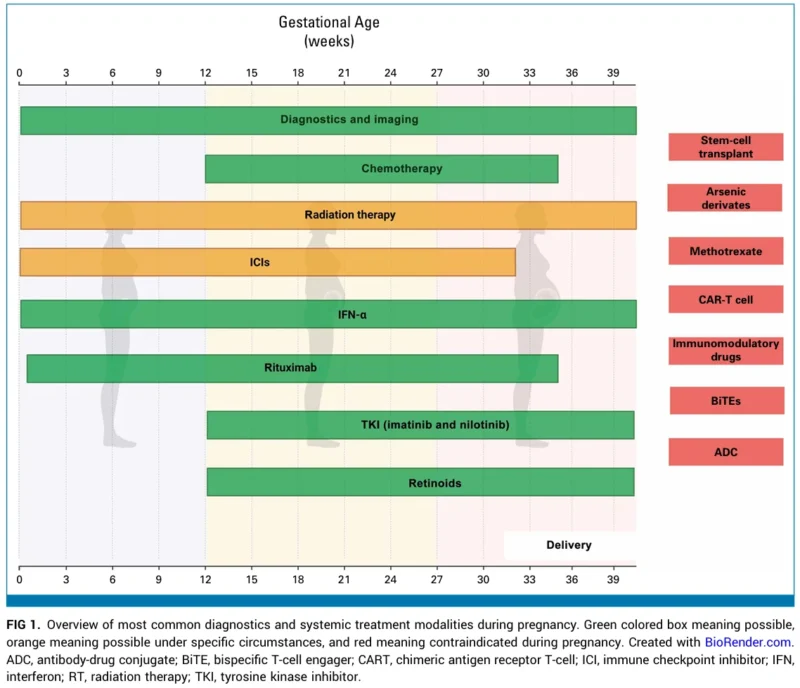
In most cases, this results in a planned and coordinated delivery, allowing timely resumption of chemotherapy postpartum, if indicated. Granulocyte colony-stimulating factor is classified as US FDA pregnancy category C, requiring careful consideration before use.
Large molecules, including monoclonal antibodies such as rituximab and ICIs, require active transport through FcRn receptors. This mechanism does not begin until approximately 14 weeks of gestation and gradually increases during the second and third trimesters. Consequently, the risk of congenital malformations is relatively low. However, ICIs during pregnancy have been associated with an increased risk of intrauterine growth restriction and premature rupture of membranes.
A study by Maggen et al. reported outcomes in 36 pregnant patients with non-Hodgkin lymphoma treated with rituximab, with neonatal complications occurring in 13% of cases and maternal infections in 8%.
In contrast, TKIs are small molecules that readily cross the placenta from the first trimester onward. Their use during early pregnancy is associated with congenital anomalies, with a reported prevalence of approximately 11% for imatinib, as well as spontaneous abortion rates ranging from 12% – 25%.
The Risks of Radiotherapy During Pregnancy
Current knowledge is derived primarily from animal studies and observations of survivors of the Hiroshima and Nagasaki atomic bombings and the Chernobyl nuclear disaster, although direct extrapolation to therapeutic radiation is imperfect.
With advancing gestation, the risk of structural abnormalities decreases, although susceptibility to neurodevelopmental effects persists. Radiation exposure throughout pregnancy carries a small stochastic risk of childhood malignancy that is proportional to fetal radiation dose and has no known threshold. Therefore, radiotherapy should be reserved for exceptional circumstances.
Specific Considerations by Malignancy Type
Acute leukemia during pregnancy is a medical emergency in which maternal survival remains the primary priority. Gestational age is the key factor guiding treatment decisions. For AML, daunorubicin and cytarabine remain the backbone of treatment after the first trimester, whereas targeted agents should be avoided. For ALL, pediatric-inspired regimens can be adapted by omitting methotrexate, avoiding asparaginase, and preferentially using daunorubicin over idarubicin. In Philadelphia chromosome-positive ALL, nilotinib is preferred because it crosses the placenta the least.
Acute promyelocytic leukemia presents unique challenges because both all-trans retinoic acid and arsenic trioxide are contraindicated during the first trimester. Hyperleukocytosis and disseminated intravascular coagulation require urgent management. If pregnancy is continued, daunorubicin monotherapy may be considered until the second trimester. Thereafter, ATRA combined with daunorubicin can be administered, whereas ATO remains contraindicated.

Hodgkin Lymphoma
Hodgkin lymphoma is the most common lymphoma diagnosed during pregnancy and is often identified at an early stage. Treatment can frequently be deferred until after delivery, making full-term pregnancy a realistic goal.
During the first trimester, treatment options may include close observation in selected cases, vinblastine monotherapy, or, when necessary, initiation of definitive therapy after the first trimester. In the second and third trimesters, asymptomatic patients with limited disease may continue under close observation. When treatment is required, ABVD remains the preferred regimen.
More intensive regimens such as BEACOPP, as well as newer agents including brentuximab vedotin, are avoided. Data on relapsed or refractory disease during pregnancy remain limited, and management should be individualized.
Non-Hodgkin Lymphoma
Management of NHL during pregnancy depends on lymphoma subtype, disease burden, symptoms, and gestational age.
Patients with low-burden indolent lymphomas, such as follicular or marginal zone lymphoma, can often be managed with close observation until delivery. In contrast, aggressive lymphomas, including diffuse large B-cell lymphoma, primary mediastinal B-cell lymphoma, and Burkitt lymphoma, require prompt systemic treatment.
R-CHOP remains the standard treatment for DLBCL and has been successfully administered during the second and third trimesters, with favorable outcomes. The use of polatuzumab vedotin, bispecific antibodies, and CAR T is generally not recommended.

Experience with DA-EPOCH-R in nonpregnant patients suggests an antimetabolite-free option for selected pregnant patients with Burkitt lymphoma or primary mediastinal B-cell lymphoma.
For rare lymphomas such as cutaneous T-cell lymphoma, most systemic therapies lack adequate pregnancy safety data, and management generally relies on skin-directed approaches, including topical corticosteroids, emollients, and phototherapy whenever possible.
Chronic Myeloid Neoplasms and Aplastic Anemia
Pregnancy in women with essential thrombocythemia and polycythemia vera is associated with an increased risk of thrombotic and obstetric complications.
Low-dose aspirin is generally recommended throughout pregnancy for women with ET or PV unless contraindicated. In higher-risk patients, low-molecular-weight heparin and interferon-α may be used when cytoreductive therapy is required, whereas hydroxyurea and anagrelide should be avoided because of potential fetal toxicity. In women with PV, therapeutic phlebotomy may also be used to maintain safe hematocrit levels.
Although rare, aplastic anemia can present during pregnancy and cause significant complications. Management is largely supportive and focuses on maintaining adequate blood counts. If additional treatment is required, cyclosporine may be used. In patients with associated paroxysmal nocturnal hemoglobinuria, complement inhibition may also reduce thrombotic risks.

Multiple Myeloma
Multiple myeloma during pregnancy is rare but often requires prompt intervention because of the risk of disease-related complications, including bone lesions, spinal cord compression, hypercalcemia, and infection. Initial management relies on corticosteroids, thromboprophylaxis, and supportive care.
When systemic therapy is necessary, treatment options are limited. Conventional agents such as cyclophosphamide, doxorubicin, and vincristine have the greatest clinical experience during pregnancy, whereas most modern anti-myeloma therapies are contraindicated or lack adequate safety data. In contrast, monoclonal gammopathy of undetermined significance and smoldering myeloma generally do not require treatment during pregnancy.
Outcomes After In Utero Exposure to Cancer Therapy
Infants whose mothers received rituximab in the second/ third trimester are born with B-cell depletion with spontaneous resolution by 4-6 months without infectious complications. B-cell recovery is fast, showing a regular immunophenotype.
Available follow-up studies conclude that, when avoiding chemotherapy during organogenesis and if controlled for gestational age at birth, outcome of children born from pregnancies complicated by maternal cancer and treatment is comparable to the general population. Enrollment of all cases of cancer diagnosed during pregnancy in the INCIP database is encouraged. (Dierickx D. et al., 2026)
Written by Susanna Mikayelyan, MD
FAQ
Is pregnancy after leukemia or lymphoma associated with a higher risk of cancer relapse?
Current evidence suggests that pregnancy itself does not increase the risk of disease recurrence in women who have achieved remission. However, pregnancy is generally recommended only after an appropriate disease-free interval, allowing recovery from treatment and reducing the likelihood of relapse during pregnancy.
Why are targeted therapies not always safer than chemotherapy during pregnancy?
Targeted therapies selectively inhibit molecular pathways involved in cancer growth, but many are small molecules capable of crossing the placenta, particularly during early pregnancy. Several targeted agents remain contraindicated because of fetal toxicity observed in animal studies or limited human experience. Therefore, "targeted" does not necessarily mean "safe" during pregnancy.
Can women become pregnant after hematopoietic stem cell transplantation?
Although myeloablative conditioning frequently results in permanent ovarian failure, spontaneous pregnancies have been reported after HSCT. The likelihood depends on factors including patient age, conditioning intensity, cumulative chemotherapy exposure, and whether total body irradiation was used. Early fertility counseling remains essential before transplantation whenever possible.
Why is ovarian tissue cryopreservation controversial in some hematologic malignancies?
Unlike egg or embryo cryopreservation, ovarian tissue transplantation carries the theoretical risk of reintroducing malignant cells. This concern is particularly important in diseases with a high likelihood of ovarian involvement, such as acute lymphoblastic leukemia. Ongoing research is evaluating methods to eliminate malignant contamination before transplantation.
Why is the first trimester considered the highest-risk period for cancer treatment?
The first trimester coincides with organogenesis, when the developing fetus is most vulnerable to teratogenic effects. Exposure to chemotherapy or certain targeted agents during this period is associated with the greatest risk of major congenital malformations. After organogenesis, treatment may become feasible for selected patients, although risks such as fetal growth restriction and preterm birth remain.