
Progress in the treatment of acute promyelocytic leukemia (APL) has been one of the major successes in acute myeloid leukemia (AML) over the last two decades, establishing APL as a model of targeted differentiation therapy.
Nevertheless, important challenges remain, including early hemorrhagic mortality, treatment-related toxicities and optimization of therapy for high-risk and rare APL variants, emphasizing that the therapeutic story of APL continues to evolve.
A Distinct Subtype of AML
APL represents 5-20% of adult AML cases, with an estimated annual incidence of 1-7.4 cases per 1,000,000 person-years, and is considered a distinct clinicopathologic subtype due to its unique molecular pathogenesis, characteristic coagulopathy and marked responsiveness to therapy.
What Makes APL Unique?
The hallmark molecular alteration in APL primarily disrupts cellular differentiation rather than promoting uncontrolled proliferation. In the majority of cases (>95%), APL is characterized by the t(15;17) translocation, which generates the PML::RARA fusion gene and its corresponding oncogenic fusion protein through rearrangement of the promyelocytic leukemia and retinoic acid receptor alpha genes.
Physiologically, RARA regulates granulocytic differentiation. In APL, the fusion protein binds DNA with abnormally high affinity for transcriptional corepressors and histone deacetylase complexes, leading to epigenetic silencing of genes necessary for maturation. As a result, leukemic promyelocytes accumulate within the bone marrow and peripheral blood in a state of arrested differentiation.
The PML component disrupts formation of PML nuclear bodies, structures involved in apoptosis, senescence, DNA damage responses and cellular stress signaling. Loss of normal PML-NBs contributes to leukemic survival and resistance to apoptosis.
In addition to classical fusion, several rare rearrangements have been described, Among these, PLZF::RARA t(11;17) is the most common, accounting for approximately 1%. PLZF acts as a transcriptional repressor involved in cell cycle regulation and myeloid differentiation.
The Coagulopathic Profile
The coagulopathy of APL arises from simultaneous activation of procoagulant and fibrinolytic pathways. Leukemic promyelocytes express high levels of tissue factor, which activates the extrinsic coagulation cascade, and release cancer procoagulant, a cysteine protease capable of directly activating factor X. Inflammatory cytokines produced by malignant cells further amplify coagulation through endothelial injury and activation of additional coagulation pathways.
Alongside this, APL cells promote excessive fibrinolysis through expression of annexin II and other fibrinolytic mediators that enhance plasmin generation. Impaired primary hemostasis is another contributor to bleeding, as most patients present with thrombocytopenia at diagnosis. Clinically, this process often manifests as DIC and severe complications, particularly intracranial hemorrhage, which remains the leading cause of early mortality and explains why APL is considered a hematologic emergency.
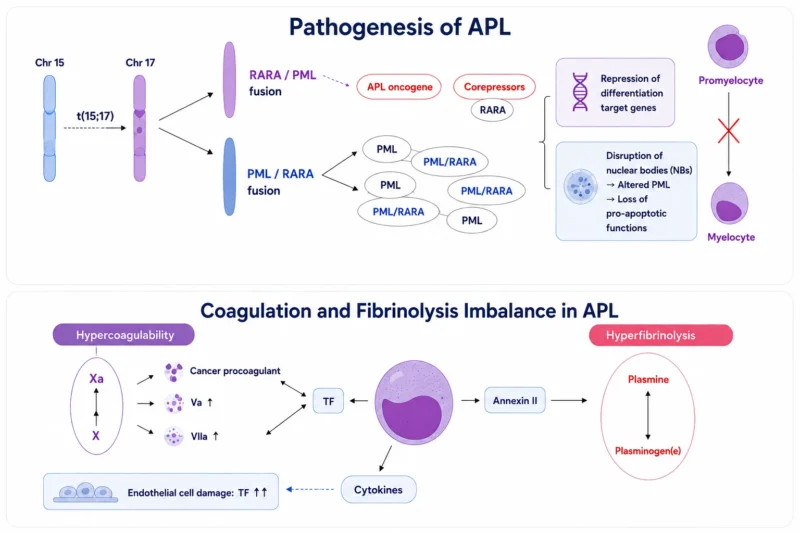
mdpi.com
The Success: Turning Differentiation Back On
The central oncogenic mechanism proved directly reversible. All-Trans Retinoic Acid (ATRA) binds the altered RARA domain and releases transcriptional repression, allowing leukemic promyelocytes to resume terminal differentiation. Rather than rapidly destroying blasts through cytotoxicity alone, ATRA restores the physiologic maturation program .
Arsenic trioxide (ATO) promotes oxidation, multimerization, ubiquitination and subsequent proteasomal degradation of the fusion protein while also reconstituting PML nuclear bodies and restoring apoptosis.
ATO has had a long and intriguing history in medicine, ranging from its early reputation as a toxic substance, including the purported arsenic poisoning of Napoleon, as well as its use in the treatment of syphilis and trypanosomiasis, to its modern role as a highly effective targeted therapy for APL.
The Other Side of the Coin
Though the combination has lower hematologic toxicity than standard chemotherapy, it is associated with unique treatment-related adverse effects.
Differentiation syndrome remains one of the most important complications. Driven by rapid leukemic cell maturation, cytokine release, and endothelial injury, it can manifest with fever, dyspnea, pulmonary infiltrates, pleural or pericardial effusions, hypotension, renal dysfunction, and leukocytosis. Despite its potentially life-threatening nature, early recognition and prompt corticosteroid therapy have improved outcomes.
Hepatotoxicity is relatively common during ATO-based therapy. Oxidative stress and mitochondrial dysfunction are thought to contribute to hepatocellular injury, although most cases remain reversible with dose adjustments.
Arsenic-related alterations in cardiac ion channel activity, often exacerbated by electrolyte disturbances or concomitant medications, may predispose patients to ventricular arrhythmias, making close ECG and electrolyte monitoring essential throughout treatment.
Neurologic complications, especially pseudotumor cerebri, are more frequently associated with ATRA, particularly in younger patients. Symptoms such as headache, visual disturbances, papilledema, and increased intracranial pressure likely reflect retinoid-induced alterations in cerebrospinal fluid dynamics.
Additional toxicities include myalgias, arthralgias, peripheral neuropathy, fluid retention, pancreatitis and infectious complications, particularly during induction therapy. With this in mind, modern management relies heavily on early recognition of toxicities, supportive care, and timely intervention.
Modern Risk-Adapted Therapy
The WBC count at presentation remains the basis of risk stratification. Patients with a WBC count ≤10 × 10⁹/L are classified as low- or intermediate-risk (standard-risk), a WBC count >10 × 10⁹/L – high-risk disease. For standard-risk APL, the combination of ATRA and ATO without conventional chemotherapy has become the standard of care, based on the landmark APL0406 trial.
In high-risk APL marked leukocytosis increases the risk of early differentiation syndrome during induction. For this reason, cytoreductive therapy is commonly incorporated, most often with low-dose anthracyclines. Clinical trials, including the APOLLO, demonstrated superior efficacy and tolerability of ATRA-ATO combined with low-dose idarubicin compared with conventional chemotherapy-based approaches. In patients unable to receive anthracyclines, gemtuzumab ozogamicin, an anti-CD33 ADC may serve as an alternative.
A meta-analysis by Ahmad H. et al. (2026), including 12 studies comparing ATRA-ATO with ATRA+chemotherapy in newly diagnosed APL, demonstrated superior outcomes with the chemotherapy-free approach. In randomized controlled trials, ATRA-ATO significantly improved CRR (RR 1.04), DFS (RR 1.22) and OS (RR 1.07). Toxicity profiles were generally comparable, yet ATRA-ATO was associated with a higher risk of QTc prolongation (RR 3.79).
High-risk patients achieving remission after anthracycline-based induction may subsequently continue with chemotherapy-free consolidation. Maintenance is mainly reserved for selected high-risk patients treated with chemotherapy-containing regimens without ATO.
MRD assessment is recommended at the end of consolidation, with serial monitoring every three months for 2-3 years in high-risk patients. RT-qPCR detection of the PML::RARA transcript is a gold standard.
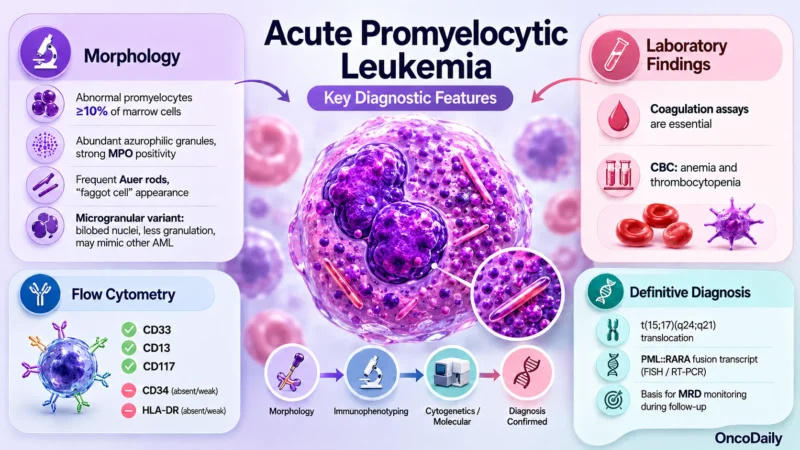
Risk Beyond Initial Remission
In relapsed disease, salvage therapy is typically selected according to prior treatment exposure, alternating between ATRA-ATO and chemotherapy-based approaches. Achieving molecular remission before HSCT remains the primary objective, with autologous transplantation preferred for MRD-negative relapse and allogeneic transplantation reserved for persistent MRD-positive disease.
Clinical trials and retrospective studies have explored several biomarkers as potential prognostic indicators. Among them, FLT3-ITD mutations, higher CD56 expression and lower expression of Preferentially Expressed Antigen of Melanoma (PRAME) have been associated with shorter event-free survival and increased relapse risk. Though their role in routine clinical practice remains limited, ongoing research may refine future risk stratification.
The Next Challenges of Curable Leukemia
Outcomes of APL in real-world practice continue to differ from the results reported in pivotal clinical trials, as these studies often underrepresent older patients, individuals with significant comorbidities, and those with poor performance status, while patients who die from severe hemorrhagic complications before enrollment are frequently excluded from outcome analyses.
Current research increasingly focuses not only on maintaining cure rates, but also on simplifying therapy. Oral arsenic-based regimens and outpatient-oriented approaches aim to reduce hospitalization, treatment burden and healthcare costs while preserving efficacy.
Chinese researchers pioneered the use of IV ATO in the 1980s as a treatment for relapsed APL. Realgar-Indigo naturalis formula (RIF) is an oral arsenic-containing formulation developed in China for the APL. In the multicenter phase III APL16 trial conducted between 2018 and 2022, oral RIF demonstrated non-inferiority to IV ATO in patients with non-high-risk APL. All 108 eligible patients achieved hematologic CR, while the 2-year DFS rates were 97% in the ATRA-RIF arm vs 98%, after a median follow-up of 29 months (Chen S. et al., 2025).
The SY-2101 study by Ravandi F. et al. (2025), was a randomized crossover phase I pharmacokinetic and safety trial evaluating an oral formulation of ATO in patients who were already in morphologic complete remission after induction therapy. During consolidation cycle 4, patients received three single-dose formulations: intravenous ATO, oral SY-2101 in the fasting state, and oral SY-2101 in the fed state.
SY-2101 demonstrated systemic arsenic exposure comparable to IV ATO, was well tolerated, and could be administered regardless of meals. The study also emphasized the substantial burden of conventional ATO therapy, which may involve up to 140 intravenous infusions lasting 2-4 hours over nearly a year, highlighting oral arsenic formulations as a potential strategy.
As survival improves, attention is also shifting toward survivorship, including long-term cardiac effects, secondary malignancies, fertility, psychological recovery, and quality of life after cure.
You can also read: Acute Myeloid Leukemia (AML) in 2026: The Current Landscape and Future Perspectives
Written by Susanna Mikayelyan, MD
FAQ
Why is acute promyelocytic leukemia (APL) considered one of oncology’s greatest success stories?
APL transformed from one of the deadliest forms of AML into one of the most curable adult leukemias after the introduction of differentiation therapy with ATRA and arsenic trioxide (ATO). Unlike conventional chemotherapy alone, these agents directly target the molecular driver of the disease and restore normal cellular maturation.
Why does APL cause severe bleeding so early in the disease?
APL cells trigger both coagulation and excessive fibrinolysis simultaneously. Combined with thrombocytopenia, this creates a high risk of catastrophic bleeding, especially intracranial hemorrhage, which remains one of the leading causes of early death before therapy fully takes effect.
Are there long-term health concerns for patients cured of APL?
Yes. As survival improves, attention is increasingly shifting toward survivorship issues such as cardiac toxicity, fertility preservation, neurocognitive recovery, secondary malignancies, chronic fatigue, and psychological health after treatment.
Can patients with APL relapse even after molecular remission?
Yes. Although long-term cure rates are high, relapse can still occur, particularly in high-risk patients or those with persistent measurable residual disease (MRD). This is why serial RT-qPCR monitoring for PML::RARA transcripts remains essential even after remission.
Could oral arsenic therapy eventually replace intravenous treatment in APL?
Possibly. Emerging oral arsenic-based approaches are showing promising efficacy and pharmacokinetic profiles. These approaches may reduce hospitalization, infusion burden, and healthcare costs while preserving outcomes, although further long-term evaluation is still needed.