
In hematology, remission once meant that disease could no longer be identified under the microscope. The recognition of Minimal Residual Disease (MRD) transformed this understanding. It refers to quantification of residual cancer cells, or surrogate markers, in patients who have achieved histologic CR after therapy.
Its primary clinical purpose is to estimate the risk of treatment failure and potentially guide intervention when relapse risk is high. MRD testing is now routinely used for prognosis and risk stratification in many leukemias, is incorporated into clinical trials, and has been accepted by the FDA as a primary endpoint for accelerated approval of new therapies in multiple myeloma. Consequently, MRD-related investigation has become one of the most active areas of research in hematologic malignancies.
Conceptual Perspective
As often occurs in science, technology has developed more quickly than the confidence in how to apply and react to it clinically. In principle, any reproducibly measurable molecular or cellular abnormality could serve as an MRD marker. Yet how well a given marker will perform as a predictor of a relevant outcome can only be established empirically. As such, MRD exists at the intersection of technology, disease biology and statistical interpretation.
Strengths and Limitations of Current MRD Tools
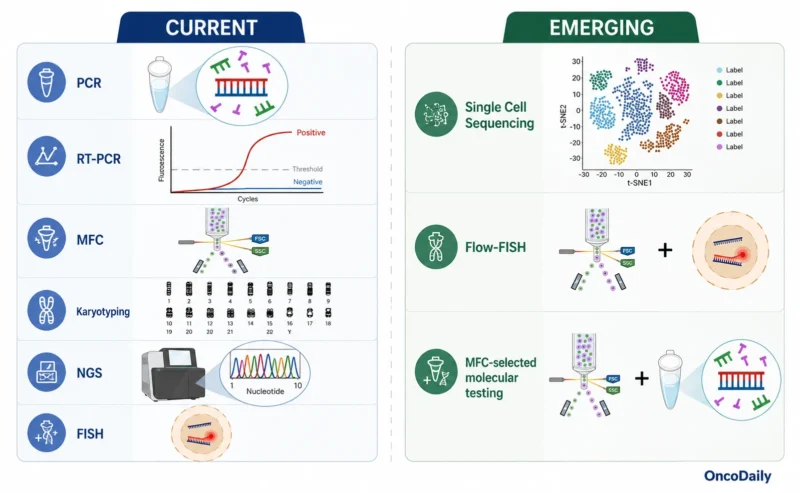
The earliest approaches to MRD detection emerged from cytogenetics. Today, commonly used modalities include multiparametric flow cytometry (MFC), PCR-based methods and NGS.
MFC identifies abnormal cell populations through combinations of surface and intracellular marker expression, enabling rapid assessment of millions of cells in near real time. These methods face biological challenges such as immunophenotypic shifts over time and overlap between regenerating and malignant populations. Two complementary conceptual strategies have emerged: tracking patient-specific abnormal phenotypes identified at diagnosis and detecting cells that deviate from normal hematopoietic patterns even in the absence of prior baseline information.
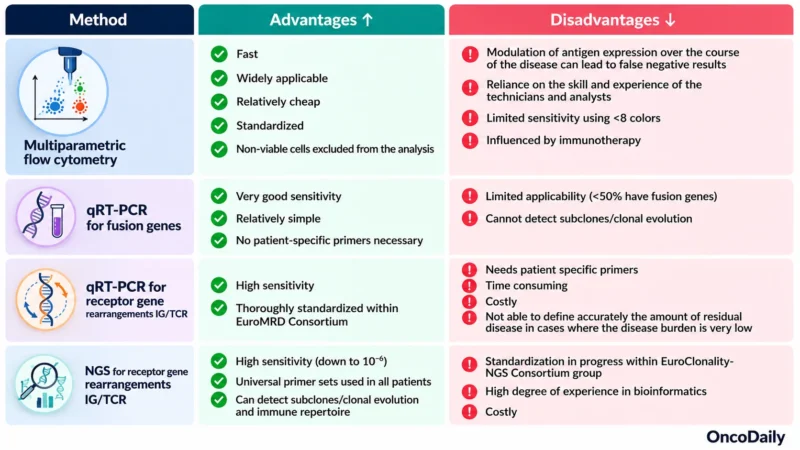
Quantitative PCR assays remain among the most established platforms when suitable molecular targets are available. Their performance, however, depends on stable target selection and accurate calibration, both of which can become challenging at extremely low disease burdens. Droplet digital PCR refined this framework further by partitioning reactions into thousands of parallel microcompartments, enabling absolute quantification while reducing technical variability.
NGS offers a more flexible strategy by enabling simultaneous interrogation of numerous genomic regions in parallel, allowing detection of both known and unexpected variants within evolving clones. Beyond analytical sensitivity, a major strength of NGS lies in its ability to characterize clonal diversity and mutational dynamics over time. However, its implementation remains technically complex, with wide differences in methodology, cost, availability and clinical integration.
What’s New
Hybrid strategies combining flow cytometry with molecular sequencing allow enrichment of suspicious cellular populations prior to genomic analysis, improving signal-to-noise ratios and helping distinguish persistent malignancy from age-related clonal hematopoiesis.
More recently, genome-wide technologies such as chromosomal microarray analysis and optical genome mapping have improved the ability to characterize chromosomal complexity, copy-number variation, and cryptic structural rearrangements without reliance on traditional cell culture methods.
Residual disease exists on a continuum rather than in rigid positive-versus-negative categories, and advanced analytical frameworks, machine learning approaches are being explored to better personalize risk estimation.
Choosing Where to Look
Selection of the compartment is an important challenge in hematologic malignancies, as residual disease burden may differ substantially between bone marrow, peripheral blood, lymph nodes and other tissue sites.
Disseminated malignancies may show relatively similar MRD levels across blood and marrow, whereas marrow-centered diseases frequently demonstrate lower MRD levels in peripheral blood. Though, detectable MRD in blood may still identify biologically aggressive disease associated with higher relapse risk.
In malignancies with extramedullary involvement, residual disease within lymph nodes or other sanctuary sites may not be adequately captured. This has increased interest in multimodal surveillance strategies combining molecular assays, liquid biopsy approaches such as circulating tumor DNA and functional imaging.
MRD Across Hematologic Malignancies: Advances and Gaps
Two of the most striking examples of successful MRD implementation in clinical practice are acute promyelocytic leukemia (APL) and chronic myeloid leukemia (CML), both driven by disease-defining molecular alterations.
In APL, detection of PML-RARα transcripts by RT-PCR was shown to predict relapse as early as the chemotherapy era, findings later confirmed with modern chemotherapy-free regimens. Improved concordance between bone marrow and peripheral blood testing subsequently reduced the need for repeated marrow biopsies and supported incorporation of MRD monitoring into clinical guidelines.
Similarly, in CML, disease activity has long been closely linked to BCR::ABL1 transcript levels. Over the past two decades, evidence from TKI trials established molecular monitoring as a central component of disease management, guiding response assessment, treatment switching and eligibility for treatment-free remission after sustained deep molecular response.
The marked genetic heterogeneity and the absence of universal immunophenotypic markers complicate assay development and interpretation in AML. Molecular MRD monitoring relies mainly on qPCR assays targeting recurrent lesions such as NPM1 mutations and CBF rearrangements.

The relatively high ELN threshold of 0.1% for MFC-based MRD largely reflects technical limitations. At this threshold, detectable MRD after therapy may reflect persistent disease rather than truly MRD, with a substantial risk of false-negative results. In other words, detection of 1%-0.1% residual blasts by MFC may be more comparable to the role of SPEP in myeloma.
In AML, achievement of MRD negativity after CR is associated with markedly improved survival, with reported 5-year OS rates approaching 70% (vs 35%). Similar patterns have been observed in both pediatric and adult ALL, where MRD positivity remains one of the strongest predictors of relapse and poorer outcomes.
Comparable findings have emerged in CLL and MM and importantly, these associations persist across different treatment approaches, patient populations, cytogenetic risk groups and detection methods.
MRD-Directed Therapies
In 2023, blinatumomab, an anti-CD19 bispecific T-cell engager, became the first FDA-approved therapy with a specific MRD indication in ALL. In the BLAST trial, treatment of MRD-positive patients in complete remission led to MRD clearance in 78% of evaluable patients after one cycle of therapy.
Later studies showed improved relapse-free survival (80% vs. 64%) and OS (85% vs. 68%) even in patients considered MRD-negative, suggesting that currently defined MRD thresholds may not fully capture biologically relevant residual disease.
You Can Watch More on OncoDaily TV
A similar pattern has emerged in FLT3-mutated AML. In the phase III QuANTUM-First trial, the FLT3 inhibitor quizartinib improved relapse-free and overall survival when added to standard therapy regardless of pre-transplant MRD status, with benefit observed in both MRD-positive and -negative patients.
In MM, trials such as MASTER and GEM2012MENOS65 have explored treatment escalation or de-escalation based on MRD status, supporting the potential role of such strategies, particularly in standard-risk disease.
An FDA analysis of drug applications between 2014 and 2021 showed that although more than 1/4 included MRD data, many proposals to incorporate MRD into prescribing information were rejected because of ongoing concerns regarding assay validation, data standardization and statistical interpretation.
“Residual” Questions Behind Residual Disease
MRD testing is not a one-size-fits-all concept. Standardization remains uneven across diseases and platforms. Head-to-head comparisons between different assays also highlight limitations.
In AML, concordance between flow cytometry and NGS has been reported at only 69%, and in ALL, some patients classified as negative by flow cytometry still demonstrate detectable disease by NGS. Even molecular assays may yield discrepant results because of differences in targets and analytical design.
Only a relatively small proportion of studies have evaluated treatment adaptation based on residual disease status. Most interventional studies have focused on AML and ALL, and much of the available evidence derives from observational cohorts and case-control studies, which remain vulnerable to selection bias and incomplete adjustment for prognostic variables.
Reductions in relapse risk do not necessarily translate into improved survival, raising broader questions about how these endpoints should ultimately be interpreted clinically:
1. For diseases that are not readily eradicated, should MRD negativity always be the therapeutic goal?
2. Across diseases, does intervention at an MRD-positive state improve outcomes more than waiting for morphologic or radiographic relapse?
3. And critically, could reacting to MRD positivity in some settings lead to unnecessary treatment intensification and overtreatment despite a relatively low risk of progression?
Practice points
- MRD assessment requires assays targeting specific molecular markers with sufficient sensitivity and an appropriate detection threshold.
- MRD results may not reliably predict relapse risk in individual patients, and relapse is not always preceded by detectable MRD positivity.
- Outside clinical trials, treatment decisions are generally not based solely on MRD results, with some exceptions such as CML.
Research agenda
- Development of adaptive MRD thresholds based on assay characteristics, disease biology, and individual patient risk.
- Determining how MRD-guided treatment changes should balance therapeutic benefit against treatment-related toxicity.

You can also read: Tumor Lysis Syndrome (TLS): The Systemic Aftermath of Rapid Malignant Cell Breakdown
Written by Susanna Mikayelyan, MD
FAQ
What Is Minimal Residual Disease (MRD)?
MRD refers to small amounts of residual cancer that remain detectable after treatment despite complete remission by conventional methods. Highly sensitive techniques such as flow cytometry, PCR, and NGS are used to identify residual malignant cells below the limits of standard testing.
Can MRD negativity ever be misleading?
Yes. MRD negativity does not necessarily mean complete eradication of disease. Residual malignant cells may remain below the assay’s detection threshold, within unsampled tissue compartments, or outside the biological scope of the test being used.
Why can two MRD tests give different results in the same patient?
Different assays measure different aspects of disease biology and vary in sensitivity, target selection, and analytical design. A patient may therefore appear MRD-negative by flow cytometry while still showing detectable disease by molecular techniques such as NGS.
Could MRD eventually replace bone marrow biopsies?
In some settings, partially. Advances in circulating tumor DNA analysis, liquid biopsy technologies, and multimodal surveillance strategies may reduce dependence on repeated marrow sampling, though complete replacement remains unlikely in the near future.
Does deeper MRD sensitivity always improve patient care?
Not necessarily. Detecting increasingly smaller amounts of disease does not automatically translate into improved survival or better treatment decisions. One of the major challenges in the field is determining which levels of detectable disease are truly clinically meaningful.
Why is MRD easier to standardize in some diseases than others?
Diseases such as CML and APL are driven by stable, disease-defining molecular alterations that are relatively straightforward to track. In contrast, genetically heterogeneous malignancies like AML often lack universal markers, making assay interpretation and standardization more difficult.
Could artificial intelligence improve MRD interpretation?
Potentially. Machine learning approaches are increasingly being explored to analyze complex flow cytometry and sequencing datasets, identify subtle abnormal populations, and improve individualized risk estimation.