Despite being commonly discussed as a single disease, non-Hodgkin lymphoma (NHL) is actually an umbrella term for more than 80 distinct lymphoid malignancies that differ substantially in their biology, clinical behavior, and treatment requirements.
Diffuse large B-cell lymphoma (DLBCL) is the most frequent histological subtype of NHL, comprising approximately one-third of new cases, and is regarded as the paradigm for the management of aggressive lymphoma.
The Bigger Picture
NHL diversity reflects the different stages of lymphocyte development at which malignant transformation occurs, along with the broad range of genetic and molecular alterations that drive lymphomagenesis.
B-cell lymphomas account for approximately 85-90% of NHL diagnoses in Western populations including DLBCL, follicular lymphoma, mantle cell lymphoma, and marginal zone lymphoma. NK-cell and T-cell lymphomas are less common but exhibit unique characteristics and require different therapeutic approaches.
One of the most important clinical distinctions within NHL is the difference between indolent and aggressive lymphomas. Indolent lymphomas, such as follicular lymphoma and many marginal zone lymphomas, typically grow slowly and may remain asymptomatic for years, although often characterized by a pattern of repeated relapse and remission. In contrast, aggressive lymphomas, most notably DLBCL, tend to progress rapidly and require prompt treatment but are often potentially curable with modern therapies.
Who Is at Risk for DLBCL?
The real cause of DLBL is unknown. Risk factors include genetic traits, immunological dysregulation, and viral, environmental, or occupational exposures. The typical age at diagnosis is in the mid-60’s, with 30% of individuals being older than 75. Most cases arise de novo, though transformation from indolent B-cell malignancies can also occur.
Richter Transformation (RT): When Chronic Lymphocytic Leukemia Turns Aggressive
Various studies consistently reported that autoimmune conditions are associated with an increased risk, including Sjogren’s syndrome (OR = 8.92) and hemolytic anemia (OR = 3.2). Also, a moderate association between rheumatoid arthritis (OR = 1.4) and a borderline association between systemic lupus erythematosus was identified. An international cohort of SLE patients from 30 centers found that DLBCL was the most common NHL subtype to develop.
Infectious agents associated with DLBCL include HIV/AIDS, human herpesvirus 8 (HHV-8), hepatitis C virus (HCV), and Epstein–Barr virus (EBV). Among people living with HIV, DLBCL is the most common NHL subtype, accounting for approximately 50-70%.
How Does It Present?
DLBCL most commonly presents as a rapidly enlarging lymph node or extranodal mass. Progression often occurs over weeks to months. Approximately one-third of cases arise at extranodal sites, most commonly in the gastrointestinal tract, though virtually any organ can be involved, including the skin, bone, testes, CNS, thyroid, and breast. Clinical manifestations therefore vary considerably.
Constitutional or “B” symptoms: fever, drenching night sweats, and unintentional weight loss, are often associated with more advanced disease. Additional symptoms such as abdominal pain, bowel obstruction, neurological deficits, or airway compression, may result from local tumor growth.
The Path to Lymphomagenesis
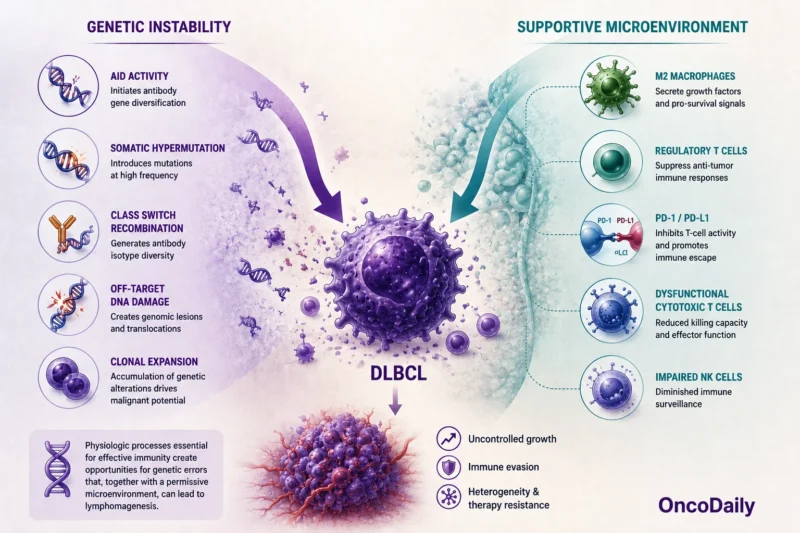
Most DLBCLs originate from B cells participating in the germinal center (GC) reaction, a highly specialized process that occurs within secondary lymphoid tissues following antigen exposure. Within the germinal center, activated B cells undergo rapid proliferation and immunoglobulin gene remodeling to generate high-affinity antibodies.
This process takes place across two functionally distinct compartments: the dark zone and the light zone. In the dark zone, proliferating B cells undergo somatic hypermutation, which introduces mutations into immunoglobulin genes to diversify antigen recognition.
In the light zone, B cells interact with follicular dendritic cells and T-follicular helpers and are selected based on the affinity of their B-cell receptors. Cells with high-affinity receptors survive and differentiate into memory B cells or plasma cells, whereas low-affinity cells undergo apoptosis.
Though essential for normal immune responses, these mechanisms place substantial stress on the B-cell genome. Repeated cycles of proliferation, DNA modification, and selection increase the risk of genetic errors. Activation-induced cytidine deaminase, the enzyme responsible for SHM and class-switch recombination, can generate off-target DNA damage.
A Supportive Niche
Immunosuppression is readily apparent within the DLBCL microenvironment. M2-polarized macrophages and regulatory T cells support lymphoma growth and immune evasion, while dysfunction of cytotoxic T cells and NK cells, together with PD-1/PD-L1 signaling, further impairs anti-tumor immunity.
DLBCL Itself Is Not a Single Disease
DLBCL comprises several clinicopathologic entities, including primary mediastinal large B-cell lymphoma, EBV-positive DLBCL, and T-cell/histiocyte-rich large B-cell lymphoma. However, DLBCL-NOS (not otherwise specified) accounts for the majority of cases.
Gene expression profiling further reveals that even DLBCL-NOS is not a single disease, dividing it based on so-called “cell of origin”:
- germinal center B-cell-like (GCB, 56%)
- activated B-cell-like (ABC, 32%)
- unclassified/type 3 (11%)
Retrospective studies have revealed significantly better outcomes for GCB compared with ABC, yet prospective studies have failed to detect significant differences in terms of survival. Besides, COO alone does not explain the clinical heterogeneity across patients.
Making the Diagnosis
After clinical evaluation and radiographic imaging, diagnosis is confirmed by excisional biopsy of an enlarged lymph node. The underlying architecture of the affected lymph node is disrupted and effaced by the diffuse infiltration of medium-to-large cells with big nucleoli and copious cytoplasm, which is the morphological hallmark of DLBCL.
The three major morphologic variants are centroblastic, immunoblastic, and anaplastic. Of those, a worse prognosis is associated with the immunoblastic variation. Morphologic diagnosis should be confirmed by immunohistochemistry. When gene expression profiling is unavailable, immunohistochemical algorithms are commonly used to distinguish COO.
Immunophenotyping and Molecular Profiling
Most cases express pan-B-cell markers, including CD19, CD20, CD22, CD79a, and CD45, and typically show surface immunoglobulin expression. Certain markers carry prognostic significance, including FOXP1, with poorer outcomes, and CD30, defining a distinct biological subgroup. Elevated Ki-67 reflects the high proliferative activity.
Through molecular profiling, MYD88 and CD79B mutations are frequently observed in ABC-DLBCL, whereas EZH2 mutations and BCL2 translocations are more common in GCB-type. Constitutive activation of the NF-κB pathway is a hallmark of ABC-DLBCL and represents an important therapeutic target.
A particularly high-risk category comprises double-hit and triple-hit lymphomas, characterized by MYC rearrangement together with BCL2 and/or BCL6.
Biomarkers Beyond Tissue Biopsy
The liquid biopsy technique relies on the analysis of circulating tumor-derived DNA and other associated biomarkers in peripheral blood. In DLBCL, ctDNA analysis has shown potential for disease detection, prognostic assessment, response monitoring, and early identification of relapse.
MicroRNAs are small non-coding RNAs that regulate gene expression at the post-transcriptional level. Several miRNA signatures, for example, overexpression of miR-155 is characteristic of ABC-DLBCL. While investigational, miRNAs can be detected in blood and tissue samples, and represent promising biomarkers.
Prognostic Scoring Systems
Many patients present with advanced-stage disease at diagnosis, but stage alone does not determine prognosis. The International Prognostic Index (IPI) is the most widely used model and incorporates five factors:
- age >60 years
- elevated lactate dehydrogenase
- poor performance status
- advanced-stage disease
- involvement of more than one extranodal site
In the rituximab era, the Revised IPI (R-IPI) and the NCCN-IPI were developed, with the latter providing better identification of very low- and very high-risk patients. These models are valuable, but they don’t fully account for the biological diversity of DLBCL, with modern risk stratification increasingly integrating both clinical and molecular factors.
First-Line Management
More than 60% of patients can be cured after using rituximab combined with cyclophosphamide, doxorubicin, vincristine, and prednisone (R-CHOP) to inhibit the growth of cancer cells while targeting the CD20 receptor. Patients with limited-stage disease and favorable risk factors achieve the best outcomes, with reported 6-year OS rates of 95%.
Polatuzumab vedotin is an antibody-drug conjugate targeting CD79b. In the phase III POLARIX trial, Pola-R-CHP improved PFS compared with R-CHOP in previously untreated DLBCL. While OS didn’t differ significantly, the regimen was established as an important frontline option for selected patients.
R-CHOP Plus ‘X’
Several targeted agents have been evaluated in combination with R-CHOP. Lenalidomide showed encouraging activity in some studies of ABC-DLBCL, although randomized trials produced inconsistent results. Similarly, bortezomib and ibrutinib failed to demonstrate a clear benefit in unselected patient populations.
When Does Radiotherapy Add Value?
Radiotherapy may provide additional benefit in patients with bulky disease (≥7.5 cm) and in selected extranodal presentations, including primary CNS, ocular, cutaneous, and testicular involvement. In contrast, among patients with non-bulky disease, studies have shown limited survival benefit from adding radiotherapy to R-CHOP-based treatment.
PET-Adapted Therapy
PET imaging can identify additional disease sites in approximately 35% of patients and alter disease stage in around 12%. Patients with negative interim PET generally experience excellent outcomes, with reported 3-year progression-free and overall survival rates exceeding 90%. PET-adapted strategies may help optimize treatment intensity while reducing unnecessary toxicity.
Recent Trial Updates
In the phase III frontMIND trial, presented at the 2026 ASCO and EHA Annual Meetings support the addition of tafasitamab and lenalidomide to R-CHOP in high-risk newly diagnosed DLBCL. Tafa-Len-R-CHOP significantly improved PFS compared with R-CHOP alone (HR 0.75), with notable benefit in ABC-DLBCL. Although associated with increased hematologic toxicity, the regimen showed a manageable safety profile and may represent a new frontline option.
Another notable update was the phase II interim analysis of epcoritamab plus R-miniCVP in older/ frail or anthracycline-ineligible, newly diagnosed patients. The regimen achieved an ORR of 96%, a complete metabolic response rate of 88%, and an estimated 1-year PFS of 88.5%, which merits further evaluation.
Relapsed and Refractory DLBCL
For transplant-eligible patients who relapse after first-line therapy, salvage chemotherapy followed by ASCT has traditionally been the standard second-line approach.
This strategy is primarily suitable for medically fit patients and has limited efficacy in primary refractory disease or in patients who relapse within 12 months of initial treatment. In this high-risk population, conventional salvage therapy achieves an objective response rate of ~ 26%, a CR rate of 7%, and a median OS of only 6.3 months.
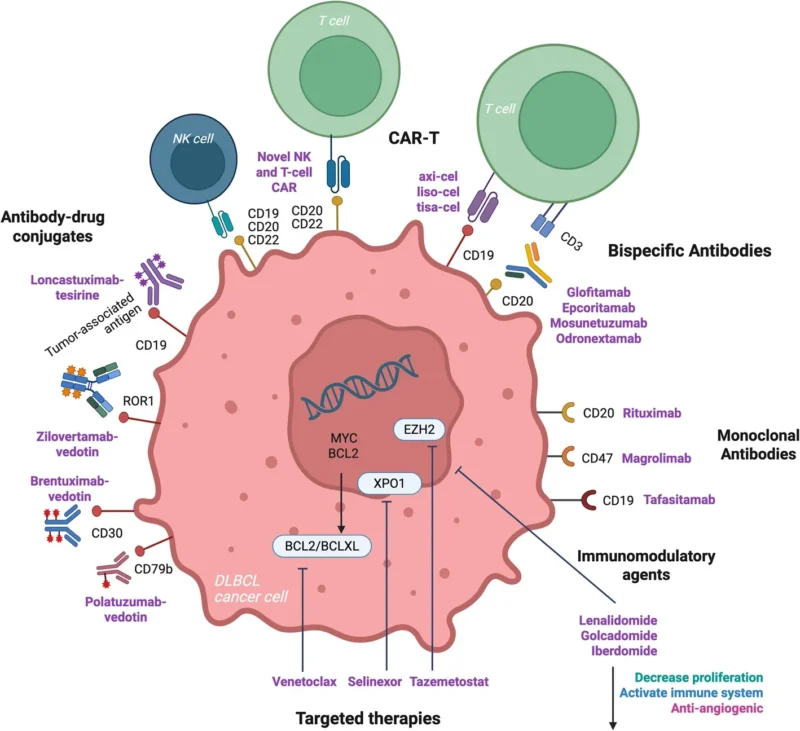
The recent FDA and EMA approved therapies in R/R DLBCL are immunotherapeutic or with novel mechanisms of action targeting key B-cell pathways, which are improving outcomes compared to historical cytotoxic chemotherapy.
springer.com
Phase III EPCORE DLBCL-1 trial demonstrated significantly improved PFS with epcoritamab monotherapy compared with CIT in patients with R/R LBCL (HR 0.74). Responses were also more durable, with a median DOR of 36.8 vs 5.6 months, further supporting it as an effective chemotherapy-free option.
Updated results from the phase III SUNMO trial demonstrated continued superiority of fixed-duration mosunetuzumab plus polatuzumab vedotin over R-GemOx in ASCT-ineligible R/R LBCL, with durable responses and prolonged PFS.
Cellular Immunotherapies
Eligibility for CAR-T differs from that for auto-SCT. Multiple real-world studies have demonstrated comparable safety and efficacy in patients older than 70 years. Functional status, comorbidities, and geriatric assessment are therefore often more relevant when selecting candidates.
Evidence has also supported the use of CAR-T in selected patients who would not have met the strict eligibility criteria of pivotal trials, including some individuals living with HIV. It is recommended but not required to have a CD4 count > 200 and undetectable HIV viral load.
Currently approved CD19-directed CAR-T products include axicabtagene ciloleucel, tisagenlecleucel, and lisocabtagene maraleucel. In clinical trials, CAR-T therapy achieved ORR of 52-82% and CR rates of 40-54% in heavily pretreated patients. More recently, randomized studies demonstrated superior outcomes compared with conventional salvage chemotherapy in selected patients with early relapsed or refractory disease.
A newer CD19-directed autologous CAR-T products, rapcabtagene autoleucel, is generated to produce T-cells with a rapid manufacturing process (2 days) and preserves T-cell stemness (NCT03960840). Ongoing research is focused on improving safety and developing allogeneic “off-the-shelf” and in vivo CAR-T products.
CAR-NK cells are being engineered with a similar approach as CAR-T with the benefit that NK cells as part of the innate immune system do not require antigen presentation. Clinical trials of CAR-NK targeting CD19, CD20, and CD22 for the broad treatment of B NHLs are underway.
Addressing CAR-T Failure
Approximately 50-60% of patients either fail to respond or eventually relapse. Outcomes after CAR-T failure are poor, with reported median OS of only 5-6 months. Biopsy at relapse is important to confirm disease recurrence and assess antigen expression, as loss of CD19 through antigen escape occurs in up to 30% of cases and may influence subsequent treatment selection.
Clinical trial enrollment after CAR-T relapse is strongly encouraged. Bispecific antibodies such as glofitamab and epcoritamab have demonstrated response rates of approximately 50%. Other options include loncastuximab tesirine for CD19-positive disease and, in selected responders, autologous or allogeneic stem cell transplantation.
Increasing attention is being directed toward post-CAR-T maintenance and relapse mitigation strategies, with multiple ongoing studies evaluating whether early intervention can prolong remission and reduce the risk of relapse.

Follicular Lymphoma (FL): Evolving Biology and Modern Therapeutic Paradigms
Written by Susanna Mikayelyan, MD
FAQ
What makes DLBCL different from leukemia?
Although both are blood-related cancers, DLBCL usually forms tumors in lymph nodes or organs, whereas leukemias primarily involve the bone marrow and blood. However, both diseases can originate from lymphoid cells and share some molecular abnormalities.
Can DLBCL develop from a slow-growing lymphoma?
Yes. Some cases arise through transformation of indolent lymphomas, particularly follicular lymphoma. When transformation occurs, the disease typically becomes more aggressive, requiring different treatment approaches and often carrying a less favorable prognosis than de novo DLBCL.
Why do some patients relapse after achieving complete remission?
Relapse can occur when small populations of lymphoma cells survive treatment. These residual cells may possess genetic features that make them resistant to therapy. Advances in molecular profiling are helping researchers better understand and target these resistant clones.
Are there lifestyle changes that can reduce the risk of DLBCL recurrence?
No lifestyle intervention has been proven to prevent recurrence. However, maintaining overall health through regular exercise, balanced nutrition, smoking cessation, vaccination, and routine follow-up care can help patients tolerate treatment, reduce complications, and improve quality of life.
What is the significance of "double-hit" and "triple-hit" lymphoma?
These terms describe lymphomas carrying rearrangements involving MYC together with BCL2 and/or BCL6 genes. Such tumors tend to behave more aggressively, respond less favorably to standard treatment, and often require intensified therapeutic strategies or enrollment in clinical trials.
Could artificial intelligence improve DLBCL diagnosis and treatment selection?
Potentially. AI-based tools are being developed to analyze pathology slides, imaging studies, and genomic data. These technologies may help identify high-risk patients, predict treatment response, and support more personalized therapeutic decisions in the future.