
At ASCO 2026, Dai Chihara, MD, PhD, presented interim futility results from the phase II NCT06045247 study conducted at MD Anderson Cancer Center evaluating epcoritamab plus R-miniCVP in older, frail, or anthracycline-ineligible patients with newly diagnosed DLBCL.
Rationale and Hypothesis
The median age at diagnosis of DLBCL is ~65 years, and nearly 1/3 of patients in the US are diagnosed after the age of 75 years. In this population, comorbidities, poor performance status, cardiac disease and limited physiologic reserve often preclude standard anthracycline-based CIT.
Although R-mini-CHOP has demonstrated activity as an attenuated frontline regimen in selected elderly patients, reported 2-year PFS rates remain ~47% and nearly 1/4 of patients are unable to complete all 6 planned cycles.
Epcoritamab, a subcutaneous CD3×CD20 bispecific antibody, has shown promising efficacy both as monotherapy and in combination regimens in DLBCL.
Investigators hypothesized that epcoritamab plus non-anthracycline chemotherapy (R-miniCVP) could represent a potentially effective and safer treatment strategy for previously untreated DLBCL in this vulnerable population.
Schema and Endpoints
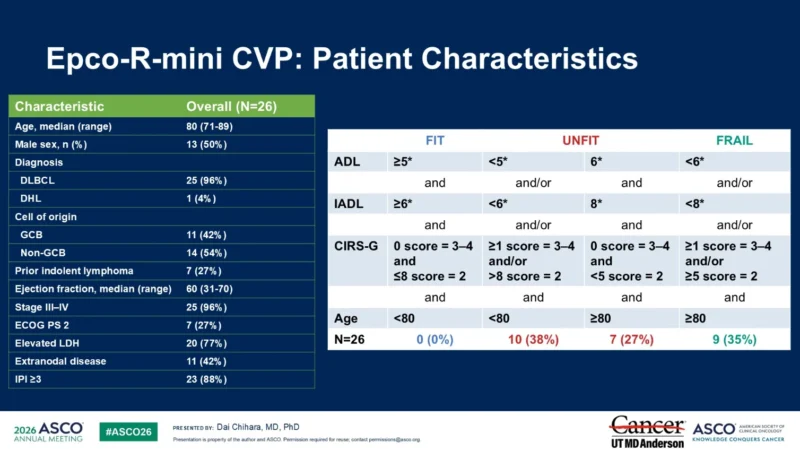
This open-label, single-arm phase 2 study enrolled patients with histologically confirmed DLBCL who were considered unfit or frail according to the FIL simplified geriatric assessment. Patients were also eligible if they were unable to receive anthracyclines because of reduced ejection fraction below 50% (but ≥ 30) or prior anthracycline exposure.
Treatment consisted of one cycle of R-miniCVP for disease debulking, followed by the addition of epcoritamab beginning in cycle 2 using step-up dosing. Subsequent cycles included epcoritamab 48 mg administered on day 1 of each cycle. Patients achieving CR after 6 cycles completed treatment, while those with PR continued epcoritamab through 12 cycles.
The primary endpoint of the study was CR rate after 6 cycles. Secondary endpoints included PFS and safety outcomes, particularly CRS and neurotoxicity. The study used a Bayesian optimal phase II (BOP2) design to support go/no-go decisions based on both efficacy and toxicity outcomes.
Historically, standard R-mini-CHOP has demonstrated an end-of-treatment CR rate of ~63%, while the study aimed to achieve a CR rate of 60% with epcoritamab plus R-miniCVP.
Interim Findings
The trial plans to enroll 40 patients overall. At the time of the interim futility analysis data cutoff (May 5, 2026), 26 patients had completed 6 cycles of treatment and were evaluable for efficacy analysis.
Historically, standard R-mini-CHOP has demonstrated an end-of-treatment CR rate of ~63%, while the study aimed to achieve a CR rate of 60% with epcoritamab plus R-miniCVP.
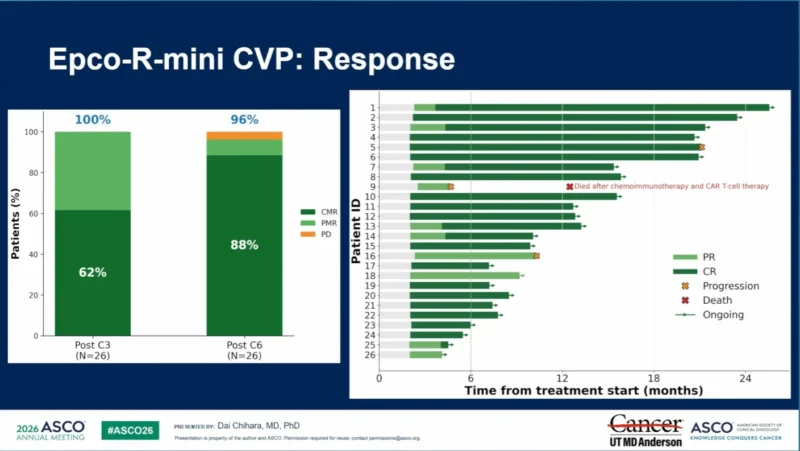
Response rates appeared encouraging. After cycle 3, the ORR was 100%, including a 62% complete metabolic response rate. Following 6 cycles, the ORR was 96%, with an 88% CMR rate. One patient experienced disease progression after cycle 6 and subsequently died despite additional CIT and CAR T-cell therapy.
With a median follow-up of 11.6 months, the estimated 1-year PFS rate was 88.5% (95% CI, 59.3-97.2%) and the estimated 2-year OS was 92.3% (95% CI, 56.6-98.9%).
Safety Analysis
CRS occurred in 55% of patients, all events were grade 1. CRS typically occurred around C2D15 and resolved completely within 1-2 days in all affected patients. Four patients required tocilizumab for management.
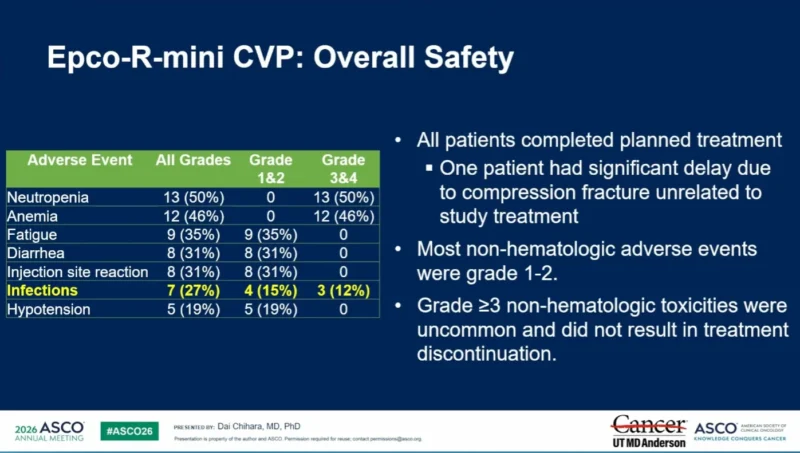
One patient developed grade 2 ICAN after C2D15. Symptoms resolved within 24 hours after prophylactic prednisone was replaced with dexamethasone. Following a protocol amendment substituting dexamethasone for prednisone prophylaxis, no additional neurotoxicity events were observed. Most non-hematologic adverse events were grade 1-2.
Bottom Line
Despite the relatively short follow-up, interim analysis demonstrated that epcoritamab plus R-miniCVP is a safe and effective regimen for older unfit/frail or anthracycline-ineligible patients with newly diagnosed DLBCL.
Discussion Points
The heterogeneous inclusion criteria, both frail patients and those with significant cardiac comorbidities, complicate historical comparisons and interpretation across studies. Important questions remain regarding the optimal treatment backbone.
The study also highlights the ongoing consideration of attenuated chemotherapy versus chemotherapy-free immunotherapy approaches in this population.
Future Direction
Based on the findings, investigators proposed future multicenter evaluation in a larger cohort of 80 patients, including incorporation of MRD assessment.