After frontline therapy, up to 40% of patients with large B-cell lymphoma (LBCL) develop relapsed or refractory disease. Those who are ineligible for autologous stem cell transplantation or experience relapse after ASCT have limited treatment options and generally dismal outcomes.
In this setting, commonly used chemoimmunotherapy regimens such as rituximab-gemcitabine-oxaliplatin (R-GemOx) and bendamustine-rituximab (BR) are associated with limited durability of response. Epcoritamab is a subcutaneous CD3×CD20 bispecific antibody approved as monotherapy for patients with R/R DLBCL after at least two prior lines of systemic therapy.
EPCORE DLBCL-1 was a global, randomized, open-label phase 3 trial evaluating epcoritamab monotherapy versus investigator’s choice chemoimmunotherapy in patients with R/R LBCL who were ineligible or had relapsed after ASCT. The primary results were presented by Christopher P. Fox at EHA 2026.
Treatment and Endpoints
Patients were randomized 1:1 to receive subcutaneous epcoritamab (n=241) or chemoimmunotherapy (n=242), consisting of R-GemOx (n=174) or BR (n=68). Epcoritamab was administered until disease progression or unacceptable toxicity, and chemoimmunotherapy was given according to standard treatment schedules.
The dual primary endpoints were PFS, assessed by independent review according to Lugano criteria, and OS. Secondary endpoints included overall and complete response rates, duration of response, time to next treatment, and safety.
Patient Population in EPCORE DLBCL-1
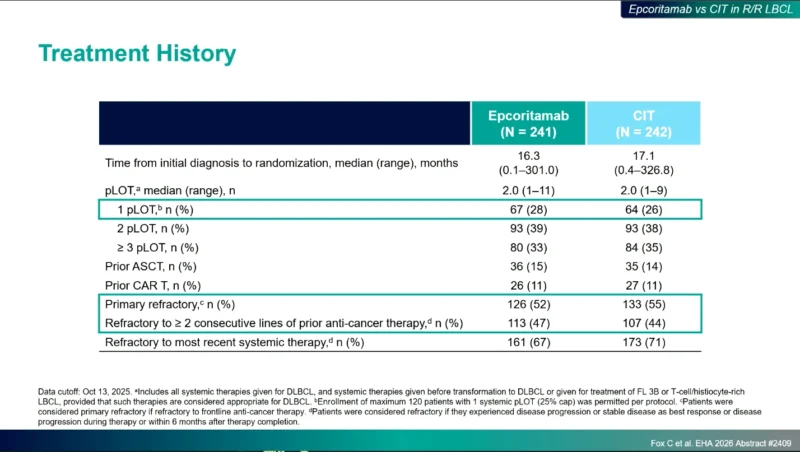
A total of 483 patients were enrolled, with balanced baseline characteristics between treatment arms. The median age was 71 years and approximately half of patients were treated in North America or Western Europe.
The study enrolled a clinically high-risk population. Nearly 3/4 of patients had received at least two prior lines of therapy, 1/3 had received three or more prior lines, and 69% were refractory to their most recent treatment. Prior stem cell transplantation and CAR-T-cell therapy had been administered in 15% and 11% of patients, respectively.
Most patients presented with advanced-stage disease, with ~78% having stage III/IV lymphoma at study entry. Diffuse large B-cell lymphoma constituted the majority of enrolled cases, while transformed lymphoma represented ~18%.
Progression-Free Survival
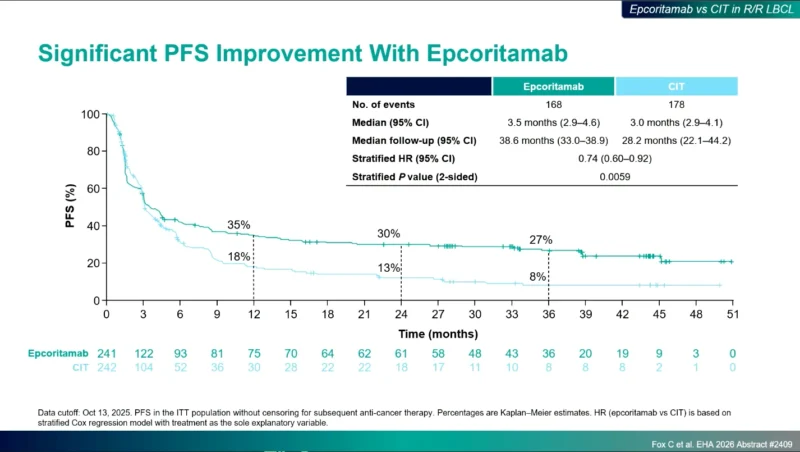
The trial met its primary endpoint, demonstrating a statistically significant improvement in PFS with epcoritamab compared with chemoimmunotherapy.
Epcoritamab reduced the risk of disease progression or death by 26% (HR 0.74; 95% CI, 0.60-0.92; P=0.0059). While median PFS was short in both arms (3.5 vs 3.0 months), separation of the Kaplan-Meier curves became increasingly apparent over time, suggesting a subset of patients derived durable benefit.
At 12 months, PFS rates were 35% with epcoritamab and 18% with chemoimmunotherapy. This advantage was maintained at 36 months (27% vs 8%), indicating improved long-term control.
Response Outcomes
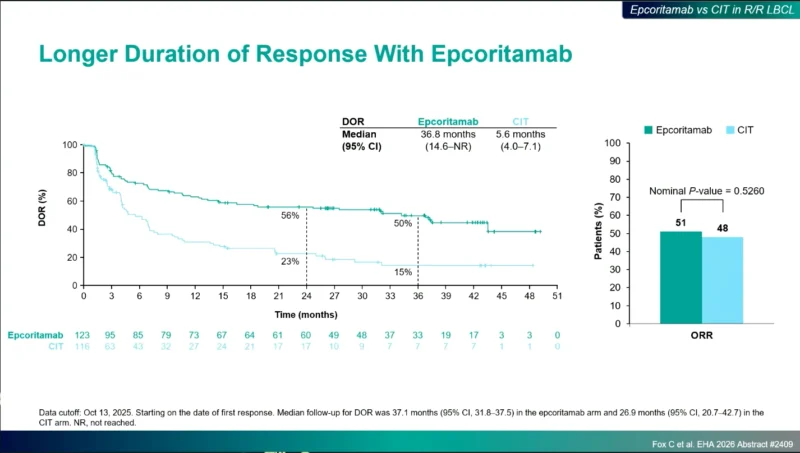
Overall response rates were comparable between treatment groups, the quality and durability of responses differed substantially. Complete response rates were higher with epcoritamab (38% vs 26%), and responses were maintained for longer periods.
Median duration of response reached 36.8 months with epcoritamab compared with 5.6 months with chemoimmunotherapy. Among responding patients, 50% remained in response at 36 months in the epcoritamab arm vs 15% in comarative arm.
Time to Next Treatment and Subsequent Therapies
The improvement in disease control translated into a longer time to next treatment (TTNT) with epcoritamab. Median TTNT was 6.6 months with epcoritamab vs 4.3 months.
Fewer patients in the epcoritamab arm required subsequent anti-cancer therapy (43% vs 65%). Use of later-line cellular and immune-based therapies was also less frequent following epcoritamab, including:
- CAR-T-cell therapy (3% vs 11%)
- CD3×CD20 bispecific antibodies (1% vs 14%)
- stem cell transplantation (2% vs 6%)
Overall Survival
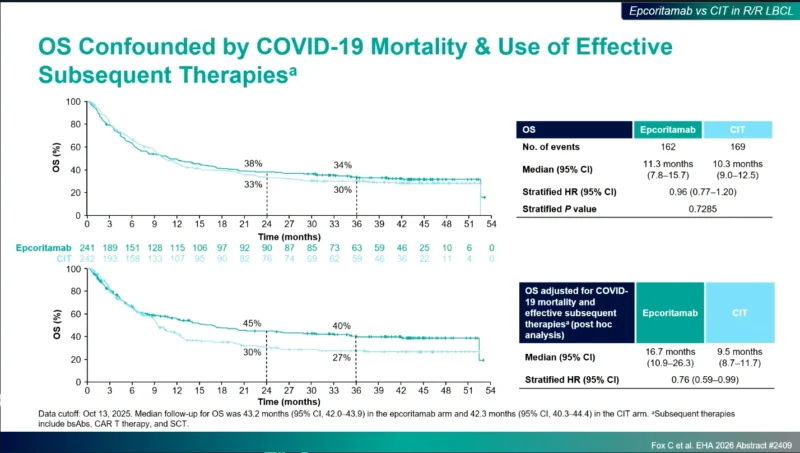
OS did not differ significantly between treatment groups in the primary analysis with 36-month rates of 34% and 30% for epcoritamab and chemoimmunotherapy, respectively.
It was noted that interpretation of OS was complicated by COVID-19-related mortality and the greater use of effective subsequent therapies in the chemoimmunotherapy arm. Investigators estimated that ~25% of OS time in the CIT arm was accrued after receipt of these therapies, compared with 5% in the epcoritamab arm.
In a post-hoc analysis adjusting for COVID-19 mortality and the use of subsequent therapies, OS favored epcoritamab (HR 0.76; 95% CI, 0.59-0.99).
Outcomes in Patients With One Prior Line of Therapy
An exploratory analysis evaluated patients who had received one prior line of therapy. Trends favored epcoritamab across multiple efficacy endpoints, including PFS and OS.
Complete response rates were also numerically higher with epcoritamab (45% vs 38%). While the subgroup was not powered for formal statistical comparisons, the findings suggest activity of epcoritamab in earlier relapse.
Treatment-Related Toxicities
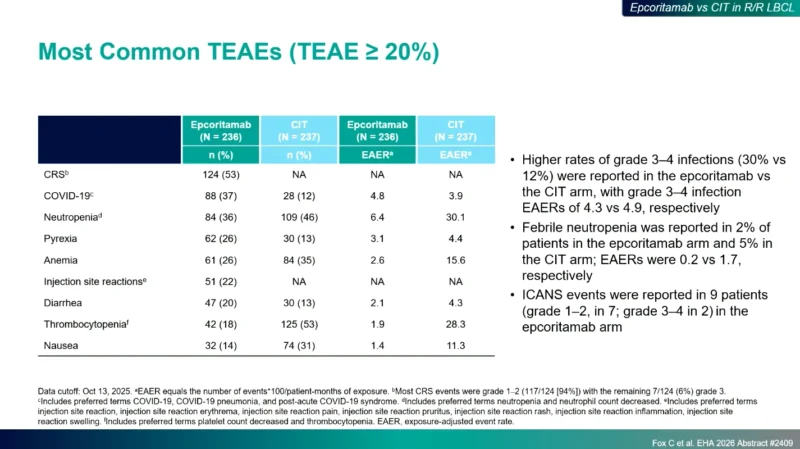
The safety profile of epcoritamab was consistent with previous experience with CD3×CD20 bispecific antibodies. Treatment exposure was substantially longer with epcoritamab than with chemoimmunotherapy (mean duration 11.2 vs 2.1 months), with nearly 1/3 of patients receiving at least 12 treatment cycles.
CRS was the most characteristic toxicity, occurring in 53% of patients and being predominantly low grade. ICANS was uncommon, affecting 4% of patients. Grade 3-4 infections were reported more frequently with epcoritamab (30% vs 12%), and COVID-19 infections were also more common during the pandemic-era study period.
Although fatal adverse events occurred more often in the epcoritamab arm, exposure-adjusted fatal event rates were similar between groups, and many fatal events were attributed to COVID-19-related complications.
Key Safety Takeaway
Despite longer treatment exposure, no new safety signals were observed. The principal toxicities were CRS and infections, while severe neurotoxicity was uncommon.
The Bigger Picture
EPCORE DLBCL-1, the largest randomized phase 3 trial in R/R LBCL, is the first to demonstrate a statistically significant PFS benefit with a CD3×CD20 bispecific antibody monotherapy over chemoimmunotherapy. Epcoritamab achieved deeper and more durable responses. Though OS was not significantly different at the primary analysis, differences in COVID-19-related mortality and the use of subsequent therapies should be considered when interpreting this endpoint. These findings further support the role of epcoritamab in R/R LBCL.