Key takeaways
- Palliative chemotherapy controls cancer rather than curing it.
- It can shrink tumors, relieve symptoms, and sometimes extend life.
- There is no fixed treatment length or life-expectancy estimate.
- Side effects are weighed carefully against the expected benefit.
- Treatment is usually stopped when it no longer helps or becomes too burdensome.
Palliative chemotherapy is chemotherapy given when the goal is to control cancer rather than cure it. It may shrink tumors, slow cancer growth, relieve symptoms, and in some cancers help people live longer. The word palliative does not necessarily mean that someone is near the end of life; treatment may continue for months or longer when it is still helping and the side effects remain manageable.
How much someone benefits depends on the type of cancer, its biology, previous treatments, overall health, and personal goals. The decision to continue chemotherapy is therefore based not only on what happens on a scan, but also on how the person feels and functions during treatment.
What Is Palliative Chemotherapy?
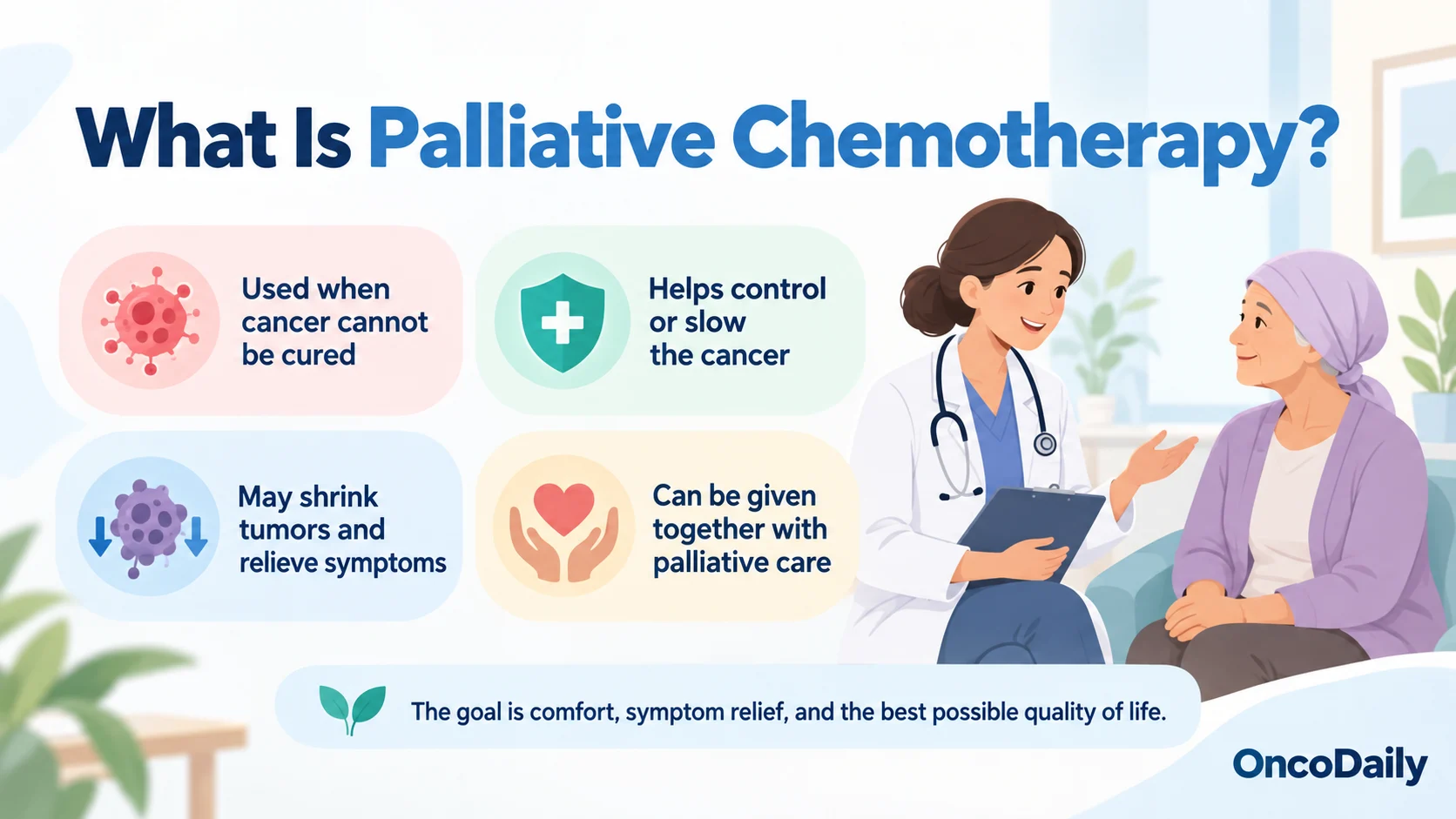
Palliative chemotherapy is chemotherapy given when cancer is not considered curable with the available treatment, but chemotherapy may still help control the disease. The aim may be to shrink a tumor, slow its growth, relieve pain or pressure, improve symptoms such as breathlessness or difficulty swallowing, or delay complications caused by the cancer. In some situations, treatment may also extend survival (Archer et al., 1999; Roeland and LeBlanc, 2016).
The main difference between palliative and curative chemotherapy is the treatment goal, not necessarily the drugs themselves. The same chemotherapy medicine may sometimes be used with curative intent in one situation and palliative intent in another (Roeland and LeBlanc, 2016).
Palliative chemotherapy is also different from palliative care. Chemotherapy directly treats the cancer, while palliative care focuses on symptoms, emotional well-being, practical needs, and quality of life. The two can be given together, and palliative care does not require someone to stop anticancer treatment (National Cancer Institute, 2024).
When Is Palliative Chemotherapy Recommended?
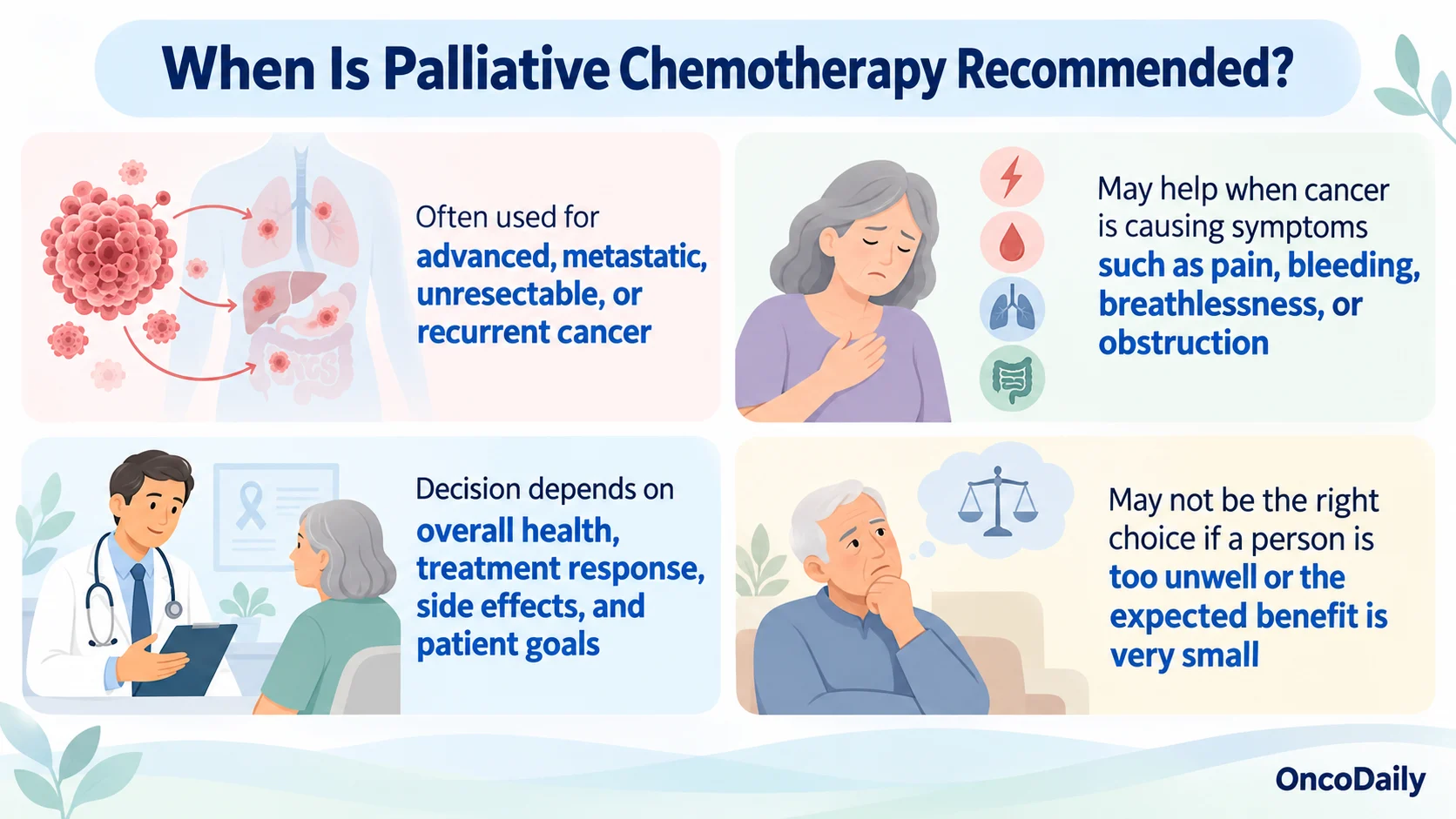
Palliative chemotherapy is most often considered for advanced, metastatic, unresectable, or recurrent cancer when cure is unlikely but the disease may still respond to systemic treatment (Rajagopal et al., 2014).
It may be recommended when a tumor is causing pain, bleeding, breathlessness, obstruction, or pressure on an organ. Treatment may also be considered before major symptoms develop if the cancer is clearly progressing and chemotherapy has a reasonable chance of controlling it (Rajagopal et al., 2014).
The decision depends on the cancer type, previous treatments, overall health, performance status, expected response, and possible side effects. Patient preferences are equally important. Some people may prioritize living as long as possible, while others may place greater importance on avoiding treatment toxicity, spending less time in hospital, or maintaining independence (Koedoot et al., 2003).
Chemotherapy may be less appropriate when a person is too unwell to tolerate treatment, when standard treatments have already stopped working, or when the chance of benefit is very small compared with the likely burden of therapy. These decisions are individualized rather than based on stage alone (Geyer et al., 2023).
What Are the Benefits of Palliative Chemotherapy?
The main benefit of palliative chemotherapy is cancer control. If treatment shrinks or stabilizes a tumor, it may reduce pain, improve breathing or swallowing, decrease bleeding or pressure, and help someone remain active for longer (Archer et al., 1999).
Palliative chemotherapy can also delay disease progression and, in some cancers, prolong survival. Earlier randomized studies in advanced colorectal cancer, for example, showed that chemotherapy improved both progression-free survival and overall survival compared with supportive care alone, although modern outcomes vary considerably according to the cancer and treatment being used (Colorectal Cancer Collaborative Group, 2000).
For many patients, the goal is not simply to add time, but to preserve good-quality time. Treatment may be worthwhile if it improves symptoms or allows someone to remain independent and continue doing things that matter to them (Koedoot et al., 2003).
These benefits are not guaranteed. If the cancer does not respond, or if treatment causes substantial toxicity, chemotherapy can make someone feel worse rather than better. This is why the expected benefit is continually weighed against side effects and treatment burden (Roeland and LeBlanc, 2016).
How Long Can You Have Palliative Chemotherapy?
There is no fixed time limit for palliative chemotherapy. Treatment may continue while the cancer is shrinking or stable, the side effects remain manageable, and the person continues to feel that the treatment is worthwhile (Rajagopal et al., 2014).
Chemotherapy is usually given in cycles, with treatment followed by a recovery period. After several cycles, doctors reassess how well it is working using scans, blood tests, symptoms, and overall daily functioning. If the cancer is responding or remains stable, treatment may continue (Rajagopal et al., 2014).
Some patients eventually move to a maintenance treatment, have a planned treatment break, or switch to another therapy. Others may stop because side effects accumulate or the cancer begins to grow again.
The decision is therefore based less on a fixed number of cycles and more on an ongoing question: is the treatment still providing more benefit than burden? (Roeland and LeBlanc, 2016).
Palliative Chemotherapy: Life Expectancy and Survival
There is no single life expectancy for someone receiving palliative chemotherapy. Survival depends on the type of cancer, molecular features, how far it has spread, previous treatments, overall health, and how well the cancer responds (Rajagopal et al., 2014).
Some people gain only a short period of disease control, while others may live considerably longer if the cancer remains sensitive to treatment. Outcomes can differ greatly even among people with the same cancer diagnosis, which is why general survival figures should be interpreted carefully (Rajagopal et al., 2014).
A median survival is also not an individual deadline. If a study reports a median survival of 12 months, it means that half of the patients in that study lived longer than 12 months and half lived for less. It does not predict exactly how long one particular patient will live.
For this reason, estimates are most useful when they are based on the person’s specific cancer, treatment options, response to therapy, and overall condition, rather than on general statistics about palliative chemotherapy.
What Are the Side Effects of Palliative Chemotherapy?
Palliative chemotherapy can cause the same side effects as chemotherapy given with curative intent because many of the same drugs are used.
Common side effects include fatigue, nausea, vomiting, appetite or taste changes, diarrhea or constipation, mouth sores, hair loss with some treatments, anemia, low white blood cell counts, and an increased risk of infection (National Cancer Institute, 2024).
Other side effects depend on the particular drugs. Some chemotherapy can cause peripheral neuropathy, leading to numbness, tingling, or pain in the hands and feet, while certain regimens may affect kidney, liver, heart, skin, or other organ function (National Cancer Institute, 2024).
Not everyone experiences the same side effects, and severity can vary between treatment cycles. Many effects improve after chemotherapy is delayed or stopped, although some, particularly neuropathy, may last longer.
Because the purpose of palliative chemotherapy is to provide meaningful benefit without excessive treatment burden, doctors may reduce the dose, delay a cycle, change the regimen, or stop treatment when toxicity becomes too difficult (Roeland and LeBlanc, 2016).
Palliative chemotherapy should therefore not be thought of simply as “lighter chemotherapy.” The drugs may be the same; what differs is the balance between cancer control, side effects, daily functioning, and the goals of treatment.
When Should Palliative Chemotherapy Be Stopped?
Palliative chemotherapy is usually reconsidered when it is no longer controlling the cancer, side effects become too difficult, or the chance of meaningful benefit becomes very small (Geyer et al., 2023).
If scans and symptoms show that the cancer is progressing despite treatment, continuing the same chemotherapy is unlikely to help. Treatment may also be stopped when repeated infections, severe fatigue, neuropathy, organ toxicity, or other complications begin to have a major effect on everyday life (Geyer et al., 2023).
Declining overall health is another important factor. When someone becomes significantly weaker or needs substantial help with daily activities, further chemotherapy may be more likely to cause harm than benefit, particularly when previous evidence-based treatments have already stopped working (Geyer et al., 2023).
Patient preference is equally important. Some people decide that they would rather spend more time at home, avoid repeated hospital visits, or focus completely on symptom relief, even when another treatment option could technically be offered (Koedoot et al., 2003).
Stopping chemotherapy does not mean stopping care. Treatment for pain, nausea, breathlessness, fatigue, anxiety, and other symptoms should continue, and palliative care can become increasingly important. Hospice may also be considered when the focus of care shifts fully toward comfort near the end of life (National Cancer Institute, 2024).
FAQ
Can palliative chemotherapy cure cancer?
No. It is usually given when cure is not expected, with the goal of controlling the cancer, easing symptoms, and sometimes extending life.
Does palliative chemotherapy mean the end of life is near?
Not necessarily. Some people receive palliative chemotherapy for months or longer while the treatment continues to help.
How long can you stay on palliative chemotherapy?
There is no fixed limit. Treatment may continue as long as the cancer is controlled and side effects remain manageable.
Can palliative chemotherapy help you live longer?
In some cancers, yes. The amount of benefit varies depending on the cancer type, overall health, and response to treatment.
When is palliative chemotherapy stopped?
It may be stopped if the cancer keeps growing, side effects become too difficult, overall health declines, or the patient decides the treatment burden is no longer worth it.