Behind the single name of non-Hodgkin lymphoma (NHL) lies an umbrella term comprising dozens of distinct malignancies originating from different lymphocyte lineages, arising at different stages of lymphoid development, occupying distinct biological niches, and following diverse evolutionary paths. Some develop within lymph nodes, while others arise primarily in the skin, gastrointestinal tract, or other tissues. Some remain indolent for years, while others require urgent therapy.
Understanding NHL therefore requires more than memorizing subtype names. It requires an understanding of where these malignancies originate, how they evolve, and why they behave so differently from one another.
The Geography of Origin: Where Does a Lymphoma Begin?
Despite sharing a common lymphoid ancestor, B cells, T cells, and NK cells follow distinct developmental pathways and perform different roles in immune defense. B cells produce antibodies, T cells coordinate and execute cellular immune responses, and NK cells provide rapid surveillance against infected and malignant cells. Throughout their lifespan, these cells continuously mature, migrate through specialized lymphoid tissues, and adapt their function in response to antigenic stimulation.
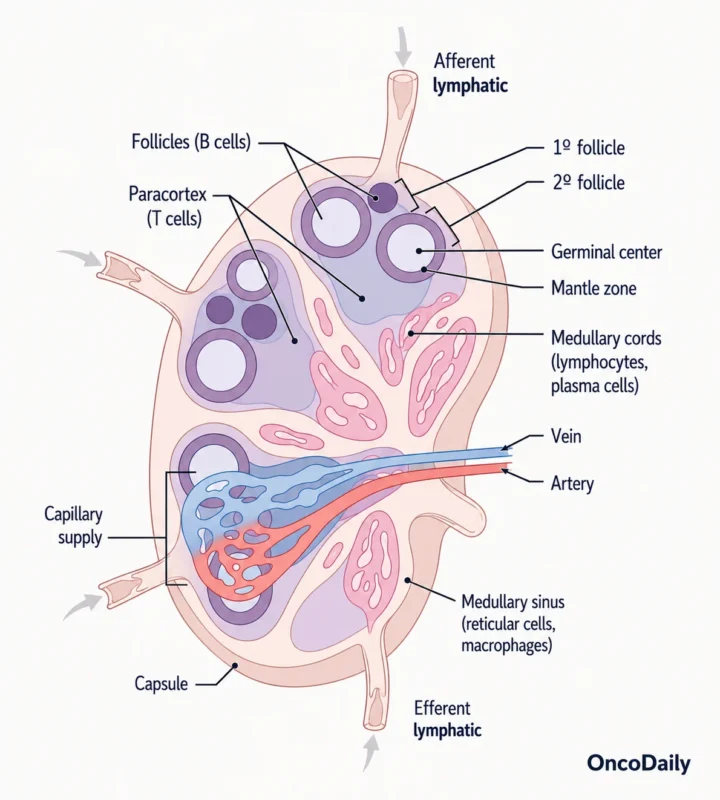
A lymph node is more than a meeting place for immune cells. It contains specialized microenvironments where immune cells mature, interact, and respond to antigenic stimulation. Within the B-cell compartment, naïve B cells occupy the mantle zone, activated B cells undergo rapid proliferation and selection within germinal centers, and more differentiated populations reside in the marginal zone. Each of these niches provides distinct cellular interactions, signaling pathways, and pressures. Lymph nodes are the best-known example, but similar lymphoid follicles are also found in the spleen, mucosa-associated lymphoid tissue, and other lymphoid sites.
Many lymphoma subtypes retain the features of the normal lymphocytes from which they arise. Consequently, the stage of lymphocyte development at which malignant transformation occurs governs the behavior of the resulting lymphoma, influencing where it develops, how quickly it grows, and, in part, how it responds to treatment. This makes normal lymphoid architecture a useful map for understanding NHL.
The Germinal Center: Where B Cells Mature
During the germinal-center reaction, two distinct modifications of DNA alter the B-cell receptor: somatic hypermutation and class-switch recombination. These processes are essential for generating antibody diversity, but they are error-prone and can cause DNA damage that may initiate lymphoma development.
The germinal center B cells give rise to most B-cell lymphomas. Among these, follicular lymphoma is the most common indolent type and occupies the quieter end of the spectrum. Many patients live with the disease for years before treatment becomes necessary. However, “slow-growing” does not mean static. FL follows a prolonged and unpredictable course characterized by remission, relapse, and gradual evolution over many years.
A subset of cases ultimately transforms into a more aggressive disease, most commonly diffuse large B-cell lymphoma. A short duration of first remission (<24 months) after standard immunochemotherapy induction (POD24) has been proven to be a strong predictor of significantly worse clinical outcomes. A poor prognosis of early relapsers has also been reported in patients treated with non-chemotherapy rituximab-based doublets or rituximab monotherapy.

Diffuse large B-cell lymphoma is the most common aggressive NHL worldwide, accounting for approximately one-third of new cases. Molecular studies have revealed substantial heterogeneity based on cell of origin, most notably germinal center B-cell-like (GCB) and activated B-cell-like (ABC). DLBCL responds well to first-line R-CHOP-based immunochemotherapy and is curable in approximately two-thirds of patients.
Those who do not relapse within the first 24 months have a very good prognosis and are expected to have a life expectancy similar to that of the general population, although late relapses are observed. Some cases develop de novo, while others evolve from pre-existing indolent lymphomas with markedly different outcomes.
If follicular lymphoma exemplifies the slow tempo of indolent lymphomas, Burkitt lymphoma represents the opposite extreme. It is one of the fastest-growing human malignancies, capable of doubling in size within days, yet remains highly curable with modern therapy. Burkitt lymphoma also provided some of the earliest evidence linking viral infection, genetic alterations, and human malignancy.
While the endemic form is strongly associated with equatorial Africa and Epstein-Barr virus, sporadic and immunodeficiency-associated variants occur worldwide. Regardless of where it arises, its extraordinary growth rate makes Burkitt lymphoma a medical emergency, with rapidly enlarging tumors and, in some cases, spontaneous tumor lysis syndrome even before treatment begins.
The Mantle Zone: Resting Before Activation
Mantle cell lymphoma arises from the mantle zone of normal lymphoid follicles. Most are derived from a B-cell that has not experienced the germinal center and carries unmutated immunoglobulin heavy chain variable genes. The quiescent nature of the mantle zone does not preclude malignant transformation, and subsequent genetic alterations contribute to the broadest clinical spectra: from indolent forms to highly aggressive blastoid variants. The remarkable heterogeneity is reflected in its therapeutic approach, ranging from observation in selected cases to intensive combination therapy, cellular immunotherapy, and stem cell transplantation for aggressive disease.
The Marginal Zone: Rapid Responders to Blood-Borne Antigens
The marginal zone is specialized for responding to repeated antigen exposure, particularly at mucosal surfaces. Marginal zone lymphoma, which includes extranodal, nodal, and splenic subtypes, often develops in tissues affected by chronic infections or autoimmune disorders. This relationship is sometimes so strong that removing the underlying stimulus can lead to lymphoma regression, as seen after Helicobacter pylori eradication in gastric MALT lymphoma. In many ways, MZL represents a lymphoma that develops not from a single transforming event, but from years of interaction between the immune system and its environment.
The Plasma Cell Connection: Lymphoplasmacytic Lymphoma and Waldenström Macroglobulinemia
Lymphoplasmacytic lymphoma arises from B cells transitioning toward antibody-producing plasma cells. When associated with monoclonal IgM production, the disease is termed Waldenström macroglobulinemia. Rather than forming bulky nodal masses, WM often manifests through bone marrow involvement and complications related to circulating monoclonal IgM, such as hyperviscosity, neuropathy, cryoglobulinemia, and, rarely, Bing-Neel syndrome. Treatment is initiated in symptomatic patients, BTK inhibitors are a standard of care for both treatment-naïve and relapsed WM.
The Other Side of NHL: T-Cell and NK-Cell Lymphomas
Unlike B-cell lymphomas, which largely reflect successive stages of B-cell maturation, peripheral T-cell and NK-cell lymphomas arise from immune cells with fundamentally different roles. Helper T cells, cytotoxic T cells, T-follicular helper cells, and NK cells each give rise to distinct entities.
Peripheral T-cell lymphomas are a heterogeneous group of mostly aggressive mature T-cell malignancies. Although less common than B-cell NHLs, they account for a disproportionate share of lymphoma-related mortality because of their heterogeneity, lack of specific biomarkers, and relative resistance to conventional therapies. Differences in immune function, tissue tropism, and dependence on the tumor microenvironment further distinguish PTCL subtypes and explain their distinct therapeutic approaches.
Extranodal NK/T-cell lymphoma preferentially arises in the nasal cavity and other extranodal sites, reflecting its close relationship with Epstein-Barr virus, distinctive tissue tropism, and marked geographic predilection for East Asia and Latin America.
Mycosis fungoides, the most common cutaneous T-cell lymphoma, originating from mature skin-homing T cells. It often follows a prolonged course, evolving from subtle patches and plaques that can mimic inflammatory skin disorders to more advanced stages with tumors, nodal involvement, or systemic dissemination.
This slow evolution, together with its resemblance to benign skin conditions, often delays diagnosis for years. Early-stage MF is largely managed with skin-directed therapies aimed at controlling lesions and preserving quality of life. As the disease progresses beyond the skin, undergoes large-cell transformation, or becomes refractory, treatment increasingly relies on systemic lymphoma-directed therapies.
Different Ways to Become a Lymphoma
Despite their remarkable diversity, lymphomas often arise through a limited number of strategies. Rather than developing through a single pathway, different subtypes become malignant by disrupting the cellular programs that regulate survival, proliferation, cell-cycle control, immune signaling, or differentiation.
- Escaping cell death: Follicular lymphoma exemplifies this. Constitutive BCL2 overexpression prevents apoptosis, allowing genetically abnormal B cells to accumulate despite limited proliferative activity.
- Accelerating growth: Burkitt lymphoma represents the opposite, where MYC activation drives one of the highest proliferation rates observed in human cancer
- Hijacking the cell cycle: Mantle cell lymphoma becomes malignant through cyclin D1 overexpression, which overrides normal cell-cycle checkpoints and promotes continuous cellular division.
- Exploiting chronic immune stimulation: Marginal zone lymphoma commonly develops in the setting of persistent antigenic stimulation, where a supportive microenvironment promotes prolonged B-cell survival and eventually malignant transformation.
- Rewiring cellular programs: Diffuse large B-cell lymphoma illustrates how different combinations of genetic and signaling alterations give rise to biologically and clinically distinct molecular subtypes.
The Epigenetic Layer
Epigenetic mechanisms regulate gene expression without changing the genetic code. Through mechanisms such as DNA methylation and histone modification, cells can switch entire groups of genes on or off, controlling differentiation, activation, and survival. Another layer of regulation comes from microRNAs, short non-coding RNAs that fine-tune gene expression after transcription. Particularly in PTCL, their dysregulation contributes to lymphoma development and progression.
Transformation and Progression
As malignant clones in lymphomas acquire additional genetic and epigenetic alterations, some develop more aggressive behavior. This evolution may involve transformation into a different lymphoma subtype or progression within the same disease through increasingly aggressive variants.
Follicular lymphoma provides the classic example of histologic transformation to diffuse large B-cell lymphoma, characterized by the acquisition of aggressive biological features that reshape prognosis and treatment. Marginal zone lymphoma may also transform to diffuse large B-cell lymphoma, although less frequently. In cutaneous T-cell lymphoma, mycosis fungoides may undergo large-cell transformation, a more proliferative and aggressive phenotype.
Progression does not always require a change in diagnosis. Mantle cell lymphoma may acquire increasingly aggressive biological features through ongoing clonal evolution while retaining the same histologic identity.
Clinical Evaluation
Many lymphomas present with painless lymphadenopathy, with or without constitutional (“B”) symptoms, including fever, drenching night sweats, and unexplained weight loss. Both B- and T-cell lymphomas may involve virtually any organ, with presenting symptoms determined more by the site of involvement than by the lymphoma subtype itself, from abdominal pain and bowel obstruction to cough, neurologic deficits, or persistent skin lesions.
Diagnosis now aims to do more than confirm the presence of lymphoma. The objective is to define disease extent, identify biologic risk, and establish a baseline for treatment response.
PET-CT: More Than a Staging Tool
Perhaps no investigation has changed lymphoma management more profoundly than ^18F-FDG PET-CT. PET-CT improves anatomic staging while identifying metabolically active disease, frequently revealing additional sites of involvement that alter stage and, in some patients, treatment strategy. It has become the standard imaging modality for most FDG-avid lymphomas, though its role remains limited in CLL/SLL, Waldenström macroglobulinemia, and cutaneous marginal zone lymphoma.
PET-CT has also become integral to treatment response assessment. Baseline metabolic activity provides the reference against which treatment response is measured, while the Deauville five-point score has standardized interpretation across clinical practice and clinical trials. Metabolic complete remission is now the preferred endpoint in many lymphoma subtypes, particularly DLBCL.
Prognosis
The Ann Arbor and Lugano classifications remain the foundation of lymphoma staging and continue to guide initial treatment decisions. Disease extent, however, provides only part of the prognostic picture. Patients with the same stage may experience markedly different outcomes. Disease-specific models such as NCCN-IPI for DLBCL, FLIPI for follicular lymphoma, and MIPI for mantle cell lymphoma, refine risk stratification within individual subtypes.
Molecular Risk Assessment
Clinical prognostic models are increasingly complemented by molecular biomarkers. Integrated scores such as the m7-FLIPI combine recurrent genetic alterations with clinical variables. Gene-expression profiling and circulating tumor DNA are also emerging as tools for monitoring treatment response, detecting minimal residual disease, and identifying relapse earlier.
These approaches are not yet part of routine clinical practice for most patients, but they illustrate the growing role of molecular profiling in lymphoma evaluation and more individualized monitoring.
Geography Beyond the Lymph System : Global Patterns of NHL
With more than 500,000 new cases diagnosed annually, NHL ranks among the ten most common cancers worldwide. The global age-standardized incidence is approximately 5.6-5.8 cases per 100.000 population, while mortality remains lower at 2.4-2.6 deaths per 100.000, reflecting both the prolonged natural history of indolent lymphomas and many therapeutic advances over recent decades. NHL is predominantly a disease of aging, with a median age at diagnosis of 65-70 years, also diagnosed more frequently in males than females.
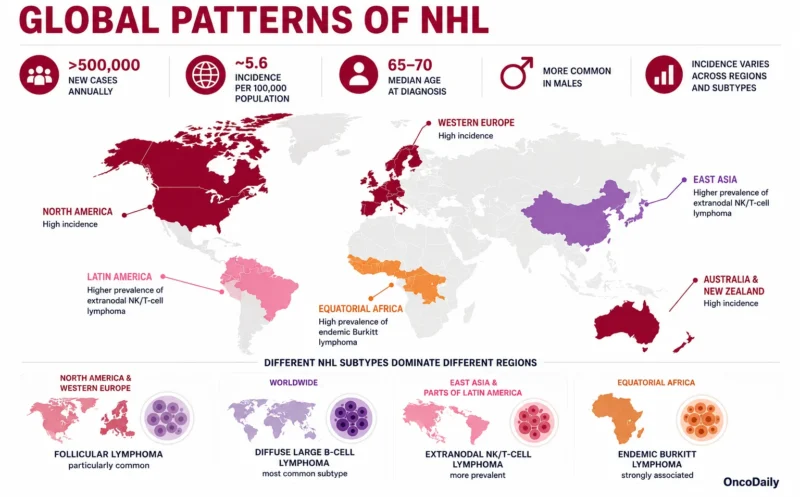
NHL is not distributed evenly across the world. Both overall incidence and the prevalence of specific subtypes vary substantially according to geography, socioeconomic development, environmental exposures, infectious diseases, and population demographics.
Countries with a high Human Development Index, including North America, Western Europe, Australia, and New Zealand, report the highest incidence rates, often exceeding 12 cases per 100,000 population. These differences likely result from older populations, improved diagnostic capability, wider availability of pathology and molecular testing, and greater detection of indolent lymphomas that may remain unrecognized in resource-limited settings.
Perhaps the most remarkable feature of NHL epidemiology is that different lymphoma subtypes dominate different regions of the world. While diffuse large B-cell lymphoma is the most common subtype worldwide, follicular lymphoma is particularly common in North America and Western Europe, extranodal NK/T-cell lymphoma is more prevalent in East Asia and parts of Latin America, and endemic Burkitt lymphoma remains strongly associated with equatorial Africa.
What NHL Is Teaching Us About Cancer Evolution
Studies of NHL have helped illuminate principles of clonal evolution, immune escape, tumor-microenvironment interactions, and treatment resistance. Technologies such as circulating tumor DNA analysis, spatial transcriptomics, and single-cell sequencing are providing increasingly detailed views of lymphoma evolution in real time.
Few malignancies have advanced this far toward replacing cytotoxic therapy with biologically targeted approaches. This is becoming increasingly feasible in B-cell lymphomas, where bispecific antibodies, antibody-drug conjugates, and targeted therapies are reducing reliance on conventional chemotherapy and moving into earlier lines of treatment. Cellular therapies are likewise being evaluated earlier in the course, rather than being reserved for heavily pretreated patients.
Progress in peripheral T-cell lymphomas has been slower because many therapeutic targets are shared by both malignant and normal T cells. Nevertheless, epigenetic therapies, kinase inhibitors, and emerging cellular therapies are expanding treatment options for these difficult-to-treat diseases.
With a growing number of effective therapies available, improving outcomes is no longer the only goal. The current generation of lymphoma trials increasingly evaluates long-term toxicity, quality of life, treatment duration, and financial burden.
The Challenge of Equitable Access
The absolute number of NHL cases continues to rise because of population growth and aging. Current projections suggest that the global burden of NHL may increase substantially over the coming decades, approaching 900,000 new cases annually worldwide by 2045. At the same time, improving survival is resulting in a growing population with ongoing needs for surveillance, management of late effects, and survivorship care.
As molecular diagnostics, targeted therapies, bispecific antibodies, CAR-T cell therapy, and precision medicine become increasingly integrated into lymphoma care, one of the major global challenges is ensuring equitable access to these advances across different regions of the world.
(Silkenstedt E. et al., Solia E. et al., 2024; Roccuzzo G. et al., Liu L. et al., Peñalver et al., Kumar et al., Bock A.M. et al., Lap C.J. et al., Boccellato E. et al., Yoon S.E. et al., 2025; Kessler S.A. et al., Noor W.D. et al., 2026)
Watch more on OncoDaily TV
Written by Susanna Mikayelyan, MD
FAQ
Can non-Hodgkin lymphoma be prevented?
Most cases of non-Hodgkin lymphoma cannot be prevented because they arise from complex interactions between aging, genetic alterations, and the immune system. However, reducing certain risk factors, such as controlling HIV infection, treating chronic infections like Helicobacter pylori, and avoiding unnecessary immunosuppression when possible, may lower the risk of specific lymphoma subtypes.
Can an indolent lymphoma become aggressive?
Yes. Several indolent lymphomas can undergo histologic transformation into a more aggressive disease. The best-known example is follicular lymphoma transforming into diffuse large B-cell lymphoma, a process driven by the accumulation of additional genetic and epigenetic alterations over time.
Why do some lymphomas develop outside lymph nodes?
Lymphocytes normally circulate throughout the body and reside in many tissues, including the stomach, skin, lungs, spleen, and intestine. Lymphomas often arise where their normal precursor cells naturally live, explaining why many subtypes primarily involve extranodal organs rather than lymph nodes.
Why are infections linked to certain lymphomas?
Persistent infections can provide continuous immune stimulation or directly contribute to malignant transformation. Examples include Helicobacter pylori in gastric MALT lymphoma and Epstein–Barr virus in several B-cell and NK/T-cell lymphomas. Not every infected person develops lymphoma, but these infections can increase risk in susceptible individuals.
Why isn't chemotherapy the only treatment for lymphoma anymore?
Modern lymphoma treatment increasingly targets the biological mechanisms that drive individual lymphoma subtypes. Monoclonal antibodies, BTK inhibitors, bispecific antibodies, antibody-drug conjugates, CAR-T cell therapy, and other immunotherapies can achieve effective disease control while reducing reliance on conventional chemotherapy in many patients.
What is the tumor microenvironment, and why does it matter in lymphoma?
The tumor microenvironment consists of immune cells, stromal cells, blood vessels, and signaling molecules surrounding lymphoma cells. Rather than being passive bystanders, these neighboring cells can promote lymphoma survival, suppress immune responses, and influence sensitivity or resistance to treatment.
Why is non-Hodgkin lymphoma more common in developed countries?
The incidence of non-Hodgkin lymphoma is generally higher in high-income countries such as those in North America, Western Europe, and Australia. This likely reflects a combination of aging populations, improved access to pathology and molecular diagnostics, greater detection of indolent lymphomas, and differences in environmental and lifestyle factors. In contrast, underdiagnosis may contribute to lower reported rates in resource-limited regions.
Why do different parts of the world have different lymphoma subtypes?
The distribution of lymphoma subtypes varies because of differences in genetics, infectious diseases, environmental exposures, and population demographics. For example, follicular lymphoma is more common in Western countries, extranodal NK/T-cell lymphoma is more prevalent in East Asia and Latin America, and endemic Burkitt lymphoma remains strongly associated with equatorial Africa, where Epstein–Barr virus and chronic malaria are highly prevalent.
Is non-Hodgkin lymphoma becoming more common worldwide?
Yes. Although survival has improved substantially over recent decades, the total number of people diagnosed with non-Hodgkin lymphoma is expected to continue increasing. Population growth, longer life expectancy, and global aging are major contributors to this trend, creating a growing need for long-term survivorship care and equitable access to modern lymphoma treatments.