
Most lymphomas are characterized largely by the burden of malignant cells they create. Waldenström Macroglobulinemia (WM) behaves differently. WM is determined not only by lymphoplasmacytic infiltration of the bone marrow, but also by the monoclonal IgM continuously released into the circulation. As the clone expands, the blood itself becomes biologically altered. This dual identity, part indolent lymphoma, part monoclonal gammopathy, is what makes WM unique and clinically quite complex.
WM in Context
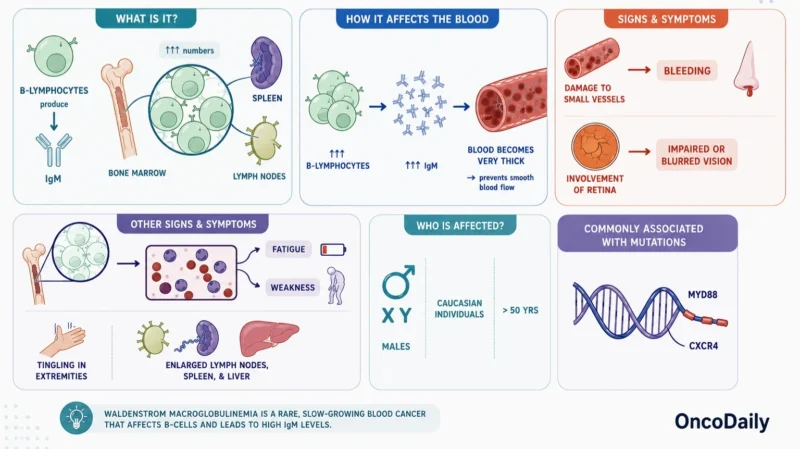
WM, also referred to as lymphoplasmacytic lymphoma, is a rare type of non-Hodgkin lymphoma that accounts for ~2% of hematologic malignancies. It occurs more commonly in men and Caucasian populations, with a median age at diagnosis of 60-70 years.
Factors associated with increased WM risk include:
- Pre-existing IgM MGUS, the recognized precursor condition to WM
- Chronic immune dysregulation or infection, particularly Sjögren syndrome, hepatitis C and HIV/AIDS
- Family history of WM or related B-cell lymphoproliferative disorders
Frequent suppression of “uninvolved” immunoglobulins, particularly IgG and IgA, further supports the role of underlying immune dysregulation. Interestingly, these reduced background Ig levels do not consistently correlate with increased infections and often persist despite effective treatment, suggesting that they may reflect a pre-existing defect rather than a consequence of the disease itself.
Thus, WM may arise in the setting of broader immune disturbance and persistent antigenic stimulation, somewhat analogous to their role in MALT lymphoma.
The Cell of Origin
Genetic analysis of the VH regions from patients with WM and IgM MGUS indicate that both develop from a post-germinal center cell that has undergone somatic hypermutation but not isotype switching.
Thus, WM may be viewed as a malignancy “paused” during terminal B-cell maturation, a clone that continues to acquire plasma cell features while retaining lymphoid survival programs. At the molecular level, MYD88 L265P mutations are detected in ~90-95% of patients, while CXCR4 mutations occur in ~40%.
MYD88 functions as an adaptor protein within Toll-like receptor and IL-1 receptor signaling. Physiologically, this pathway contributes to innate immune activation and controlled inflammatory signaling. In WM, constitutive MYD88 activation sustains the oncogenic program through IRAK kinases, BTK signaling and NF-κB transcriptional pathways.
CXCR4 regulates chemokine-mediated cellular trafficking and marrow homing. Mutated signaling enhances retention of malignant cells within stromal niches and may contribute to delayed/diminished responses to BTK inhibition.
Patients with MYD88^MUT/CXCR4^MUT disease often demonstrate higher bone marrow burden, elevated serum IgM levels and increased risk of hyperviscosity, whereas MYD88 wild-type disease is more frequently associated with lymphadenopathy and carries a greater risk of transformation to diffuse large B-cell lymphoma (DLBCL).
How WM Evolves Over Time
Progression can be viewed less as a rapidly expanding tumor mass and more as gradual strengthening of a supportive ecosystem:
- IL-21-mediated STAT3 activation promoting tumor-cell proliferation
- IL-6 and CCL5 signaling enhancing monoclonal IgM secretion
- BLyS and CD40L derived from immune and stromal cells supporting B-cell survival
- Ephrin/Eph-mediated endothelial adhesion
As the marrow niche becomes increasingly crowded, hypoxia and angiogenic signaling become more prominent. Hypoxia does not necessarily accelerate WM proliferation directly, but it may promote cellular egress from the marrow and contribute to dissemination. Patients also carry an increased risk of secondary malignancies (Patel N et al., Solia E et al., 2024).
Recognizing and Diagnosing WM
Importantly, the manifestations of WM arise as much from tumor burden as from the activity of monoclonal IgM itself. Unlike many paraproteins, IgM plays a direct pathogenic role through its unique structural and immunologic properties, contributing to altered microcirculatory flow, autoimmune and inflammatory phenomena:
- Hyperviscosity syndrome (epistaxis, headaches and visual disturbances)
- Cold agglutinin disease (IgM acts as an autoantibody against RBCs)
- Cryoglobulinemia
- Peripheral neuropathy
- AL amyloidosis
- Iron deficiency
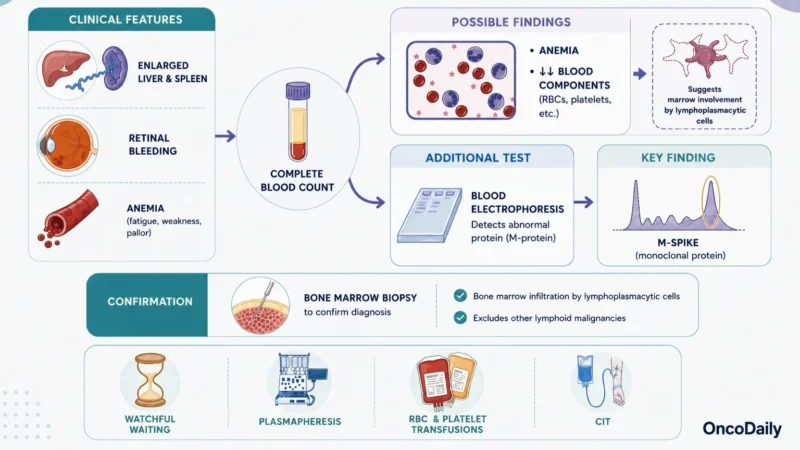
Bone marrow involvement commonly leads to anemia (60-80%), while thrombocytopenia and leukopenia are less frequent. Many patients also develop lymphadenopathy or splenomegaly and a smaller proportion may present with renal involvement, pleural effusions, or the rare but important Bing-Neel syndrome caused by CNS infiltration.
The diagnosis of WM requires two key findings:
- Bone marrow infiltration by lymphoplasmacytic cells (≥10%)
- Presence of a serum monoclonal IgM protein
Serum protein electrophoresis frequently reveals a monoclonal “M-spike”. Gene-expression and immunophenotypic studies suggest that WM more closely resembles chronic lymphocytic leukemia than plasma cell myeloma.
When to Treat WM
Much of current practice is shaped by observational studies, institutional experience and expert consensus rather than large randomized trials. Though the therapeutic armamentarium for WM includes a variety of options with favorable results, it remains an incurable disease characterized by a natural history of remissions and relapses. Many patients experience prolonged survival with good quality of life.
Early treatment has not been shown to improve OS in asymptomatic patients, while therapy-related toxicity and treatment-driven resistance remain important considerations. Therefore, observation (“watch and wait”) is the preferred strategy until clear indications:
- WM-related anemia (hemoglobin ≤10 g/dL)
- Thrombocytopenia (platelets <100,000/mm³)
- Moderate or severe peripheral neuropathy
- Symptomatic extramedullary disease,
- Symptomatic hyperviscosity
- Symptomatic cryoglobulinemia, cold agglutinin disease, autoimmune complications, or amyloidosis
Hyperviscosity represents one of the hallmark complications and therapy may be considered in asymptomatic patients with markedly elevated IgM (>6000 mg/dL). Symptomatic hyperviscosity requires urgent plasmapheresis in addition to definitive therapy.
Clinical Scenario-Based Treatment
Overall, WM management is becoming more genotype-directed, balancing urgency of response, prior treatment exposure and long-term tolerability.
Rituximab- or proteasome inhibitor-based combinations remain important, when treatment discontinuation is a priority. CHOP-R, CVP-R, and CDR produce ORRs around 80%, with PFS near 30-36 months. Bendamustine-rituximab remains one of the most effective finite approaches, with ORR ~90%, although its use may be limited by bendamustine-related neurotoxicity.
Bortezomib-, Carfilzomib- and Ixazomib-based combinations achieve high response rates (ORR ~85%, major responses ~77%) and may be particularly attractive for younger patients or when avoiding conventional chemotherapy, however, baseline neuropathy limit the use of bortezomib-containing regimens as well.
Across major studies, including the pivotal ibrutinib trial, INNOVATE, ASPEN, and phase II datasets with acalabrutinib, tirabrutinib and pirtobrutinib, BTK inhibitor-based therapy has consistently produced high response rates (ORR ~93%), with durable disease control and 4-year PFS approaching 76%.
Patients with CXCR4-mutated WM tend to experience slower and less deep responses to BTK inhibition, and the ASPEN trial helped refine therapeutic selection in this setting. Zanubrutinib produced higher major response rates than Ibrutinib (79% vs 65%), together with faster responses and improved PFS, including within TP53-mutated subgroups. As a result, zanubrutinib is increasingly favored over ibrutinib in current practice.
In treatment-naïve WM, patients with MYD88-mutated/CXCR4 wild-type disease are often managed with BTK inhibitor monotherapy. Patients with CXCR4-mutatation may require more rapid IgM reduction. In such situations, plasmapheresis together with bendamustine-rituximab or proteasome inhibitor-based therapy may be preferred.
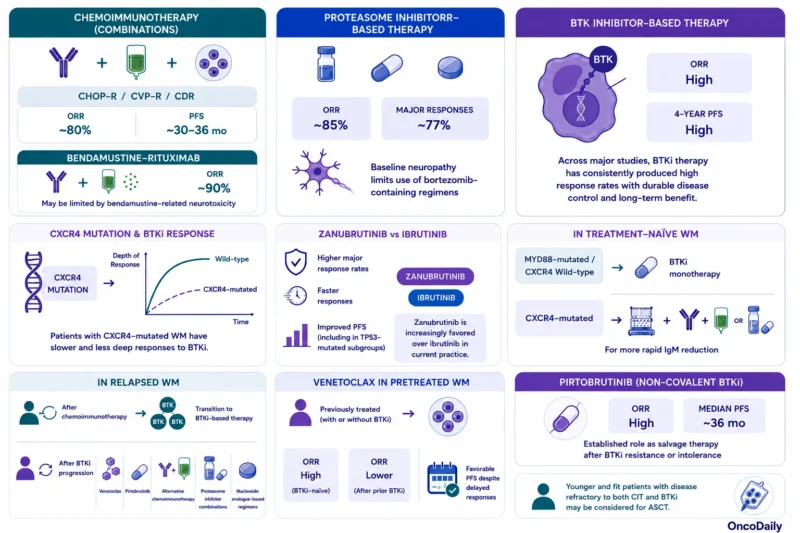
In relapsed WM, prior treatment exposure becomes a major determinant of selection. Patients relapsing after chemoimmunotherapy frequently transition to BTK inhibitor-based therapy, whereas those progressing on covalent BTK inhibitors increasingly receive Venetoclax, pirtobrutinib, alternative chemoimmunotherapy, proteasome inhibitor combinations, or nucleoside analogue-based regimens.
In previously treated WM, venetoclax produced rapid and clinically meaningful responses, although efficacy was lower after prior BTK inhibitor exposure (75% vs 93%). Despite this and delayed response kinetics,18-month PFS remained favorable, supporting venetoclax as an option in this setting.
Pirtobrutinib, a non-covalent BTK inhibitor, has shown an ORR of 83% and median PFS of 36 months, establishing its role as a salvage therapy after BTKi resistance or intolerance. Younger and fit patients with disease refractory to both CIT and BTKi may be considered for ASCT.
Ongoing Trials
One notable investigational strategy combines pirtobrutinib, venetoclax and rituximab in treatment-naïve WM. This is designed as a fixed-duration, chemotherapy-free approach.
The schema begins with pirtobrutinib alone, followed by venetoclax escalation and subsequent addition of rituximab, with pirtobrutinib plus venetoclax continued through cycle 24. Conceptually, this strategy attempts to combine rapid BTK pathway inhibition with BCL2-directed apoptosis and anti-CD20 immune targeting, potentially producing deeper remissions.
Among bispecific antibodies, epcoritamab, a CD20 × CD3 T-cell engager, is being evaluated in a phase 2 study. The trial uses step-up dosing with weekly administration early in therapy, followed by less frequent dosing and long-term follow-up. Other emerging agents include:
- Etentamig (ABBV-383) – a BCMA × CD3 bispecific antibody
- Surovatamig – a CD19-directed bispecific T-cell engager
The role of CD19-directed CAR-T therapy in WM is still evolving and currently remains investigational for highly refractory profiles (Bibas M et al., Danesin N et al., Qiu L et al., Blackmore S et al., Gertz MA 2025, Guijosa A et al., 2026)
You can also read: Richter Transformation (RT): When Chronic Lymphocytic Leukemia Turns Aggressive
Written by Susanna Mikayelyan, MD
FAQ
Why does Waldenström macroglobulinemia cause symptoms outside the bone marrow?
Unlike many lymphomas, Waldenström Macroglobulinemia causes disease not only through tumor infiltration, but also through the biological effects of circulating IgM. The monoclonal protein itself may contribute to hyperviscosity, neuropathy, cryoglobulinemia, autoimmune phenomena, and microcirculatory dysfunction.
Can patients with Waldenström macroglobulinemia live for years without treatment?
Yes. Many patients remain asymptomatic for prolonged periods, and early treatment has not consistently improved overall survival. As a result, “watch and wait” remains a standard strategy until symptoms, cytopenias, hyperviscosity, organ dysfunction, or clinically significant IgM-related complications develop.
Does a very high IgM level always mean treatment is required?
Not necessarily. Treatment decisions are driven more by symptoms and organ involvement than by IgM level alone. However, markedly elevated IgM levels may increase the risk of hyperviscosity, and some patients may require intervention even before classic symptoms appear.
Why do BTK inhibitors work particularly well in Waldenström macroglobulinemia?
The majority of WM cases harbor MYD88 Mutation, which activates signaling pathways involving BTK and NF-κB. This biologic dependence helps explain the strong activity of BTK inhibitors such as Ibrutinib and Zanubrutinib.
Why do some patients respond differently to BTK inhibitors?
Mutations in CXCR4 may alter cellular trafficking and marrow retention, potentially contributing to delayed or less profound responses to BTK inhibition. Patients with MYD88-mutated/CXCR4-mutated disease may therefore behave differently from those with CXCR4 wild-type WM.
Can Waldenström macroglobulinemia transform into a more aggressive cancer?
Yes. Histologic transformation to Diffuse Large B-Cell Lymphoma may occur in a subset of patients and is associated with more aggressive clinical behavior and poorer outcomes. Transformation risk appears higher in MYD88 wild-type disease.
Why is plasmapheresis sometimes urgently needed in WM?
When IgM levels become sufficiently high, blood viscosity may increase to dangerous levels, impairing microcirculation and causing headaches, visual changes, bleeding, or neurologic symptoms. In these situations, plasmapheresis can rapidly remove circulating IgM while definitive therapy begins.