Marginal zone lymphoma (MZL) is the second most common indolent B-cell non-Hodgkin lymphoma. It is the prototype of an antigen-associated malignancy, with clear examples in which removal of the inciting antigen leads to lymphoma regression. While prognosis is generally favorable, many patients experience successive relapses and require multiple lines of therapy over time.
Despite its clinical importance, the relative rarity of MZL has limited dedicated clinical and biological research compared with other lymphomas. This review aims to summarize current knowledge of MZL and discuss emerging therapies that are expanding treatment options for patients.
A Heterogeneous Lymphoma
Marginal zone lymphoma comprises three principal clinicopathologic subtypes: extranodal MZL of mucosa-associated lymphoid tissue (MALT lymphoma), nodal MZL, and splenic MZL. Within the extranodal category, gastric MALT lymphoma is the most common, followed by involvement of the ocular adnexa, salivary glands, thyroid, and lung. The WHO 5th edition also recognizes primary cutaneous MZL and pediatric nodal MZL as distinct entities.
MZL accounts for 5%-17% of all NHL cases. Incidence increases with age and is generally higher in men. Extranodal MZL involving the salivary glands and thyroid occurs more frequently in women, likely reflecting the higher prevalence of autoimmune sialadenitis and thyroiditis. Incidence also varies by race and ethnicity, with the highest rates reported among non-Hispanic White populations. The balance between MZL subtypes also differs by region: U.S. cohorts report approximately 61% EMZL, 30% NMZL, and 9% SMZL, whereas multinational series suggest proportions closer to 70%, 10%, and 20%. (Noor W.D., et al., 2026)
The Normal Marginal Zone
The marginal zone is a specialized B-cell compartment situated at the outer edge of lymphoid follicles, where immune cells encounter antigens and initiate early immune responses. Physiologically, it functions as an immune surveillance niche in which specialized B cells continuously interact with self- and non-self antigens. In extranodal MZL, lymphoid tissue often arises at mucosal sites in response to persistent inflammatory stimuli, providing a setting in which prolonged B-cell activation can occur.
Despite their clinical differences, MZL subtypes share several histopathologic and immunophenotypic features, including a proliferation of small mature B cells that typically lack CD5 and CD10 expression and may exhibit plasmacytic differentiation.
When Chronic Immune Stimulation Persists
Chronic inflammation resulting from viral or bacterial infections, or from autoimmune diseases, plays a central role in many forms of MZL. Infectious agents associated with MZL include Helicobacter pylori, Chlamydophila psittaci, Campylobacter jejuni, Borrelia burgdorferi, and hepatitis C virus.
Associations with autoimmunity are similarly well established. Sjögren syndrome is strongly linked to salivary gland MALT lymphoma, and Hashimoto thyroiditis is associated with thyroid MALT lymphoma. HCV-associated MZL may involve the spleen, salivary glands, orbit, or thyroid, with type II cryoglobulins contributing to immune-mediated pathology.
Infection, Inflammation and Lymphomagenesis
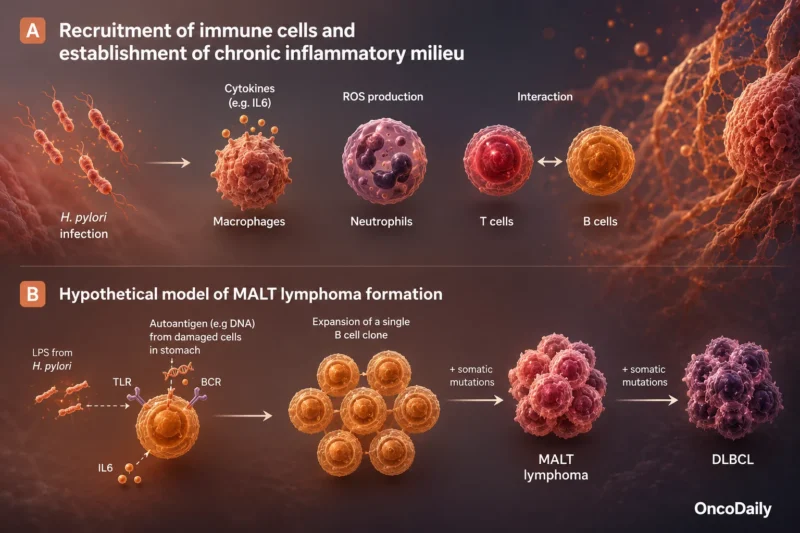
The strongest pathogen-specific association involves H. pylori-related chronic gastritis, which is implicated in ~2/3 of gastric MALT lymphomas. Persistent H. pylori infection promotes continuous antigenic stimulation within the gastric mucosa, attracting and expanding lymphoid cells in a tissue that normally contains little organized lymphoid tissue. Bacterial virulence factors, particularly cytotoxin-associated gene A (CagA), further contribute by activating intracellular signaling pathways that enhance B-cell survival and proliferation.
Ongoing B-cell activation, supported by T-cell help, favors the expansion of antigen-selected B-cell clones. Over time, some clones acquire genetic alterations that enhance survival signaling, allowing proliferation to become progressively less dependent on the initiating infection and ultimately evolve into lymphoma.
Genetic Events Across MZL Subtypes
The genetic basis of MZL encompasses both shared and subtype-specific alterations. Across MZL subtypes, recurrent abnormalities converge on NF-κB signaling, with trisomies of chromosomes 3 and 18 and mutations affecting chromatin-remodeling proteins. In MALT lymphoma, recurrent chromosomal translocations, including t(11;18), t(14;18), and the less common t(1;14), result in constitutive NF-κB activation.
The NOTCH pathway, a key regulator of B-cell differentiation and homing, is frequently affected in splenic and nodal MZL. Inactivation of protein tyrosine phosphatase receptor type D (PTPRD) is seen almost exclusively in nodal MZL, while alterations in KLF2, a transcription factor, rank among the most common genetic events in splenic MZL.
Recent genomic studies have further underscored the heterogeneity of splenic MZL. Two major genetic clusters have been described: the NNK subtype, defined by alterations involving NF-κB, NOTCH, and KLF2 and associated with inferior survival, and the DMT subtype, characterized by mutations affecting DNA damage response, MAPK, and TLR signaling pathways. Mutations in epigenetic regulators such as KMT2D and CREBBP occur across all MZL subtypes.
Clinical Presentation and Histologic Transformation
Extranodal MZL most often presents as localized disease with an indolent course, and symptoms are largely determined by the affected organ. Gastric MALT lymphoma commonly presents with dyspepsia, epigastric discomfort, nausea, or is discovered incidentally during endoscopy. Ocular adnexal disease may cause orbital swelling, conjunctival lesions, or visual symptoms, whereas salivary gland and thyroid MALT lymphomas often present as painless gland enlargement. Pulmonary MALT lymphoma is frequently asymptomatic and detected incidentally on imaging.
Nodal MZL is the rarest and least well-understood subtype. Most patients present with disseminated disease, often accompanied by bone marrow involvement. Although its histologic appearance may resemble extranodal or splenic MZL, patients lack clinical evidence of either entity. Large transformed cells are encountered more frequently, and the risk of transformation appears higher. Autoimmune disorders are less commonly associated with nodal MZL than with extranodal disease.
Splenic MZL often presents with splenomegaly, abdominal fullness, early satiety, and circulating villous lymphocytes. Cytopenias related to hypersplenism are common, while peripheral lymphadenopathy is usually absent or minimal. Many patients are asymptomatic at diagnosis. An association with hepatitis C virus infection has been reported in both nodal and splenic MZL.
Histologic transformation occurs at a rate of ~1.1 events per 100 patient-years and most commonly results in diffuse large B-cell lymphoma. Outcomes are substantially worse following transformation, with 5-year OS declining from 86% in patients without transformation to 65% after transformation. The risk varies across subtypes, with a 10-year transformation risk of approximately 21% in splenic MZL, 17% in nodal MZL, and 8% in extranodal MZL, identifying splenic MZL as the subtype with the highest long-term risk.
Establishing the Diagnosis
The diagnosis of MZL relies on tissue biopsy, supported by immunophenotyping and, when appropriate, molecular studies. The immunophenotypic profile is often more useful for excluding competing diagnoses than for confirming MZL itself, as tumor cells typically express pan-B-cell markers while lacking CD5, CD10, and cyclin D1. Histologically, MZL consists of small mature B cells expanding around reactive follicles, with lymphoepithelial lesions frequently observed in extranodal disease.
Distinguishing splenic MZL from other CD5-negative and CD10-negative indolent B-cell lymphoproliferative disorders can be challenging. Although spleen histology remains the diagnostic gold standard, the diagnosis can often be suspected from peripheral blood findings. The villous lymphocytes of splenic MZL typically display short bipolar cytoplasmic projections and a round nucleus, in contrast to hairy cell leukemia, where cells have circumferential projections and a more ovoid nucleus.
Staging and Prognostic Assessment
Staging is commonly performed using the Ann Arbor or Lugano classification together with CT imaging. The role of PET-CT continues to evolve, with the highest detection rates reported in the ocular adnexa, lung, salivary glands, soft tissues, and bone. In gastric MALT lymphoma, endoscopy with biopsies and Helicobacter pylori testing is essential. Bone marrow evaluation is generally reserved for advanced-stage disease or when splenic or nodal involvement is suspected. Assessment should also include evaluation for histologic transformation.
Several prognostic models have been developed to account for the clinical diversity. The revised MALT-IPI, SMZL-HPLL, and simplified SMZL-HPLL are among the most commonly used tools in clinical practice. The MZL-IPI was subsequently introduced as a unified model applicable across subtypes and incorporates hemoglobin level, absolute lymphocyte count, and disease subtype to identify patients with different risk profiles and clinical outcomes. In splenic MZL, TP53 mutations and unmutated IGHV status have been associated with inferior outcomes.
Beyond baseline risk models, dynamic markers are increasingly recognized. Progression of disease within 24 months (POD24) after first-line immunochemotherapy is associated with poor outcomes and identifies patients with more aggressive disease and inferior survival.
Challenges in Evidence Generation
The treatment paradigm for B-cell non-Hodgkin lymphomas is rapidly evolving, but advances in MZL have been more limited, with only a single US FDA-approved agent significantly impacting treatment. In pivotal randomized trials of indolent lymphomas, MZL subgroups have often been included without sufficient statistical power to detect differences between treatment arms. Furthermore, the current Lugano classification may not fully capture the presentation or treatment responses of some MZL subtypes, limiting trial access and complicating efficacy assessment across the spectrum.
As a result, current MZL management is largely informed by single-arm studies, and treatment sequencing remains relatively empirical. Although frontline approaches in both early- and advanced-stage disease can achieve prolonged disease control, fewer options in the relapsed/refractory setting provide comparable outcomes. Recent studies of CD20×CD3 bispecific antibodies and antibody-drug conjugates have reported promising results, including deep and durable responses, while circulating tumor DNA is being explored as a tool for risk stratification and molecular response monitoring.
Site-Specific Management of Extranodal MZL
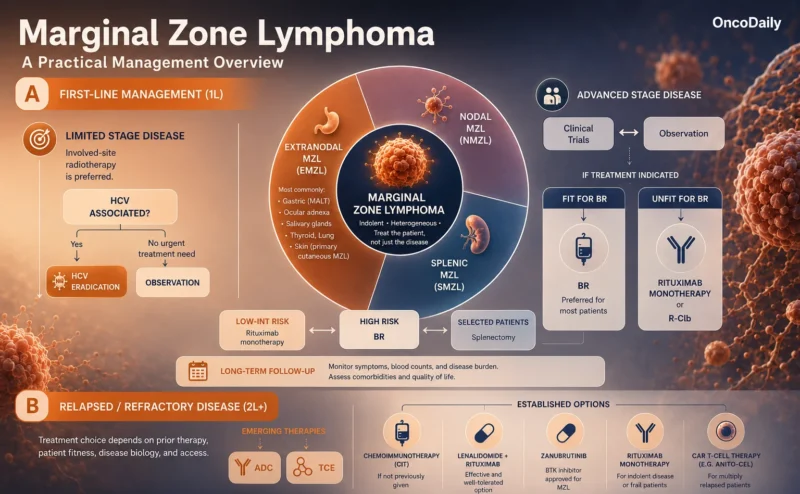
Management of localized extranodal MZL (EMZL) varies according to site, stage, and underlying biology. Radiation therapy remains the standard curative approach for most localized non-gastric EMZLs. When radiation is unsuitable, rituximab monotherapy may provide an alternative. Emerging data also support response-adapted ultra-low-dose radiation as a less toxic alternative.
Eradication therapy is the preferred first-line treatment for localized Helicobacter pylori-positive disease and can result in durable lymphoma regression. A meta-analysis of 2936 patients found a 75% complete remission rate after 3- or 4-agent antimicrobial regimens. For H. pylori-negative disease, tumors harboring t(11;18), or cases refractory to eradication therapy, involved-site radiation therapy provides excellent disease control.
Local treatment, particularly radiation therapy, is effective for most localized ocular adnexal, salivary gland, and thyroid MALT lymphomas. In contrast, pulmonary MALT lymphoma often follows an indolent course and may be managed with surveillance, local therapy, or rituximab-based treatment. Primary cutaneous MALT lymphoma rarely progresses systemically and is usually treated locally, whereas central nervous system MALT lymphoma, most often presenting as dural disease, is generally managed with surgery and/or radiation. Systemic therapy is reserved for more extensive cases.
Colonic and small intestinal MALT lymphomas are rare, and management is individualized according to disease extent and symptoms. In some cases of small intestinal disease, Campylobacter jejuni eradication may result in lymphoma regression.
Nodal and Splenic MZL
Nodal MZL is generally associated with favorable long-term outcomes, and some patients may remain treatment-free for years after diagnosis. For limited-stage disease, involved-site radiation therapy is the preferred approach. Treatment in splenic MZL is reserved for symptomatic splenomegaly, cytopenias, constitutional symptoms, or progressive disease.
Rituximab-based therapy has largely replaced splenectomy as the preferred frontline approach, although splenectomy is still an option for refractory disease or persistent symptomatic splenomegaly. Similar to nodal MZL, hepatitis C virus eradication may induce lymphoma regression in affected patients. Chemoimmunotherapy, most commonly BR or R-CVP, is generally reserved for higher-risk presentations.
Advanced-Stage Disease: When to Treat
Unlike follicular lymphoma, there are no validated treatment-initiation criteria developed specifically for advanced-stage MZL. In practice, management is commonly guided by the GELF criteria, which identify patients with high tumor burden or clinically significant disease, including bulky lymphadenopathy, splenomegaly, cytopenias, leukemic involvement, pleural effusions or ascites, organ compression, and B symptoms. Patients who do not meet treatment criteria may be managed with active surveillance, whereas symptomatic or progressive disease generally warrants systemic therapy.
Relapsed and Refractory MZL
Rituximab-based regimens remain widely used, but response rates and PFS tend to decline with each subsequent line of therapy. Older age, POD24, and high-risk MZL-IPI are associated with inferior outcomes following second-line treatment.
Established and Emerging Targeted Therapies
Lenalidomide plus rituximab (R²) is an established option supported by the AUGMENT and MAGNIFY studies, although MZL comprised a relatively small proportion of enrolled patients.
BTK inhibition has become a central treatment strategy in relapsed/refractory MZL. Ibrutinib was the first approved covalent BTK inhibitor, while zanubrutinib subsequently demonstrated higher response rates in MAGNOLIA and has become a key treatment option. Acalabrutinib, orelabrutinib, and rocbrutinib have also shown activity.
Non-covalent BTK inhibitors, including pirtobrutinib and nemtabrutinib, are emerging options, particularly for patients previously exposed to covalent BTK inhibitors. Biomarker analyses suggest that MYD88 and TNFAIP3 mutations may be associated with improved outcomes with zanubrutinib, whereas KMT2D mutations may be linked to shorter PFS.
Combination approaches are also being explored to improve durability of response. Examples include orelabrutinib plus obinutuzumab, zanubrutinib-based combinations being evaluated in MAHOGANY, and BTK/BCL2 combinations incorporating venetoclax or sonrotoclax.
Emerging Immunotherapies
CD20×CD3 bispecific antibodies are among the most promising emerging therapies in MZL. Mosunetuzumab, epcoritamab, and odronextamab have all demonstrated activity, with particularly encouraging results reported for odronextamab in ELM-2. Ongoing phase III studies include MARSUN and OLYMPIA-5, both evaluating bispecific antibody-based approaches in combination with lenalidomide.
Additional antibody-based strategies include tafasitamab plus acalabrutinib in IELSG49, the anti-CD19 antibody-drug conjugate loncastuximab tesirine, and zilovertamab vedotin combined with ibrutinib.
Cellular Therapy and Transplantation
CAR T-cell therapy is emerging as an important option for fit patients with heavily pretreated disease. Axi-cel demonstrated durable activity in ZUMA-5, while liso-cel was approved following TRANSCEND FL, showing high response rates with manageable cytokine release syndrome and neurologic toxicity. Where available, CAR T-cell therapy may be considered after at least two prior lines of treatment.
Hematopoietic stem cell transplantation is now reserved for a small subset of patients with early relapse, POD24, or refractory disease. Although both autologous and allogeneic transplantation can provide disease control, treatment-related toxicity and non-relapse mortality have narrowed their role as targeted therapies and cellular immunotherapies continue to expand.
What Comes Next?
Several next-generation approaches are currently under investigation. These include BTK degraders such as BGB-16673 and bexobrutideg (NX-5948), combinations of BTK degradation and BCL2 inhibition being evaluated in CaDAnCe-104, and EO2463, a gut bacteria-derived therapeutic vaccine being studied with lenalidomide and rituximab in the EONHL1-20/SIDNEY trial.
You can also read: Mantle Cell Lymphoma (MCL): Revealing the Biology Beneath the Mantle and Modern Therapeutic Frontiers
Written by Susanna Mikayelyan, MD
FAQ
Can marginal zone lymphoma ever be cured?
The possibility of cure depends on the subtype and stage. Localized extranodal MZL, particularly gastric MALT lymphoma associated with Helicobacter pylori, can sometimes be eradicated with antibiotic therapy alone. Localized disease treated with radiation therapy may also achieve long-term remission. In contrast, advanced-stage nodal and splenic MZL are generally considered chronic conditions that can often be controlled for many years.
Is marginal zone lymphoma hereditary?
Most cases of MZL are not inherited. While certain genetic mutations are found within lymphoma cells, these changes usually develop during a person's lifetime rather than being passed down through families. Environmental, infectious, and autoimmune factors appear to play a larger role than inherited genetic risk.
Can autoimmune diseases increase the risk of developing MZL?
Yes. Chronic autoimmune stimulation is strongly linked to several forms of MZL. Sjögren syndrome increases the risk of salivary gland MALT lymphoma, while Hashimoto thyroiditis is associated with thyroid MALT lymphoma. Persistent immune activation is thought to create an environment that favors lymphoma development.
How often does marginal zone lymphoma transform into an aggressive lymphoma?
Transformation is uncommon but clinically important. Histologic transformation occurs at a rate of approximately 1.1 events per 100 patient-years and most frequently results in diffuse large B-cell lymphoma (DLBCL). The risk is highest in splenic MZL and lowest in extranodal MZL.
Why is PET/CT less useful in some forms of MZL?
Unlike many aggressive lymphomas, MZL often exhibits variable FDG uptake. Some sites, particularly gastrointestinal and cutaneous MALT lymphomas, may show little or no FDG avidity. As a result, PET/CT can underestimate disease burden in selected patients and is not universally relied upon for staging or response assessment.
What might MZL treatment look like in the next decade?
Future treatment is likely to become increasingly targeted and individualized. Emerging strategies include bispecific antibodies, antibody-drug conjugates, CAR T-cell therapy, non-covalent BTK inhibitors, BTK degraders, and therapeutic vaccines. Advances in molecular profiling may also help match patients to therapies based on the biology of their disease rather than subtype alone.