
Mantle cell lymphoma (MCL) arises in one of the most biologically stable compartments of the lymph node, yet can become one of the most evolutionarily dynamic B-cell malignancies. MCL has long proven a challenging entity to treat with substantial inter- and intratumoral heterogeneity.
Compared with many other lymphomas, MCL has remarkably few well-established epidemiologic risk factors and accounts for approximately 5-7% of non-Hodgkin lymphoma in Western countries, primarily affecting elderly males.
In this review, we look beneath the mantle of MCL to explore the biology behind its diverse clinical behavior and the evolving therapeutic opportunities.
The Lymphoma of the Quiet Zone
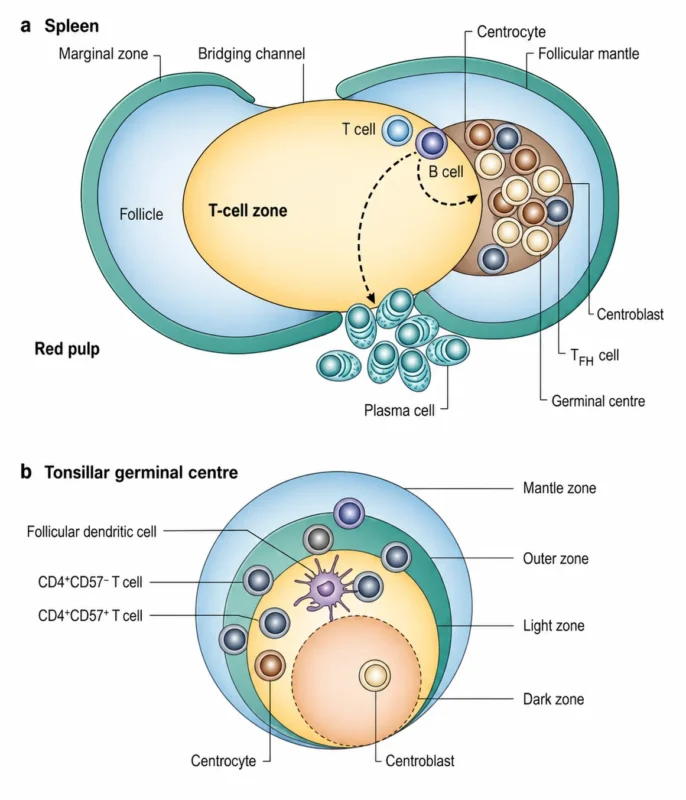
MCL derives its name from the mantle zone, a ring of small B lymphocytes surrounding the germinal center within normal lymphoid follicles. The term mantle reflects the appearance of this compartment, which forms a protective cloak around the germinal center and contains predominantly resting, antigen-naïve CD5+ B cells.
Unlike the germinal center, where B cells rapidly proliferate, mutate, and compete during the immune response, the mantle zone is primarily a site of cellular stability and surveillance. In this sense, the key molecular event is surprisingly linked to hallmark cell-cycle lesion.
In most cases, MCL is characterized by t(11;14)(q13;q32), a chromosomal translocation that leads to constitutive overexpression of cyclin D1, a key regulator of the G1-S phase transition, allowing cells to progress through the cell cycle more readily than normal.
Yet, if it were sufficient on its own, MCL would behave as a far more uniform disease than it does in clinical practice. Part of this diversity arises as additional genetic alterations involving ATM, TP53, NOTCH1, KMT2D, and CDKN2A accumulate over time. At the same time, antigen-dependent/independent signals from the B-cell receptor, interactions with stromal and immune cells, and activation of pathways such as NF-κB and PI3K/AKT/mTOR help support lymphoma cell survival and provide the foundation for BTK-targeted therapies.
SOX11 acts as an oncogene in MCL. By repressing transcriptional programs associated with germinal center entry and mature B-cell differentiation, it sustains a less differentiated cellular state, enhances BCR signaling, and influences apoptosis. Beyond these tumor-intrinsic effects, SOX11 promotes angiogenesis and cell migration, strengthens stromal interactions, and facilitates the recruitment and expansion of regulatory T cells, contributing to immune evasion and lymphoma growth.
nature.com
Why Are Some MCLs Aggressive While Others Remain Indolent?
At one end of the spectrum lies in situ mantle cell neoplasia (ISMCN), characterized by cyclin D1-positive cells confined to the mantle zones of lymphoid follicles. Often detected incidentally, ISMCN is considered an early phase of MCL and may remain asymptomatic for prolonged periods, frequently requiring observation alone.
A similarly indolent pattern is observed in non-nodal MCL (nnMCL), which accounts for approximately 10-20% of cases. Unlike classic MCL, nnMCL primarily involves the peripheral blood, bone marrow, and spleen, with little or no lymphadenopathy. Patients often present with lymphocytosis and splenomegaly rather than bulky nodal disease. Biologically, nnMCL lacks SOX11 expression, exhibits a low Ki-67 index, and carries fewer genomic alterations. Frequent IGHV mutations and evidence of somatic hypermutation suggest derivation from B cells that have undergone germinal center reactions.
In contrast, classic MCL is usually associated with progressive lymphadenopathy and a more aggressive clinical course. More than 95% of cases harbor the IGH::CCND1 translocation, and cyclin D1 overexpression, often accompanied by secondary molecular abnormalities.
Identification
MCL is recognized through the combination of morphology, a mature B-cell immunophenotype, and confirmation of cyclin D1 overexpression or t(11;14), with SOX11 helping in cyclin D1-negative cases. Initial evaluation must define the pattern and extent of involvement, as MCL commonly affects lymph nodes, bone marrow, spleen, peripheral blood, and the gastrointestinal tract
What Determines Prognosis in MCL?
Clinical risk assessment commonly begins with the Mantle Cell Lymphoma International Prognostic Index (MIPI), which incorporates age, performance status, lactate dehydrogenase, and leukocyte count. Anyway, patients with similar MIPI scores may experience markedly different outcomes depending on biological and molecular features.
Among these, Ki-67 proliferation index, TP53 alterations, and blastoid or pleomorphic morphology are among the strongest adverse prognostic factors. More broadly, complex karyotypes, a high burden of genomic alterations, and chromosomal events such as chromothripsis, chromoplexy, and breakage-fusion-bridge cycles are enriched in aggressive disease.
To better integrate proliferative activity into clinical risk assessment, the combined MIPI (MIPI-c) incorporates Ki-67. High p53 expression, elevated Ki-67, and blastoid morphology identify patients with particularly unfavorable outcomes and are increasingly used to define high-risk disease.
Gene-expression–based classifiers, such as the MCL35 proliferation signature, have been validated in large prospective studies. Prognosis is also influenced by treatment response. Patients who experience progression of disease within 24 months (POD24) have markedly worse survival. Minimal residual disease assessment has provided an additional layer of prognosis, identifying patients at increased risk of relapse despite achieving clinical remission.

MRD: Beyond Morphologic Remission and the Questions That Remain
Changing the Natural History of MCL
For many years, treatment of MCL relied on intensive chemoimmunotherapy. In younger, fit patients, induction regimens followed by autologous stem cell transplantation and rituximab maintenance became the standard approach, while bendamustine-based chemoimmunotherapy was widely adopted for older patients. These strategies improved disease control but rarely prevented relapse. Radiotherapy retains a role in selected patients with localized disease and as a palliative modality for symptomatic sites of involvement.
Can Chemotherapy Be Eliminated from Frontline Treatment?
The first major shift came with Bruton tyrosine kinase inhibitors. Agents such as ibrutinib, acalabrutinib, and zanubrutinib demonstrated substantial activity in relapsed disease and established BTK inhibition as a central therapeutic strategy. Their success subsequently led to evaluation in earlier treatment settings, including the phase III SHINE, ECHO, and TRIANGLE studies, which incorporated BTK inhibitors into frontline therapy and, with longer follow-up from TRIANGLE, questioned the routine use of ASCT in transplant-eligible patients.
At the same time, treatment is increasingly moving beyond conventional chemotherapy. Combinations incorporating BTK inhibitors, anti-CD20 antibodies, and venetoclax have demonstrated high response rates, including in biologically high-risk disease. Studies such as BOVen, OAsIs, and ENRICH have further strengthened interest in chemo-free approaches.
Perhaps the most significant advance has been the incorporation of CAR T-cell therapy. In patients with relapsed or refractory disease, particularly after BTK inhibitor exposure, CD19-directed CAR T-cell products have produced durable remissions that were rarely achievable with previous therapies. The ZUMA-2 study established brexucabtagene autoleucel as a standard treatment option in relapsed/refractory MCL, while TRANSCEND NHL 001 provided supporting evidence for lisocabtagene maraleucel.

How Should Cellular and T-Cell-Engaging Therapies Be Sequenced?
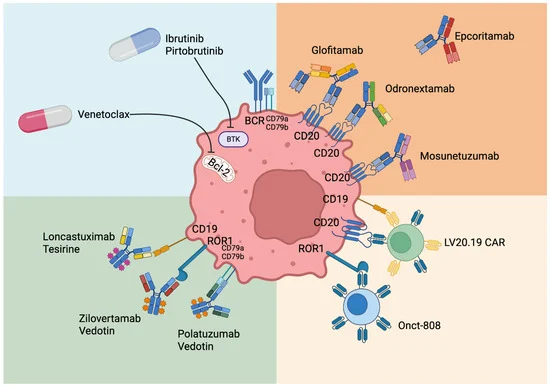
The most promising results have emerged from bispecific antibodies, by redirecting endogenous T cells toward malignant B cells. In a phase I/II study, glofitamab achieved an ORR of 85% and a CR rate of 78% in relapsed or refractory MCL, with a median PFS of 16.8 months. Responses were observed in patients previously treated with BTK inhibitors and even after CAR T-cell therapy. These findings have led to the ongoing phase III GLOBRYTE trial, which is evaluating glofitamab monotherapy against investigator’s choice of R-B or R2 in patients with R/R MCL following prior BTK inhibitor exposure.
Additional CD20×CD3 bispecific antibodies, including mosunetuzumab, epcoritamab, and odronextamab, have also shown encouraging efficacy in relapsed disease. Notably, the combination of mosunetuzumab and polatuzumab vedotin produced response and complete response rates of 75% and 70%, respectively, in a heavily pretreated population enriched for blastoid morphology, high Ki-67 expression, prior BTK inhibitor exposure, and previous CAR T-cell therapy.
Among antibody-drug conjugates, zilovertamab vedotin, a ROR1-targeting agent, demonstrated an overall response rate of 40% in heavily pretreated patients, including those previously exposed to BTK inhibitors and CAR T-cell therapy.
Cellular therapy is also entering a new phase. New constructs are therefore being designed to target multiple antigens simultaneously, to overcome loss or downregulation of CD19. The dual-target LV20.19 CAR-T construct, directed against both CD19 and CD20, achieved an overall response rate of 100% and a complete response rate of 88% in patients with heavily pretreated MCL. Durable remissions were observed with relatively few relapses during follow-up.

Will BTKi Resistance Become a Solvable Problem?
One approach has been the development of non-covalent BTK inhibitors, which inhibit BTK through reversible binding and remain active regardless of C481-mediated resistance mechanisms. Pirtobrutinib, the first non-covalent BTK inhibitor to enter clinical practice, demonstrated durable responses in heavily pretreated patients, including those previously exposed to covalent BTK inhibitors, stem cell transplantation, and CAR T-cell therapy in the phase I/II BRUIN study. These findings led to its approval for relapsed or refractory MCL following prior BTK inhibitor treatment.
Another strategy has focused on simultaneous inhibition of B-cell receptor signaling and apoptotic escape pathways. Venetoclax showed synergistic activity with ibrutinib in preclinical models and subsequently entered clinical evaluation. In the phase III SYMPATICO trial, the combination of ibrutinib and venetoclax prolonged PFS compared with ibrutinib alone, including in patients with high-risk features. Among newer BCL2 inhibitors, sonrotoclax (BGB-11417) has shown encouraging early activity in combination with zanubrutinib, with response rates exceeding 50% in relapse.
BTK degraders are also intriguing. Rather than inhibiting BTK activity, these agents induce degradation of the BTK protein through the ubiquitin-proteasome system. Preclinical studies have shown activity against both wild-type and mutant BTK, including after resistance to covalent and non-covalent BTKis. Early clinical experience with NX-2127 and NX-5948 suggests that this strategy may overcome several established mechanisms of BTKi resistance.
Another area of interest is the continued targeting of pathways linked to cyclin D1 dysregulation. Novel CDK4/6 inhibitors, including narazaciclib, directly address the cell-cycle abnormalities that define the disease.
mdpi.com
Where Does Transplantation Fit in the CAR-T Era?
In younger, fit patients, autologous stem cell transplantation was routinely used to consolidate remission after intensive induction therapy. More recently, the incorporation of BTK inhibitors into frontline treatment raised questions about the incremental benefit of ASCT when effective BTK inhibition is incorporated into frontline therapy.
The role of allogeneic stem cell transplantation has evolved differently, because it provides a graft-versus-lymphoma effect through donor-derived immune cells and has traditionally been reserved for R/R disease. Long-term remissions have been reported, with retrospective studies showing 5-year overall survival of 50% in selected patients.
Comparative analyses further suggest superior early survival and lower treatment-related mortality with brexucabtagene autoleucel than with historical allo-SCT cohorts. Nevertheless, allo-SCT remains a potential option for selected patients who relapse after CAR T-cell therapy, particularly when disease control can be achieved before transplantation.
Horizon Scanning and Future Perspectives
Presently, high-throughput transcriptomic and proteomic analyses have been instrumental in revealing constitutively activated and deregulated proteins and pathways in MCL, as well as potential prognostic factors. In this context, the advent of drug repurposing as a therapeutic strategy has opened new opportunities. These studies have generated a jigsaw puzzle of molecular information, although integrating these increasingly complex datasets into a coherent understanding remains challenging.
To address the complexity, Georgia Orfanoudaki and colleagues developed a modular bioinformatic pipeline integrating transcriptomic data with multiple network-based approaches. The complementary analytical methods yielded both overlapping and unique findings, highlighting the potential involvement of SMAD2/3:SMAD4 and RUNX1 transcriptional regulation, SUMOylation-related processes, microRNA networks, and angiogenic signaling, including SPARC and VEGFA overexpression during disease progression.
Protein-coding genes undoubtedly account for the lion’s share of drug-target discovery, however, the significance of non-coding transcripts as epigenetic modulators and switches in MCL was also evident, and their contribution to disease pathogenesis continues to be explored.

You can also read: Burkitt Lymphoma: Among the Fastest Growing Yet Most Curable Human Cancers
Written by Susanna Mikayelyan, MD
FAQ
Can mantle cell lymphoma remain stable without treatment?
Yes. Some patients, particularly those with non-nodal MCL or in situ mantle cell neoplasia (ISMCN), may experience prolonged periods of stable disease without symptoms. In carefully selected cases, an initial watch-and-wait strategy may be appropriate.
Why does mantle cell lymphoma behave so differently from one patient to another?
MCL is not a single biological entity. While most cases share the hallmark t(11;14) translocation, additional genetic alterations, differences in SOX11 expression, proliferative activity, and microenvironmental interactions can lead to markedly different clinical courses, ranging from indolent disease to highly aggressive variants.
Why is cyclin D1 not enough to explain mantle cell lymphoma?
Although cyclin D1 overexpression is a defining feature of MCL, it does not fully account for the disease's clinical diversity. Additional molecular alterations involving TP53, ATM, NOTCH1, and other pathways contribute to disease progression, treatment response, and prognosis.
Why are BTK inhibitors particularly effective in mantle cell lymphoma?
MCL cells frequently depend on B-cell receptor signaling for survival and proliferation. BTK inhibitors disrupt a key component of this pathway, reducing survival signals and inducing durable responses in many patients, particularly in relapsed disease.
Can patients receive CAR T-cell therapy more than once?
Currently, repeat CAR T-cell therapy is not routine practice. However, researchers are exploring strategies such as dual-target CAR constructs, alternative antigen targets, and sequential cellular therapies to overcome relapse after initial CAR T-cell treatment.
Are bispecific antibodies likely to replace CAR T-cell therapy?
Not necessarily. Bispecific antibodies offer advantages such as off-the-shelf availability and easier administration, whereas CAR T-cell therapy can produce exceptionally durable remissions. Future treatment algorithms may use both approaches rather than positioning them as direct competitors.
Could mantle cell lymphoma eventually become a chemotherapy-free disease?
This is one of the most important questions in current MCL research. The success of BTK inhibitors, BCL2 inhibitors, bispecific antibodies, and CAR T-cell therapy has accelerated the development of chemotherapy-free regimens, although longer follow-up is needed to determine whether they can fully replace conventional approaches.