Burkitt lymphoma is a highly aggressive mature B-cell non-Hodgkin lymphoma with a unique place in the history of cancer research. Initially described in equatorial Africa, it was the first human neoplasm shown to be associated with a virus and the first in which a recurrent chromosomal aberration was identified. Burkitt lymphoma also provided some of the earliest evidence that highly aggressive cancers could be cured with intensive chemotherapy. Today, it is one of the most extensively studied human malignancies and one of the most curable aggressive lymphomas.
The “24-Hour” Doubling Time
Burkitt lymphoma has one of the shortest documented tumor doubling times in human cancer, often cited as 24-48 hours. This extraordinary proliferative rate is reflected by its near-universal Ki-67 approaching 100%.
The MYC Story: From Translocation to Transformation
The MYC family comprises regulator genes and oncogenes that encode transcription factors involved in cell-cycle regulation. Translocations involving the MYC gene on chromosome 8 are the hallmark of Burkitt lymphoma (95% of cases). The most common translocation, t(8;14), juxtaposes MYC to the immunoglobulin heavy-chain promoter, resulting in constitutive MYC activation. Less common translocations are t(2;8) and t(8;22), involving the kappa and lambda light-chain loci, respectively.
In endemic Burkitt lymphoma, EBV latent proteins inhibit apoptosis in B cells harboring MYC translocations. EBV has also been implicated in genomic instability, telomere dysfunction, and DNA damage.
Plasmodium falciparum infection may contribute by reactivating latent EBV and promoting immunoglobulin-MYC translocations through activation of toll-like receptor 9. Aberrant activity of AID (activation-induced cytidine deaminase), an enzyme involved in immunoglobulin class switching, has likewise been linked to MYC translocations.
In normal B cells, MYC overexpression induces apoptosis through a p53-dependent pathway, disruption of TP53 and other cooperating genetic events promotes malignant transformation.
Epidemiology and Clinical Presentation
Burkitt lymphoma accounts for less than 2% of adult NHL in Western countries but represents approximately 30-40% of pediatric NHL. It is more common in males than females, with a ratio of 3-4:1. There are three clinical-epidemiologic variants: endemic, sporadic, and immunodeficiency-associated.
Endemic BL classically presents with tumors of the jaw and peri-orbital region, but recent studies have reported a shift toward more frequent abdominal involvement, including the ileum, cecum, mesentery, and gonads.
Sporadic BL present with bulky abdominal disease, particularly involving the ileocecal region. Extranodal involvement is common and may affect the gonads, kidneys, bone marrow, and skin.
Immunodeficiency-related BL occurs most commonly in people living with HIV but is also seen in transplant recipients and patients with congenital immunodeficiencies. Unlike several other HIV-related lymphomas, BL frequently arises in patients with relatively preserved immune function and its incidence has remained largely unchanged despite effective antiretroviral therapy.
Central nervous system involvement occurs in a substantial proportion of patients, particularly in advanced-stage disease. It may result in neurologic deficits, including headaches, confusion, and paralysis.
Why Burkitt Lymphoma Often Presents as a Medical Emergency
Tumor lysis syndrome may occur even before treatment. Rapid tumor-cell breakdown can cause hyperuricemia, hyperkalemia, hyperphosphatemia, and hypocalcemia, leading to acute kidney injury, cardiac arrhythmias, CNS toxicity, or death. Because TLS can occur before therapy begins, prophylaxis should be started promptly, with aggressive hydration, allopurinol, and rasburicase when indicated.
When bone marrow involvement exceeds 25% of cellularity, the disease is classified as Burkitt leukemia. A purely leukemic presentation is rare.
Epstein-Barr Virus and Burkitt Lymphoma: How Strong Is the Connection?
EBV is detected in nearly all cases of endemic Burkitt lymphoma but is present in only 25%-40% of immunodeficiency-associated cases and 10%-30% of sporadic cases.
Although EBV infects most of the world’s population, only a small fraction develop BL. The EBV genome is detected in most eBL cases and is typically clonal, indicating that infection occurs before malignant transformation. Loss of the EBV genome from BL cell lines often results in apoptosis.
EBV encodes several latent proteins involved in B-cell immortalization, but only EBNA-1 is consistently expressed in BL. Evidence also suggests a role for EBV lytic reactivation. Experimental studies have shown that the lytic cycle can promote MYC-IGH proximity. EBV-encoded BART microRNAs further contribute to oncogenesis.
For EBV-negative BL, a “hit-and-run” mechanism has been proposed, whereby EBV initiates oncogenesis but is subsequently lost. Detection of EBV microRNAs in some EBER-negative tumors and the presence of compensatory mutations provide support for this hypothesis.
Nutritional Cofactors?
Interestingly, nutritional deficiencies, particularly low dietary selenium and magnesium intake, have also been implicated as risk factors for Burkitt lymphoma. The identification of XMEN disease, a genetic disorder of the magnesium transporter associated with intracellular magnesium deficiency and impaired EBV immunity, led to the recognition of magnesium as a potential cofactor in EBV control. In a study of African children, plasma magnesium levels were significantly lower in those with Burkitt lymphoma than in healthy controls.
The Diagnostic Profile
In addition to the cytogenetic features described above, immunophenotypically, Burkitt lymphoma expresses the B-cell markers, as well as surface IgM with light-chain restriction. Germinal center markers CD10, BCL6, and CD38 are typically positive, MUM1 is usually negative. The tumor cells are negative for CD5, CD23, and usually BCL2, although BCL2 expression may be seen in approximately 20% of cases.
The “Starry Sky” Pattern
Burkitt lymphoma is composed of a monomorphic population of intermediate-sized mature B cells with round nuclei, coarse chromatin, multiple small nucleoli, and deeply basophilic cytoplasm often containing lipid vacuoles. The tumor is characterized by an exceptionally high proliferative rate, resulting in numerous mitotic figures and equally prominent apoptosis.
This rapid cellular turnover produces the classic “starry sky” appearance, one of the most recognizable histopathologic features of Burkitt lymphoma. The dark background of densely packed lymphoma cells is punctuated by pale tingible-body macrophages that have engulfed apoptotic cellular debris, creating the appearance of stars scattered across the night sky. Although not entirely specific to Burkitt lymphoma, this pattern strongly reflects the biologic hallmark of the disease-explosive growth accompanied by equally rapid cell death.
Distinguishing Burkitt Lymphoma
Several aggressive B-cell lymphomas share biologic features with Burkitt lymphoma, including Burkitt-like lymphoma with 11q aberration (a rare entity with a similar prognosis), high-grade B-cell lymphoma with MYC and BCL2 rearrangements, blastic mantle cell lymphoma, and diffuse large B-cell lymphoma.
The differential diagnosis of Burkitt lymphoma includes other CD10-positive B-cell neoplasms, particularly DLBCL, high-grade B-cell lymphoma, high-grade follicular lymphoma, and B-cell acute lymphoblastic leukemia/lymphoma.
DLBCL and high-grade B-cell lymphomas typically show larger and more pleomorphic cells than Burkitt lymphoma. BCL2 expression and a Ki-67 proliferation index below 90% favor another diagnosis. B-ALL may resemble Burkitt lymphoma morphologically but usually exhibits finer chromatin and expresses markers of immaturity.
Risk Stratification
The Burkitt Lymphoma International Prognostic Index (BL-IPI) serves as a robust prognostic tool, stratifying patients with newly diagnosed BL into three distinct risk categories (low, intermediate, and high) based on age ≥ 40 years, ECOG performance score ≥ 2, serum LDH > 3 upper limit of normal, and presence of CNS involvement as equally weighted factors.
Patients with zero factors are considered low-risk, those with one factor considered intermediate-risk and those with two or more factors considered high-risk. In the derivation cohort of 633 patients, 3-year PFS rates were 92%, 72%, and 53% (p < 0.0001), and 3-year OS rates were 96%, 76%, and 59% (p < 0.0001). Validation in an independent cohort of 457 patients confirmed these findings, establishing the index as an independent predictor of outcomes, irrespective of HIV status, disease stage, and administered first-line chemotherapy.
Modern Therapy for Burkitt Lymphoma
Management should be guided by disease risk rather than clinical subtype or EBV status. In patients with HIV-associated BL, antiretroviral therapy should be started at diagnosis and continued throughout treatment.
Frontline Management
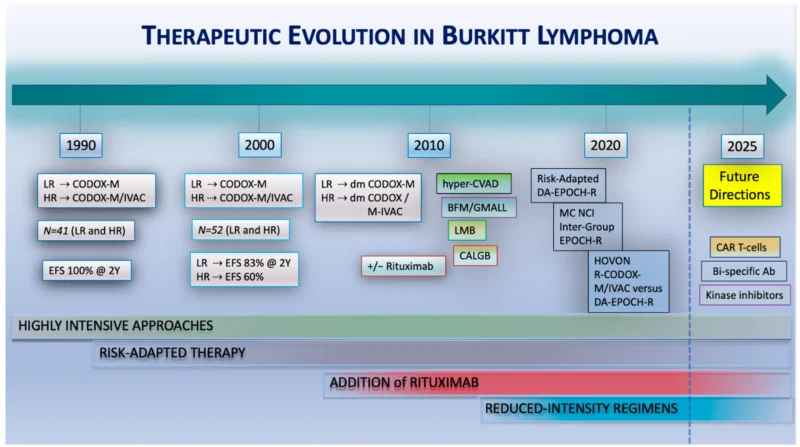
Largely evolved from pediatric B-cell ALL, intensive regimens such as CODOX-M/IVAC, HyperCVAD, and CALGB-based protocols formed the backbone of Burkitt lymphoma treatment for decades. They achieved long-term survival rates approaching 70-80% in many studies, especially in younger patients, but at the cost of substantial toxicity, including severe myelosuppression, infections, neurotoxicity, prolonged hospitalization, and treatment-related mortality.
A major advance was the incorporation of rituximab. Across prospective studies, adding rituximab consistently improved event-free and overall survival without substantially increasing toxicity, establishing chemoimmunotherapy as the modern standard of care.
Adapting Intensive Therapy for Adults
The Lymphomes Malins B (LMB) protocol is a risk-adapted, short-duration, dose-intensive chemoimmunotherapy strategy derived from pediatric Burkitt lymphoma protocols that combines rapid cytoreduction, CNS-directed therapy, and high-dose antimetabolites.
In a real-world study by Ivan Dlouhy et al. (2025) involving 55 adults treated with rituximab-containing LMB therapy, outcomes were favorable, with a complete remission rate of 85% and 3-year progression-free and overall survival rates of 79% and 84%, respectively. Frequent grade 3-4 hematologic, infectious, and mucosal adverse events require intensive supportive care. Outcomes remained particularly poor in patients with CNS involvement, whose 3-year survival was only 55%, and in patients older than 60 years.
Can Burkitt Lymphoma Be Treated With Less Toxic Therapy?
Older patients, or those with multiple comorbidities, are often ineligible for pediatric inspired highly intensive chemotherapy.
This led to the development of dose-adjusted EPOCH-R, based on the concept that prolonged exposure to effective drug concentrations may be more important than achieving high peak doses. The role of DA-EPOCH-R was further supported by a randomized phase III trial comparing it with R-CODOX-M/R-IVAC in high-risk BL.
Although the study closed early because of slow accrual, survival outcomes were comparable between the two approaches. Importantly, DA-EPOCH-R was associated with fewer severe toxicities, fewer infectious complications, shorter hospitalizations, and reduced transfusion requirements, making it an attractive option for older or less fit patients.
While intensive regimens incorporate CNS-penetrating agents such as high-dose methotrexate and cytarabine, these drugs are not included in DA-EPOCH-R and retrospective analyses suggest higher rates of CNS recurrence without additional intrathecal or intraventricular chemotherapy.
mdpi.com
Relapsed and Refractory Burkitt Lymphoma: What Is Next?
The prognosis is very poor, ranging from less than 10% to 30-40%, with longer survival only in transplanted patients. Limited prospective studies leave treatment decisions largely guided by retrospective data.
No salvage regimen has demonstrated clear superiority. Commonly used approaches include R-ICE, R-GDP, rituximab-based high-dose cytarabine regimens, and R-IVAC, typically followed by autologous or allogeneic stem-cell transplantation in responding patients. Long-term disease control is possible in a subset of patients who achieve chemosensitive remission before transplantation.
T-Cell Redirection: A Work in Progress
CAR T-cell therapy has generated interest in R/R BL, but results have been less impressive than those seen in diffuse large B-cell lymphoma. In the largest real-world series to date, CD19-directed CAR T-cell therapy produced an ORR of 58% and a CR rate of 42%, yet remissions were often short-lived, with a median PFS of only 2.3 months.
Although the published data are based on smaller case series to gain conclusions, blinatumomab seems to have less activity in BL compared with CD19-positive ALL. Early reports of the CD20×CD3 bispecific antibody glofitamab combined with polatuzumab vedotin have shown rapid and deep responses, including in patients with CNS involvement.
An ongoing global clinical trial is enrolling pediatric and young adult patients with relapsed/refractory B-cell NHL, including Burkitt lymphoma, using a three-arm randomized design evaluating the CD20×CD3 bispecific antibody odronextamab, the anti-CD19 antibody-drug conjugate loncastuximab tesirine in combination with chemotherapy, or anti-CD19 CAR T-cell therapy (Glo-BNHL, NCT05991388).
Future Perspectives
Although direct MYC inhibition remains elusive, epigenetic therapies such as histone deacetylase and BET inhibitors can suppress MYC-driven transcriptional programs.
The discovery of recurrent TCF3 and ID3 mutations in up to 70% of BL cases has further underscored the importance of PI3K signaling. This has provided the rationale for investigating copanlisib in combination with frontline chemoimmunotherapy. Additional preclinical studies have identified metabolic and cell-cycle dependencies that may be therapeutically exploitable.
Devimistat (CPI-613), a lipoic acid analogue that disrupts mitochondrial energy metabolism, has demonstrated clinical activity in a phase II study of relapsed/refractory Burkitt lymphoma. These findings provide proof-of-concept that targeting the metabolic dependencies of MYC-driven lymphomas may offer a novel treatment approach beyond conventional chemotherapy.
Geographic Disparities Persist
Although BL has excellent outcomes in high-income countries, it represents only a minority of NHL diagnoses in the Western world, whereas it is the most common childhood cancer in sub-Saharan Africa, where prognosis has improved only modestly over the past several decades.
Similar disparities are observed in adults, particularly in low- and middle-income countries, where treatment strategies developed in high-income countries are often difficult to implement and real-world outcomes have generally been inferior to those reported in prospective trials. Limited access to specialized supportive care, blood products, intensive care services, and advanced diagnostics, together with delays in seeking care, treatment-related toxicities, and treatment abandonment, may further hamper outcomes.
Written by Susanna Mikayelyan, MD
FAQ
Why does Burkitt lymphoma grow so quickly?
Burkitt lymphoma is driven by MYC activation, which promotes rapid cellular proliferation. Combined with a proliferation index that often approaches 100%, this makes BL one of the fastest-growing human cancers.
Can Burkitt lymphoma develop in healthy people?
Yes. Although BL can occur in people with HIV or other forms of immunodeficiency, the sporadic form often develops in otherwise healthy individuals with no known immune disorder.
Why is Burkitt lymphoma considered a medical emergency?
The disease can double in size within days and may rapidly involve critical organs. Delays in diagnosis or treatment can lead to life-threatening complications, including tumor lysis syndrome and central nervous system involvement.
If Burkitt lymphoma is so aggressive, why is it often curable?
Unlike many slow-growing cancers, BL is highly sensitive to chemotherapy. Its rapid cell division makes it vulnerable to intensive treatment strategies when therapy is initiated promptly.
Is Epstein-Barr virus enough to cause Burkitt lymphoma?
No. Although EBV plays an important role, particularly in endemic BL, most people infected with EBV never develop lymphoma. Additional genetic and environmental factors are required for malignant transformation.
Could targeted therapies eventually replace intensive chemotherapy?
Researchers are actively exploring bispecific antibodies, CAR T-cell therapies, metabolic therapies, and targeted agents. While promising, none have yet replaced chemoimmunotherapy as the standard frontline approach.