Peripheral T-cell lymphomas (PTCLs) were once largely defined by exclusion, encompassing a heterogeneous group of rare mature T-cell malignancies that did not fit elsewhere. Today, PTCLs are recognized as a biologically complex and diverse group of non-Hodgkin lymphomas arising from mature T cells and often associated with aggressive clinical behavior.
Despite their relatively low prevalence, PTCLs pose significant clinical challenges due to their heterogeneity, lack of specific biomarkers, and often poor response to conventional chemotherapies. In the last two decades, bridging the gap between bench work and clinical practice in PTCLs has been a focal point of intensive clinical research aimed at developing new actionable strategies.
The PTCL Spectrum
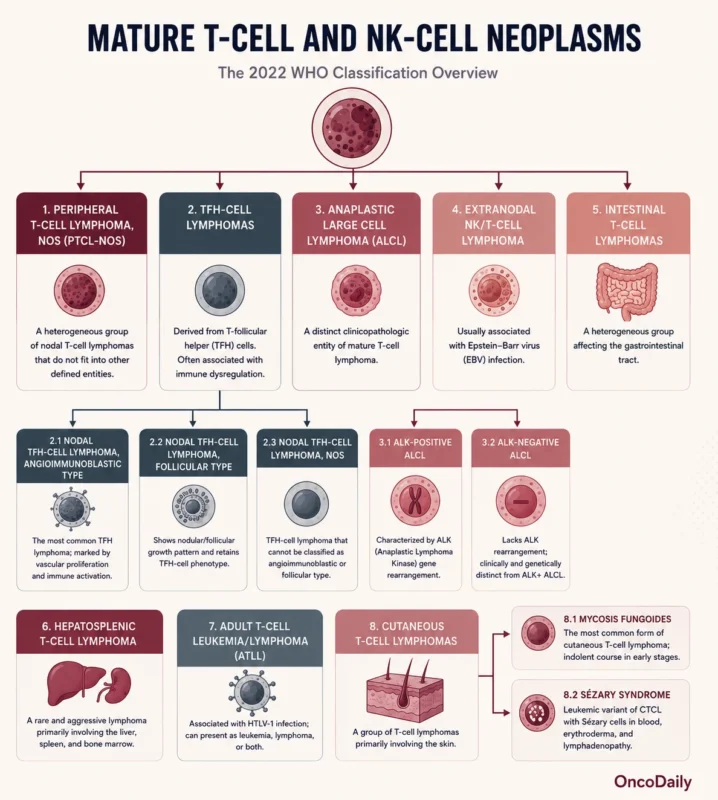
The term “peripheral T-cell lymphoma (PTCL)” is commonly used in clinical practice to describe all mature T-cell and NK-cell neoplasms. In Europe and North America, PTCL not otherwise specified (PTCL NOS), nodal T-follicular helper lymphoma, angioimmunoblastic type (nTFHL-AI), and anaplastic large cell lymphoma (ALCL) either anaplastic lymphoma kinase positive or negative are the most prevalent, making up for about 76-86% of diagnoses.
The remaining cases are distributed across a range of uncommon entities, from aggressive hepatosplenic and intestinal T-cell lymphomas to extranodal NK/T-cell and cutaneous T-cell lymphomas.
A Brief Look at PTCL Lymphomagenesis
While environmental factors such as human T-cell lymphotropic virus type 1 (HTLV-1), Epstein-Barr virus (EBV), and celiac disease are recognized causes of specific T-cell lymphoma subtypes, most peripheral T-cell lymphomas arise from genomic alterations that disrupt normal T-cell development and function.
In brief, T-cell precursors originate from hematopoietic stem cells and migrate to the thymus, where they undergo maturation and T-cell receptor rearrangement. Key transcription factors then direct differentiation into CD4+ or CD8+ T-cell lineages. Following recognition of peptide–major histocompatibility complex antigens, T cells undergo activation, clonal expansion, and differentiation into effector and memory cells, processes further supported by signaling pathways such as PI3K-AKT and JAK-STAT.
To maintain immune homeostasis and prevent autoimmunity, inhibitory mechanisms including immune checkpoints and death receptor–ligand interactions normally restrain T-cell activity. Genetic and epigenetic alterations affecting these pathways can disrupt immune regulation and contribute to PTCL development.
Importantly, many PTCLs mirror normal stages of T-cell differentiation and activation, reflecting either their cell of origin, specific differentiation state and express diverse sets of transcription factors, cytokines, and surface markers. T-cell biology is highly plastic and strongly influenced by the tumor microenvironment, making lineage relationships less rigid than those observed in many B-cell lymphomas.
The Tumor Microenvironment: Not Just a Bystander
PTCL growth and survival depend on continuous interactions with the tumor microenvironment, including immune cells, stromal cells, blood vessels, and the extracellular matrix. A key mechanism of immune escape is the PD-1/PD-L1 pathway and is particularly prominent in EBV-associated lymphomas such as ENKTL.
Tumor-associated macrophages are another important component. In GATA3-driven PTCL-NOS, lymphoma cells promote the expansion of M2-polarized macrophages, which support angiogenesis, suppress anti-tumor immunity, and reinforce PD-L1-mediated immune escape. High numbers of CD163-positive macrophages consistently correlate with inferior survival.
Intriguingly, TET2-mutated GCB cells were discovered in the microenvironment, which undergo independent clonal evolution and support the growth of TFH-like tumor cells via the CD40-CD40LG axis in age-related clonal hematopoiesis TFH lymphoma, angioimmunoblastic type.
The microenvironment also contains abundant non-malignant T cells, including regulatory T cells. Their role appears to be context-dependent: while they can suppress anti-tumor immune responses, they may also limit tumor-promoting inflammation. As a result, the prognostic impact of Tregs varies across PTCL subtypes.
Pathogenic Role of EBV
Despite its potent transforming capacity, EBV rarely causes malignancy. More than 95% of adults harbor lifelong EBV infection, yet only a minority develop EBV-associated tumors. Current models suggest that effective immune surveillance normally restrains viral replication and prevents the expansion of infected cells.
Evidence from other EBV-associated malignancies supports this concept. EBV-positive diffuse large B-cell lymphoma displays a genetic landscape distinct from its EBV-negative counterpart, while EBV-positive gastric cancer is characterized by extensive DNA methylation. In PTCL, recurrent TET2 and DNMT3A mutations and widespread epigenetic dysregulation may represent part of this permissive background.
Dissecting Clinical Heterogeneity of PTCLs
Unlike many B-cell lymphomas, which can often be traced to relatively defined stages of B-cell development, peripheral T-cell lymphomas arise from multiple T-cell populations with distinct functions. Some originate from cells that normally coordinate immune responses, others from activated cytotoxic cells, and some represent biologically diverse groups that defy simple classification.
When Immune Helpers Become Malignant: T-Follicular Helper-Cell Lymphomas
T-follicular helper cells normally reside within lymphoid follicles, where they help B cells mature, select high-affinity antibodies, and generate long-term immune memory. In many ways, they act as conductors of the adaptive immune response.
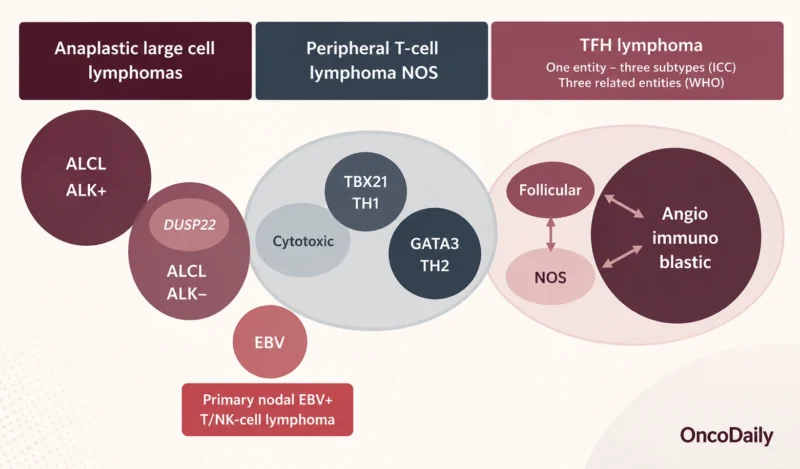
In TFH-cell lymphomas these conductors themselves become malignant. They frequently reshape the entire lymph node environment. Blood vessels expand, follicular dendritic cells proliferate, and large numbers of non-malignant immune cells are recruited into the tumor ecosystem.
This dependence on the microenvironment is one of the defining features of TFH-derived lymphomas. The lymphoma survives by exploiting the same cellular interactions that normally support immune responses.
Recent studies suggest that some TFH lymphomas may begin long before a lymphoma becomes clinically apparent. Early genetic alterations can arise in hematopoietic stem cells and persist for years, providing fertile ground for the later development of lymphoma. This has made TFH lymphomas one of the most compelling examples of the link between clonal hematopoiesis and lymphoid malignancy.
Angioimmunoblastic T-Cell Lymphoma
Angioimmunoblastic T-cell lymphoma (AITL), is the most common TFH-derived lymphoma, usually affecting older adults and presenting as a systemic disease with generalized lymphadenopathy, constitutional symptoms, and frequent involvement of the skin, liver, spleen, or tonsils. Immune abnormalities are common and often represent a prominent part of the clinical picture. Median survival remains under three years, although a subset of patients experience long-term disease control.
What makes AITL distinctive is that the lymph node is usually populated by a complex mixture of reactive immune cells. In many cases, the neoplastic TFH cells are outnumbered by the non-malignant cells they recruit and influence. One of the hallmarks of AITL is its close relationship with B cells. Large activated B-cell immunoblasts are commonly present and are frequently infected with Epstein-Barr virus. Some patients develop prominent plasma-cell proliferations, while others may later develop secondary B-cell lymphomas. Gene-expression studies have shown that cases enriched in B-cell signatures tend to have more favorable outcomes.
Anaplastic Large Cell Lymphoma
While CD30 expression is not unique to ALCL, the intensity and uniformity of expression in ALCL are sufficiently characteristic that CD30 has become both a defining diagnostic marker and a therapeutic target.
The disease exists in two major systemic forms: ALK-positive and ALK-negative. Although they appear similar under the microscope, their biology and clinical behavior differ substantially. ALK-positive disease often affects younger patients and generally has a more favorable prognosis, while ALK-negative disease is more common in adults and encompasses several biologically distinct subsets.
Breast Implant-Associated Anaplastic Large Cell Lymphoma
Breast implant-associated anaplastic large cell lymphoma is a rare T-cell lymphoma that develops in association with textured breast implants, typically many years after implantation. Despite its malignant nature, the disease generally carries an excellent prognosis when recognized and treated appropriately.
Most cases present as a fluid collection surrounding the implant rather than as a solid tumor. Diagnosis is therefore often established from cytologic examination of peri-implant effusions. In surgical specimens, lymphoma cells are usually found lining the inner surface of the fibrous capsule surrounding the implant. Less commonly, they infiltrate the capsule or form a localized mass. Regional lymph node involvement can occur but is often limited in extent.
Although BIA-ALCL closely resembles systemic ALK-negative anaplastic large cell lymphoma under the microscope and shares many immunophenotypic features, it develops in a highly distinctive setting. Chronic inflammation within the implant capsule appears to play a central role, with bacterial biofilms, persistent immune stimulation, and local hypoxia all proposed as contributing factors.
The EBV Connection: Extranodal NK/T-Cell Lymphoma
This aggressive malignancy is closely associated with Epstein-Barr virus and typically arises in extranodal tissues, particularly the nasal cavity and upper aerodigestive tract, rather than in lymph nodes.
The biology of this lymphoma reflects both viral and immune influences. Viral infection contributes to malignant transformation, while the tumor simultaneously exploits inflammatory pathways and immune signaling networks to support its growth. The result is a highly aggressive disease characterized by tissue destruction, immune dysregulation, and a distinctive geographic distribution across Asia and Latin America.
PTCL-NOS: The Most Heterogeneous Subtype
As a diagnosis of exclusion, PTCL-NOS can have heterogeneity in its morphologic features and clinical presentation, making it more challenging to diagnose, risk-stratify, and manage. It accounts for approximately 25% of cases, with 5-year overall survival rates of ~20-30%.
PTCL-NOS primarily affects adults and typically presents with advanced-stage disease involving lymph nodes, often accompanied by extranodal involvement, particularly of the skin. Constitutional symptoms are common, and most patients have an intermediate- or high-risk disease profile at diagnosis.
Recent studies have identified two major molecular subtypes of PTCL-NOS. PTCL-TBX21 is linked to a T helper 1-like/cytotoxic phenotype, frequent TET2 and DNMT3A mutations, and more favorable outcomes. PTCL-GATA3 shows greater genomic complexity, including TP53 and CDKN2A deletions and PI3K pathway activation, and is associated with inferior survival. An immunohistochemistry-based algorithm can reliably distinguish these subtypes, supporting risk stratification in both clinical practice and clinical trials.
MicroRNAs: Small Molecules, Large Effects
Another layer of regulation comes from microRNAs, short RNA molecules that fine-tune gene expression after transcription. Different PTCL subtypes display distinct microRNA expression patterns. In cutaneous T-cell lymphomas, including mycosis fungoides and Sézary syndrome, several microRNAs are associated with disease progression, resistance to apoptosis, and poorer outcomes. In extranodal NK/T-cell lymphoma, specific microRNAs have been linked to prognosis, treatment response, and chemotherapy resistance.
Beyond this, microRNAs are attracting attention as potential biomarkers. Their expression patterns may help refine diagnosis, predict prognosis, identify treatment resistance, and monitor disease evolution. Emerging data also suggest that circulating and exosomal microRNAs could provide minimally invasive tools for disease assessment in the future.
Diagnostic Pitfalls and Initial Assessment
Cases containing scattered large B cells or Hodgkin/Reed-Sternberg-like cells may closely mimic classical Hodgkin lymphoma or T-cell/histiocyte-rich large B-cell lymphoma. Careful assessment of B-cell markers and ancillary immunostains is therefore essential. Additional markers, including STAT6 and PD-L1, can further help distinguish classical Hodgkin lymphoma from PTCL-NOS.
Several reactive conditions may also resemble PTCL. These include viral infections, particularly infectious mononucleosis, drug-related lymphoid reactions, and autoimmune lymphoproliferative syndrome. Accurate diagnosis requires integration of morphology, immunophenotype, molecular findings, and clinical context.
FDG-PET/CT is the preferred imaging modality for staging and response assessment. Most patients have FDG-avid disease at diagnosis, and PET/CT often detects extranodal sites missed by conventional CT. End-of-treatment PET/CT also carries prognostic value, as patients achieving a negative scan experience longer progression-free survival.
Baseline evaluation should include a complete blood count with differential, a comprehensive metabolic panel, lactate dehydrogenase measurement, bone marrow biopsy, and calculation of the International Prognostic Index.
First-Line Treatment of PTCL: CHOP or CHOEP?
For decades, CHOP has remained the backbone of first-line treatment for PTCL. Attempts to improve outcomes have largely produced disappointing results.
The addition of etoposide to CHOP (CHOEP) is often considered for younger, fit patients. The strongest evidence for benefit appears to be in ALK-positive ALCL, where several studies showed superior 5-year progression-free and overall survival with CHOEP compared with CHOP. Outside this subgroup, the role of etoposide remains unclear.
ECHELON-2: The First Positive Phase III Trial
The most important advance in frontline PTCL therapy came from the ECHELON-2 trial, which compared CHOP with brentuximab vedotin plus CHP (BV-CHP). BV-CHP demonstrated clear clinical benefit:
- Overall response rate: 82% vs. 72%
- Complete response rate: 68% vs. 56%
- Significant improvements in progression-free and overall survival
Why Did It Succeed?
A major reason was patient selection: more than 70% of enrolled patients had anaplastic large cell lymphoma, a CD30-positive lymphoma particularly sensitive to brentuximab vedotin (BV). The treatment design also mattered. Vincristine was omitted and replaced with BV, allowing full-dose delivery of the antibody-drug conjugate without compromising dose intensity.
The greatest benefit was observed in ALK-positive ALCL, followed by ALK-negative ALCL, while outcomes in PTCL-NOS and angioimmunoblastic T-cell lymphoma improved less markedly. As a result, BV-CHP became the preferred frontline regimen for eligible patients with CD30-positive ALCL.
CHEPA in CD30-Positive PTCL: Primary Results of a Phase 2 Trial With Integrated ctDNA Analysis
The Role of Autologous Stem Cell Transplantation
The role of upfront auto‐HSCT in PTCL remains controversial, as selection bias cannot be eliminated. For younger, fit patients with PTCL-NOS, ALK-negative ALCL, and nodal TFH lymphomas who achieve complete remission after induction therapy, many guidelines continue to recommend consolidation with autologous stem cell transplantation.
This practice is supported by several prospective and retrospective studies, although definitive randomized evidence remains lacking. A recent meta-analysis reviewed data from 2,959 patients, but results across studies were mixed.
The ongoing TRANSCRIPT trial is the first randomized study designed to answer this question, comparing ASCT with observation in patients aged 18-69 years who achieve first complete remission.
Autologous vs Allogeneic Transplantation
A randomized study comparing ASCT (n=41) with allogeneic transplantation (alloSCT, n=26) found no significant difference in overall survival, but the pattern of outcomes differed markedly, supporting a strong graft-versus-lymphoma effect:
- Non-relapse mortality: 3% with ASCT vs. 31% with alloSCT
- Relapse/progression: 55% vs. 8%
Consequently, alloSCT is generally reserved for relapsed or refractory disease rather than frontline consolidation.
Emerging Biomarker-Driven Frontline Strategies
The phase II GUIDANCE-03 trial evaluated mutation-directed therapy combined with CHOP (CHOPX) in newly diagnosed PTCL. Targeted agents included decitabine for TP53 mutations, azacitidine for TET2 or KMT2D mutations, tucidinostat for CREBBP or EP300 mutations, and lenalidomide when none of these alterations were present. CHOPX achieved a significantly higher complete response rate than CHOP alone (64.6% vs. 33.3%) and prolonged median PFS (25.5 vs. 9.0 months). Overall survival also favored CHOPX, although the difference was not statistically significant.
Early studies combining belinostat or pralatrexate with CHOP yielded promising results, in previously untreated PTCL. These favorable results provided the rationale for the ongoing phase III CRESCENDO trial, which is comparing CHOP, Bel-CHOP, and Fol-CHOP.
Another approach has focused on epigenetic priming. In a multicenter phase II study, oral azacitidine plus CHOP achieved a complete response rate of 75% and encouraging 2-year progression-free and overall survival. Responses were particularly strong in TFH lymphomas, where CR rates approached 90%. Importantly, TET2 mutations were associated with higher response rates and improved survival.
The ongoing randomized phase II Alliance A051902 trial is comparing CHO(E)P alone with CHO(E)P plus oral azacitidine or CHO(E)P plus duvelisib in previously untreated CD30-negative PTCL. By focusing on the CD30-negative population that was largely underrepresented in ECHELON-2, Alliance A051902 is currently one of the most important frontline studies for PTCL-NOS.
Relapsed and Refractory PTCL: Bridging to Transplant and Beyond
Approximately 70% of patients with PTCL develop relapsed or refractory disease after first-line therapy. Consolidative alloSCT offers the highest curative potential in R/R PTCL, but remains a viable option for only a minority of patients. New strategies should be developed to lead more patients to SCT.
For fit patients, salvage chemotherapy remains the standard bridge to transplant. Regimens such as DHAP and GDP can achieve sufficient disease control to allow selected patients to proceed to SCT, where outcomes are substantially better. For patients who are not transplant candidates, bendamustine and gemcitabine remain reasonable palliative options.
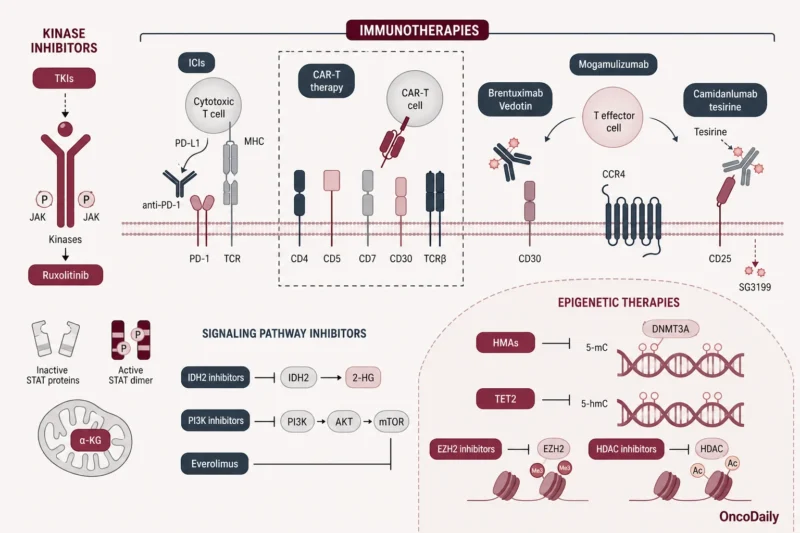
Brentuximab vedotin is an important treatment option, particularly in ALCL, where responses can be deep and durable. Some patients have achieved long-term remissions without additional therapy, Activity in PTCL-NOS and TFH lymphomas appears more modest.
Other Targeted Approaches
The dual EZH1/2 inhibitor valemetostat represents a newer epigenetic approach in relapsed disease. HDAC inhibitors romidepsin, belinostat, and chidamide, have demonstrated better response rates in TFH lymphomas, as have JAK inhibitors. The selective JAK1 inhibitor golidocitinib appears to be one of the more promising agents in this class, according to phase II JACKPOT8 study.
ALK inhibitors, including crizotinib and alectinib remain important subtype-specific therapies in relapsed ALK-positive ALCL. Among PI3K inhibitors, duvelisib has shown activity particularly in PTCL-NOS and TFH lymphomas, leading to further evaluation in the ongoing phase III TERZO trial.
Cellular Therapies: Still Investigational
Cellular therapies remain investigational in PTCL. Development has been slower than in B-cell lymphomas because malignant and normal T cells often share the same target antigens. Early studies of CAR T-cell therapies directed against TCRβ, CD5, CD7, and CD70 have reported response rates ranging from approximately 40-80% in small cohorts.
A particularly interesting approach combines cord blood-derived allogeneic NK cells with AFM13, a CD30/CD16A bispecific antibody that redirects NK cells against CD30-positive lymphoma cells. In a phase I study of heavily pretreated patients with CD30-positive lymphomas, this strategy achieved an ORR of 93% and a CRR of 67%, without cytokine release syndrome, neurotoxicity, or graft-versus-host disease. In total, 11 patients remained in CR at 14-40 months whereby six underwent consolidation and five did not.
Pinpointing the Moment of Transformation
Some of the most frequently mutated genes, detected by large-scale genomics, transcriptomics, and NGS, raise more questions than answers. TET2, a hallmark of several hematologic malignancies, is also commonly detected in healthy individuals with little risk of transformation. Likewise, loss of TET2 alone is insufficient to induce PTCL in murine models, whereas cooperating mutations such as RHOA or IDH2 can accelerate lymphomagenesis.
The challenge is therefore not simply identifying mutations, but determining which events initiate transformation, which sustain it, and which are merely passengers. Resolving this hierarchy may be as important as discovering new mutations themselves, particularly for the development of biologically rational targeted therapies.
Because the malignant cells are themselves T cells, surrounding immune populations can actively support transformation and survival. For example, EBV-positive B cells may drive T-cell transformation through chronic antigen stimulation, while TET2-deficient B cells support TET2-mutated TFH lymphoma, angioimmunoblastic type. Single-cell sequencing has become a powerful tool in “targeting” T-cell-microenvironment interactions and enabling precise distinction between malignant and normal T cells.
Most current biomarkers rely on a single data modality. Artificial intelligence offers an opportunity to integrate clinical, radiologic, histologic, genomic, and laboratory data, uncovering novel associations and more robust biomarkers. By linking features across modalities, AI may enable earlier diagnosis, improved risk stratification, more precise treatment selection, and better monitoring of treatment resistance and toxicity.
(Bisig B., et al., 2023, Luan Y., et al., 2024, Qiu Y., et al., 2024, Pichler A.S., et al., 2024, Lam H.P.J., et al., 2025, Meeuwes F.O., et al., 2025, Yoon S.E., et al., 2025, Kessler S.A., et al., 2026)

You can also read about the most common type of CTCL.
Written by Susanna Mikayelyan, MD
FAQ
Is peripheral T-cell lymphoma hereditary?
Most PTCLs are not inherited and do not run in families. Instead, they arise from acquired genetic and epigenetic alterations that accumulate over time. While inherited predisposition syndromes can increase lymphoma risk in rare cases, the vast majority of PTCL patients have no family history of the disease.
Why are T-cell lymphomas generally harder to treat than many B-cell lymphomas?
Several factors contribute to this challenge. PTCLs are biologically diverse, often diagnosed at advanced stages, and lack the abundance of highly effective targeted therapies available for B-cell lymphomas. In addition, malignant T cells can closely resemble normal immune cells, making therapeutic targeting more difficult.
Can chronic inflammation increase the risk of developing PTCL?
In some settings, yes. Chronic immune stimulation appears to contribute to certain PTCL subtypes. Examples include celiac disease-associated intestinal T-cell lymphoma, breast implant-associated ALCL, and Epstein-Barr virus-driven NK/T-cell lymphoma, where prolonged inflammatory or antigenic stimulation may promote malignant transformation.
Why is Epstein-Barr virus linked to only a small number of cancers despite infecting most adults?
More than 95% of adults carry EBV, yet very few develop cancer. In most individuals, immune surveillance keeps infected cells under tight control. Malignancy usually develops only when viral infection coincides with additional genetic, epigenetic, or immune-related abnormalities.
What makes angioimmunoblastic T-cell lymphoma so different from other lymphomas?
AITL behaves almost like a disease of the immune system itself. The malignant cells actively recruit and influence surrounding immune cells, blood vessels, and stromal elements. In some cases, the non-malignant cells within the lymph node outnumber the lymphoma cells, creating a uniquely complex tumor ecosystem.
Why are biomarkers in PTCL still limited?
Many currently available biomarkers capture only one aspect of a highly complex disease. PTCL biology is influenced by genetics, epigenetics, immune interactions, and microenvironmental factors. As a result, no single marker reliably predicts diagnosis, prognosis, and treatment response across all PTCL subtypes.
Why has CAR T-cell therapy progressed more slowly in PTCL than in B-cell lymphomas?
The main challenge is that malignant and normal T cells often share the same surface targets. Eliminating these targets can damage healthy T cells and impair immune function. Researchers are developing novel approaches to overcome this problem, including engineered CAR T cells and NK-cell-based therapies.