The ESMO Congress 2026 in Madrid, Spain, featured three Presidential Symposia presenting results from major clinical trials across multiple cancer types, including melanoma, lung, gastrointestinal, genitourinary, gynecologic cancers, and sarcoma. The sessions highlighted findings from phase III trials evaluating targeted therapies, immunotherapies, antibody–drug conjugates (ADCs), individualized cancer vaccines, and treatment optimization strategies.
Presidential Symposium I
Presidential Symposium I took place on October 24, 2026 and was chaired by Fabrice André (Villejuif, France) and James Larkin (London, United Kingdom). The session presented phase III findings on individualized mRNA neoantigen therapy in melanoma, perioperative treatment strategies in bladder cancer, maintenance therapy in small-cell lung cancer, and treatment intensification in very high-risk prostate cancer.
INTerpath-001 (LBA1): Intismeran Plus Pembrolizumab in High-Risk Melanoma
Georgina V. Long presented the results of the phase III INTerpath-001 trial (NCT05933577), which evaluated intismeran, an individualized mRNA-based neoantigen therapy, combined with pembrolizumab versus placebo plus pembrolizumab in 1,137 patients with resected stage IIB–IV cutaneous melanoma.
Key findings
- Recurrence-free survival (RFS): Estimated 24-month RFS was 82.2% with intismeran plus pembrolizumab versus 70.0% with placebo plus pembrolizumab (HR 0.58; 95% CI 0.45–0.75; p<0.001).
- Distant metastasis-free survival (DMFS): Estimated 24-month DMFS was 88.5% versus 80.2% (HR 0.62; 95% CI 0.45–0.85; p=0.002).
- Safety: Grade ≥3 adverse events occurred in 23.6% versus 20.3% of patients. Pyrexia (52.2% vs 8.2%) and injection-site pain (51.0% vs 9.5%) were more frequent with the combination.
Takeaway
INTerpath-001 demonstrated statistically significant improvements in RFS and DMFS with individualized mRNA neoantigen therapy added to adjuvant pembrolizumab. Overall survival results were not reported, and longer follow-up is needed to evaluate long-term outcomes.
VOLGA (LBA2): Perioperative Durvalumab Plus Enfortumab Vedotin in Muscle-Invasive Bladder Cancer
Thomas B. Powles (London, United Kingdom) presented the results of the phase III VOLGA trial (NCT04960709), which evaluated perioperative durvalumab with or without tremelimumab, combined with neoadjuvant enfortumab vedotin, versus radical cystectomy followed by observation or locally approved adjuvant treatment. The study enrolled 695 patients with muscle-invasive bladder cancer (MIBC) who were ineligible for or refused cisplatin-based treatment.
Key findings
- Event-free survival (EFS): Both experimental arms significantly improved EFS compared with control. The HR was 0.51 (95% CI 0.38–0.67; p<0.0001) for durvalumab plus enfortumab vedotin (D+EV) and 0.61 (95% CI 0.47–0.80; p=0.0004) for durvalumab, tremelimumab, and enfortumab vedotin (D+T+EV).
- Overall survival (OS): D+EV significantly improved OS (HR 0.58; 95% CI 0.40–0.83; p=0.0027), with estimated 24-month OS rates of 78% versus 69%. The OS comparison for D+T+EV did not reach statistical significance.
- Pathological complete response (pCR): Rates were 45% with D+EV versus 10% with control.
- Safety: Grade 3–4 adverse events assessed as possibly treatment-related occurred in 30% of patients receiving D+EV and 42% receiving D+T+EV.
Takeaway
VOLGA met both primary EFS endpoints, while a statistically significant OS benefit was demonstrated for D+EV versus control. The tremelimumab-containing regimen also improved EFS, but its OS comparison with control did not meet statistical significance at this interim analysis.
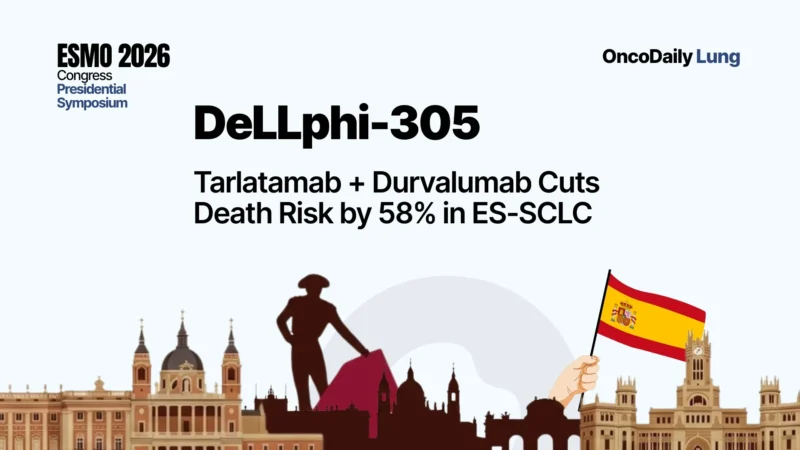
DeLLphi-305 (LBA3): Tarlatamab Plus Durvalumab Maintenance in Extensive-Stage SCLC
Jacob Sands (Boston, USA) presented the results of the phase III DeLLphi-305 trial (NCT06211036), which evaluated tarlatamab, a DLL3-targeted bispecific T-cell engager, combined with durvalumab versus durvalumab alone as first-line maintenance therapy in 563 patients with extensive-stage small-cell lung cancer (ES-SCLC) who had not progressed after initial platinum–etoposide chemotherapy plus durvalumab.
Key findings
- Overall survival: Median OS was 21.1 months with tarlatamab plus durvalumab versus 12.7 months with durvalumab alone (HR 0.42; 95% CI 0.32–0.54; p<0.001).
- Progression-free survival: Median PFS was 7.4 versus 1.9 months (HR 0.34; 95% CI 0.28–0.42; p<0.001).
- Objective response rate (ORR): Among patients with measurable disease at maintenance randomization, confirmed ORR was 26.4% versus 4.1%.
- Safety: Cytokine release syndrome occurred in 49.6% versus 1.4% of patients, predominantly at grades 1–2. Grade ≥3 adverse events occurred in 46.8% versus 40.6%.
Takeaway
DeLLphi-305 demonstrated statistically significant improvements in OS and PFS with tarlatamab plus durvalumab maintenance compared with durvalumab alone. These survival outcomes were measured from maintenance randomization in patients without progression after initial chemoimmunotherapy, rather than from the beginning of first-line treatment.
DASL-HiCaP (LBA4): Darolutamide Plus ADT and Radiotherapy in Very High-Risk Prostate Cancer
Tamim Niazi (Montreal, Canada) presented the results of the phase III DASL-HiCaP trial (ANZUP1801; NCT04136353), which evaluated darolutamide added to androgen deprivation therapy (ADT) and definitive or salvage locoregional radiotherapy in 1,106 patients with very high-risk localized or biochemically persistent or recurrent prostate cancer.
Key findings
- Metastasis-free survival (MFS): Estimated four-year MFS based on conventional imaging was 95% with darolutamide versus 88% with placebo (HR 0.42; 95% CI 0.27–0.66; p=0.0001).
- PSA progression-free survival: Estimated four-year PSA-PFS rates were 91% versus 83% (HR 0.47; 95% CI 0.33–0.67).
- Overall survival: Estimated four-year OS rates were 97% versus 95% (HR 0.88; 95% CI 0.49–1.59), without a statistically significant difference.
- Safety: Grade ≥3 adverse events occurred in 43% versus 36% of patients.
Takeaway
Adding darolutamide to ADT and locoregional radiotherapy significantly improved metastasis-free survival in patients with very high-risk prostate cancer. However, an overall survival benefit has not been established at this interim analysis.
Presidential Symposium II
Presidential Symposium II took place on October 25, 2026, and was chaired by Giuseppe Curigliano (Milan, Italy) and Yelena Y. Janjigian (New York, United States of America). The session presented phase III findings on immunotherapy combinations in biliary tract cancer, CLDN18.2-targeted antibody–drug conjugates in gastroesophageal cancer, and biomarker-directed treatment strategies targeting EGFR, MET, and KRAS G12C alterations in non-small cell lung cancer.
Krascendo 1 (LBA5): Divarasib Versus Sotorasib or Adagrasib in KRAS G12C-Mutated NSCLC
Ferdinandos Skoulidis presented the results of the phase III Krascendo 1 trial (NCT06497556), which evaluated divarasib versus investigator’s choice of sotorasib or adagrasib in 338 patients with previously treated advanced or metastatic KRAS G12C-mutated NSCLC.
Key findings
- Progression-free survival: Median PFS was 9.8 months with divarasib versus 5.7 months with sotorasib or adagrasib (HR 0.58; 95% CI 0.44–0.76; p<0.0001).
- Overall survival: Median OS was 17.7 versus 12.0 months (HR 0.56; 95% CI 0.41–0.78; p=0.0005).
- Objective response rate: Among response-evaluable patients, confirmed ORR was 58.4% versus 32.3%, with median duration of response of 11.9 versus 6.9 months.
- Safety: Grade 3–4 treatment-related adverse events occurred in 24.6% versus 34.5% of patients.
Takeaway
Krascendo 1 demonstrated statistically significant improvements in both PFS and OS with divarasib compared with established KRAS G12C inhibitors. However, most patients in the comparator arm received sotorasib, limiting conclusions about the relative efficacy of divarasib versus adagrasib individually.
SAFFRON (LBA6): Osimertinib Plus Savolitinib in EGFR-Mutated NSCLC
Shun Lu presented the results of the phase III SAFFRON trial (NCT05261399), which evaluated osimertinib plus savolitinib versus platinum–pemetrexed chemotherapy in 338 patients with EGFR-mutated, MET-overexpressed and/or MET-amplified advanced non-small cell lung cancer (NSCLC) following progression on osimertinib.
Key findings
- Progression-free survival: Median PFS was 7.6 months with osimertinib plus savolitinib versus 5.4 months with chemotherapy (HR 0.55; 95% CI 0.42–0.72; p<0.001).
- Overall survival: Median OS was 17.8 versus 12.9 months (HR 0.68; 95% CI 0.50–0.91; p=0.010).
- Objective response rate: ORR was 51% versus 27%, with median duration of response of 9.7 versus 5.7 months.
- Safety: Grade ≥3 treatment-related adverse events occurred in 40% versus 52% of patients, although serious treatment-emergent adverse events were more frequent with the combination (41% vs 28%).
Takeaway
SAFFRON demonstrated statistically significant improvements in PFS and OS with dual EGFR/MET inhibition following osimertinib progression in biomarker-selected NSCLC. However, the trial compared this combination with platinum–pemetrexed chemotherapy and did not establish superiority over other contemporary post-osimertinib treatment options.
CLARITY-Gastric 01 (LBA7): Sonesitatug Vedotin in CLDN18.2-Positive Gastroesophageal Cancer
Rui-Hua Xu (Guangzhou, China) presented the results of the phase III CLARITY-Gastric 01 trial (NCT06346392), which evaluated sonesitatug vedotin, a CLDN18.2-targeted ADC, versus investigator’s choice of treatment in patients with previously treated, unresectable locally advanced or metastatic CLDN18.2-positive gastroesophageal carcinoma.
Key findings
- Overall survival in third-line or later treatment: Median OS was 10.0 months with sonesitatug vedotin versus 5.0 months with investigator’s choice (HR 0.47; 95% CI 0.36–0.62; p<0.000001).
- Overall survival in the intention-to-treat population: Median OS was 10.6 versus 6.4 months (HR 0.58; 95% CI 0.47–0.73; p=0.000004).
- Progression-free survival: Median PFS assessed by blinded independent central review was 4.2 versus 3.8 months (HR 0.77; 95% CI 0.62–0.96; p=0.053193), not meeting the prespecified statistical significance threshold.
- Safety: Grade ≥3 treatment-related adverse events occurred in 36.4% versus 44.8% of patients.
Takeaway
CLARITY-Gastric 01 demonstrated a statistically significant OS benefit with sonesitatug vedotin in previously treated CLDN18.2-positive gastroesophageal cancer. However, BICR-assessed PFS in the intention-to-treat population, one of the trial’s two primary endpoints, did not meet the prespecified statistical significance threshold.
HARMONi-GI1 (LBA8): Ivonescimab Plus Chemotherapy in Advanced Biliary Tract Cancer
Jian Zhou (Shanghai, China) presented the results of the phase III HARMONi-GI1 trial (NCT06591520), which evaluated ivonescimab, a bispecific antibody targeting PD-1 and VEGF, plus gemcitabine and cisplatin versus durvalumab plus gemcitabine and cisplatin as first-line treatment in 682 patients with unresectable locally advanced or metastatic biliary tract cancer (BTC).
Key findings
- Overall survival (OS): Median OS was 14.9 months with ivonescimab plus chemotherapy versus 12.1 months with durvalumab plus chemotherapy (HR 0.75; 95% CI 0.61–0.92; p=0.0031).
- Progression-free survival (PFS): Median PFS was 8.4 versus 5.8 months (HR 0.61; 95% CI 0.51–0.72; p<0.0001).
- Objective response rate (ORR): ORR was 53.8% versus 32.5%, respectively (p<0.0001).
- Safety: Grade 3–4 treatment-emergent adverse events occurred in 82.0% versus 72.3% of patients. Serious treatment-emergent adverse events occurred in 43.4% versus 43.7%, while grade ≥3 immune-related adverse events occurred in 4.1% of patients in both groups.
Takeaway
HARMONi-GI1 met its primary OS endpoint and demonstrated statistically significant improvements in PFS and ORR with ivonescimab plus chemotherapy compared with durvalumab plus chemotherapy. Grade 3–4 treatment-emergent adverse events were more frequent with ivonescimab, while serious treatment-emergent adverse-event rates were similar. These findings support further consideration of ivonescimab plus chemotherapy as a potential first-line treatment option for advanced BTC.
Presidential Symposium III
Presidential Symposium III took place on October 26, 2026, and was chaired by Elizabeth Smyth (Oxford, United Kingdom) and Andres Cervantes (Valencia, Spain). The session presented phase III findings in osteosarcoma, endometrial cancer, and immunotherapy treatment optimization, including studies evaluating B7-H3- and TROP2-targeted ADCs, pembrolizumab monotherapy, and reduced-frequency immune checkpoint inhibitor administration.
ARTEMIS-011 (LBA9): Risvutatug Rezetecan in Relapsed or Refractory Osteosarcoma
Lu Xie (Beijing, China) presented the results of the phase III ARTEMIS-011 trial (NCT06935409), which evaluated risvutatug rezetecan, a B7-H3-targeted ADC, versus gemcitabine plus docetaxel in 122 patients aged 12 years or older with relapsed or refractory osteosarcoma following at least two prior lines of systemic therapy.
Key findings
- Progression-free survival: Median PFS was 5.5 months with risvutatug rezetecan versus 1.4 months with chemotherapy (HR 0.33; p<0.0001).
- Objective response rate: ORR was 15% versus 2%, while disease control rates were 76% versus 33%.
- Overall survival: OS data remained immature (HR 0.51; 95% CI 0.21–1.23).
- Safety: Grade ≥3 treatment-emergent adverse events occurred in 92.5% versus 83.3% of patients, while serious treatment-related adverse events occurred in 63.8% versus 28.6%.
Takeaway
ARTEMIS-011 demonstrated statistically significant improvement in PFS and higher response rates with risvutatug rezetecan in heavily pretreated osteosarcoma. An OS benefit has not been established, and the higher rates of serious treatment-related adverse events warrant careful consideration.
MOIO (LBA10): Reduced-Frequency Immunotherapy in Advanced Solid Tumors
Gwenaëlle Gravis presented the interim results of the phase III MOIO trial (NCT05078047), which investigated whether extending immune checkpoint inhibitor dosing intervals to every 12 weeks was non-inferior to standard schedules in patients with advanced solid tumors who had achieved a complete or partial response after six months of immunotherapy.
Key findings
- Progression-free survival: Median PFS was 25.0 months with standard dosing versus 21.9 months with reduced-frequency treatment (HR 1.35; 95% CI 0.90–2.00). Non-inferiority was not established against the prespecified HR margin of 1.30.
- Overall survival: Reduced-frequency treatment was associated with a higher hazard of death (HR 2.00; 95% CI 1.10–3.90; reported p=0.0143), raising concern about the longer dosing interval.
- Safety: Grade 3–4 immune-related adverse events occurred in 10.5% of patients with standard dosing versus 9.5% with reduced-frequency treatment. Serious adverse events occurred in 26.3% versus 25.0%.
Takeaway
MOIO did not establish PFS non-inferiority for immunotherapy administered every 12 weeks. The observed OS signal raises concern about reduced efficacy, without an apparent reduction in severe immune-related or serious adverse events. These interim findings do not support routine extension to 12-week dosing intervals across advanced solid tumors.
TroFuse-005 (LBA11): Sacituzumab Tirumotecan in Advanced Endometrial Cancer
Domenica Lorusso (Pieve Emanuele, Italy) presented the results of the phase III TroFuse-005/ENGOT-en23/GOG-3095 trial (NCT06132958), which evaluated sacituzumab tirumotecan, a TROP2-targeted ADC, versus physician’s choice of chemotherapy in 776 patients with advanced or recurrent endometrial cancer previously treated with platinum-based chemotherapy and anti-PD-1/PD-L1 therapy.
Key findings
- Overall survival: Median OS was 19.0 months with sacituzumab tirumotecan versus 12.1 months with chemotherapy (HR 0.68; 95% CI 0.55–0.84; p=0.0001).
- Progression-free survival: Median PFS was 7.2 versus 3.9 months (HR 0.59; 95% CI 0.50–0.70; p<0.0001).
- Objective response rate: ORR was 35.1% versus 17.3%, with median duration of response of 11.1 versus 6.9 months.
- Safety: Grade ≥3 treatment-related adverse events occurred in 54.4% versus 41.4% of patients. Anemia, stomatitis, and ocular surface toxicity were notable adverse events.
Takeaway
TroFuse-005 demonstrated statistically significant improvements in OS and PFS with sacituzumab tirumotecan following platinum-based chemotherapy and immunotherapy. However, these efficacy benefits were accompanied by higher rates of severe treatment-related adverse events.
KEYNOTE-C93 (LBA12): Pembrolizumab Monotherapy in dMMR Endometrial Cancer
Brian M. Slomovitz presented the results of the phase III KEYNOTE-C93/GOG-3064/ENGOT-en15 trial (NCT05173987), which evaluated pembrolizumab monotherapy versus carboplatin–paclitaxel chemotherapy in 299 patients with mismatch repair-deficient (dMMR) advanced or recurrent endometrial cancer.
Key findings
- Progression-free survival: Median PFS was 38.2 months with pembrolizumab versus 8.4 months with chemotherapy (HR 0.57; 95% CI 0.42–0.79; one-sided p=0.0002).
- Three-year PFS: Estimated rates were 52.8% versus 30.0%.
- Overall survival: Median OS was not reached in either group (HR 0.77; 95% CI 0.52–1.15; one-sided p=0.1000), without meeting the prespecified interim statistical significance criterion.
- Response and safety: Among patients with measurable disease at baseline, ORR was 64.1% versus 62.1%, with more durable responses in the pembrolizumab arm. Grade ≥3 treatment-related adverse events occurred in 18.1% versus 50.7% of patients.
Takeaway
KEYNOTE-C93 demonstrated significantly longer PFS and more durable responses with pembrolizumab monotherapy compared with chemotherapy alone. However, the PFS curves crossed during early follow-up, an OS benefit has not been established, and the study did not directly compare pembrolizumab monotherapy with contemporary chemotherapy–immunotherapy combinations.
The Bottom Line
The three Presidential Symposia at ESMO Congress 2026 presented phase III evidence across multiple solid tumors, evaluating individualized neoantigen therapies, immune checkpoint inhibitors, bispecific T-cell engagers, targeted therapies, and ADCs. Several trials demonstrated statistically significant improvements in progression-free survival and overall survival, while others investigated treatment optimization strategies, including immunotherapy dosing intervals and chemotherapy-free approaches.
The findings also highlighted the importance of interpreting survival outcomes within each study’s design, distinguishing established endpoint benefits from immature or inconclusive results, and balancing efficacy with treatment-related toxicity. Together, these presentations provide new clinical evidence across several areas of oncology, while ongoing follow-up remains important for determining longer-term survival outcomes and the clinical role of investigational treatments.