
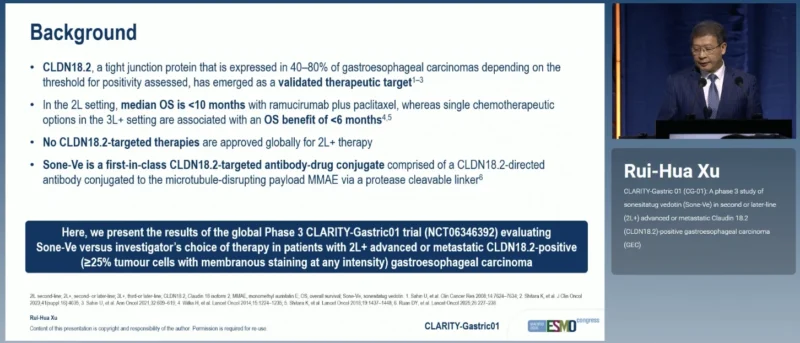
At the ESMO Congress 2026, Rui-Hua Xu (Guangzhou, China) presented results from the Phase III CLARITY-Gastric 01 (CG-01) trial (NCT06346392), evaluating sonesitatug vedotin (Sone-Ve) versus investigator’s choice of therapy in patients with unresectable locally advanced or metastatic CLDN18.2-positive gastroesophageal carcinoma (GEC) who had received at least one prior line of treatment.
The results, presented during Presidential Symposium II as Late-Breaking Abstract LBA7, included overall survival (OS), progression-free survival (PFS), and safety outcomes in patients receiving second-line or later treatment.
Why Was CLARITY-Gastric 01 Conducted?
Claudin 18.2 (CLDN18.2) is a validated therapeutic target in advanced gastroesophageal carcinoma. Sonesitatug vedotin is an antibody-drug conjugate targeting CLDN18.2 and carrying the cytotoxic agent monomethyl auristatin E (MMAE). Previous Phase I/II studies demonstrated clinical activity with Sone-Ve in patients with advanced GEC.
The Phase III CLARITY-Gastric 01 trial was conducted to evaluate the efficacy and safety of Sone-Ve compared with investigator’s choice of treatment in patients with CLDN18.2-positive advanced GEC who had received prior therapy.
CLARITY-Gastric 01 Study Design and Methods
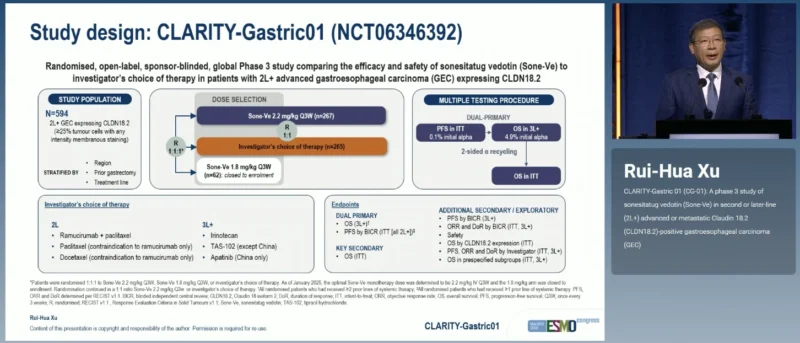
CLARITY-Gastric 01 was a global, randomized, open-label Phase III trial enrolling patients with unresectable locally advanced or metastatic GEC expressing CLDN18.2 in at least 25% of tumour cells, with membranous staining of any intensity.
Eligible patients had received at least one prior line of treatment. Participants were initially randomized in a 1:1:1 ratio to Sone-Ve 1.8 mg/kg, Sone-Ve 2.2 mg/kg, or investigator’s choice of therapy. Following dose selection, patients were randomized 1:1 to Sone-Ve 2.2 mg/kg or investigator’s choice.
Investigator’s choice of therapy included:
- Second-line treatment: Ramucirumab plus paclitaxel, or paclitaxel or docetaxel alone when ramucirumab was contraindicated.
- Third-line or later treatment: Irinotecan, trifluridine/tipiracil (outside China), or apatinib (China only).
Randomization was stratified by geographical region, prior gastrectomy, and line of therapy. The dual primary endpoints were OS in patients receiving third-line or later treatment (3L+) and PFS assessed by blinded independent central review (BICR) in the intention-to-treat population (ITT; 2L+). Overall survival in the ITT population was a key secondary endpoint.
Key Findings from CLARITY-Gastric 01
At the May 31, 2026 data cutoff, 594 patients had been randomized overall. Of these, 532 were randomized to Sone-Ve 2.2 mg/kg (n=267) or investigator’s choice of therapy (n=265). Median follow-up was 8.6 months.
Overall Survival in Third-Line or Later Treatment
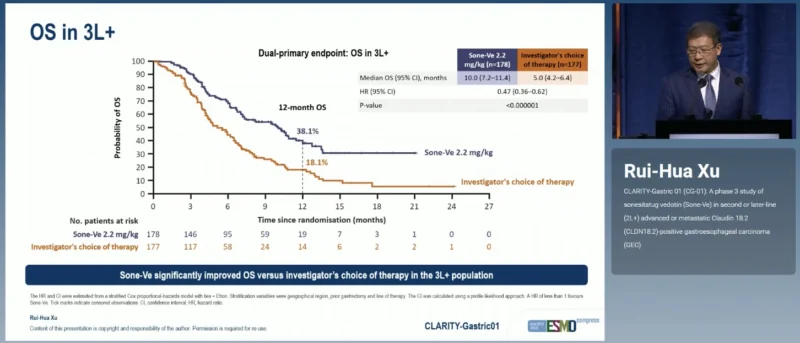
Sonesitatug vedotin demonstrated a statistically significant improvement in overall survival compared with investigator’s choice of therapy in patients receiving third-line or later treatment. Among 355 patients in the 3L+ population, 178 were assigned to Sone-Ve and 177 to investigator’s choice.
Median OS was 10.0 months (95% CI 7.2–11.4) with Sone-Ve compared with 5.0 months (95% CI 4.2–6.4) with investigator’s choice (HR 0.47; 95% CI 0.36–0.62; p<0.000001). At 12 months, the estimated OS rates were 38.1% and 18.1%, respectively.
Overall Survival in the ITT Population
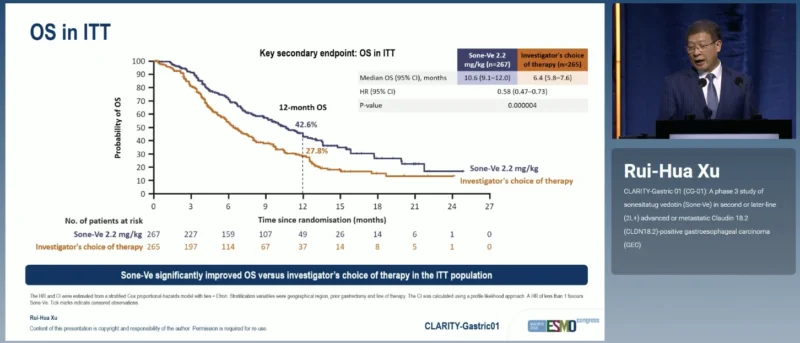
A statistically significant OS improvement was also observed in the ITT population, which included patients receiving second-line or later treatment. Median OS was 10.6 months (95% CI 9.1–12.0) with Sone-Ve versus 6.4 months (95% CI 5.8–7.6) with investigator’s choice (HR 0.58; 95% CI 0.47–0.73; p=0.000004).
The estimated 12-month OS rates were 42.6% with Sone-Ve and 27.8% with investigator’s choice. The OS hazard ratios favoured Sone-Ve across the reported CLDN18.2 expression subgroups:
- CLDN18.2 expression ≥75%: HR 0.59 (95% CI 0.45–0.78).
- CLDN18.2 expression ≥25% to <75%: HR 0.63 (95% CI 0.42–0.94).
These findings showed an OS benefit with Sone-Ve across both reported CLDN18.2 expression categories.
Progression-Free Survival
In the ITT population, median PFS assessed by blinded independent central review (BICR), a dual primary endpoint, was 4.2 months (95% CI 3.5–5.3) with Sone-Ve compared with 3.8 months (95% CI 3.0–4.2) with investigator’s choice (HR 0.77; 95% CI 0.62–0.96; p=0.053193). The comparison did not meet the prespecified threshold for statistical significance.
In the 3L+ population, median BICR-assessed PFS was 4.1 months (95% CI 3.0–5.3) with Sone-Ve compared with 2.7 months (95% CI 2.4–3.0) with investigator’s choice (HR 0.56; 95% CI 0.43–0.74). This secondary analysis was not formally tested. An exploratory investigator-assessed PFS analysis in the ITT population showed median PFS of 4.4 months (95% CI 3.8–5.7) versus 3.0 months (95% CI 2.7–4.1), respectively (HR 0.59; 95% CI 0.48–0.73).
Although these additional analyses showed hazard ratios favouring Sone-Ve, the dual primary endpoint of BICR-assessed PFS in the ITT population did not meet its prespecified statistical significance threshold.
Safety Outcomes
Safety was assessed in 513 patients who received at least one treatment dose, including 261 in the Sone-Ve group and 252 in the investigator’s choice group. Treatment-related adverse events (TRAEs) of any grade occurred in 85.8% of patients receiving Sone-Ve and 81.3% receiving investigator’s choice.
Grade 3 or higher TRAEs occurred in 36.4% versus 44.8%, respectively. Grade 3 or higher gastrointestinal toxicity was reported in 11.1% of patients receiving Sone-Ve compared with 6.3% in the investigator’s choice group. Grade 3 or higher haematological toxicity occurred in 7.7% versus 15.9%, respectively.
Treatment-related adverse events leading to discontinuation occurred in 3.1% of patients receiving Sone-Ve and 4.4% receiving investigator’s choice.
Treatment-related adverse events leading to death were reported in three patients (1.1%) in the Sone-Ve group and two patients (0.8%) in the investigator’s choice group. The investigators described the safety profile of Sone-Ve as manageable.
Conclusions
The Phase III CLARITY-Gastric 01 trial demonstrated a statistically significant overall survival benefit with sonesitatug vedotin compared with investigator’s choice of therapy in patients with previously treated, advanced CLDN18.2-positive gastroesophageal carcinoma.
In the third-line or later population, median OS was 10.0 months with Sone-Ve versus 5.0 months with investigator’s choice (HR 0.47; 95% CI 0.36–0.62; p<0.001).
In the ITT population receiving second-line or later treatment, median OS was 10.6 versus 6.4 months (HR 0.58; 95% CI 0.47–0.73; p<0.001). The OS benefit was consistent across the reported CLDN18.2 expression subgroups. Although PFS numerically favoured Sone-Ve (4.2 vs 3.8 months; HR 0.77; 95% CI 0.62–0.96), the comparison did not meet the prespecified statistical significance threshold.
Grade 3 or higher TRAEs occurred in 36.4% of patients receiving Sone-Ve and 44.8% receiving investigator’s choice, with the investigators reporting a manageable safety profile. The investigators concluded that these findings support sonesitatug vedotin as a potential second-line or later treatment option for a broad population of patients with advanced CLDN18.2-positive gastroesophageal carcinoma.
Source: ESMO Congress 2026 – LBA7, Phase III CLARITY-Gastric 01