The phase III KEYNOTE-C93/GOG-3064/ENGOT-en15 trial demonstrated significantly improved progression-free survival (PFS) with pembrolizumab monotherapy compared with carboplatin–paclitaxel in patients with mismatch repair–deficient (dMMR) advanced or recurrent endometrial cancer.
Pembrolizumab produced more durable responses, a favorable patient-reported quality-of-life result at week 12, and fewer grade ≥3 treatment-related adverse events. Overall survival (OS) numerically favored pembrolizumab but did not meet the prespecified statistical criterion at this interim analysis.
Brian M. Slomovitz presented the findings during Presidential Symposium III at ESMO Congress 2026 (abstract LBA12).
Background
Chemotherapy combined with an immune checkpoint inhibitor, followed by maintenance immunotherapy, is a preferred first-line approach for dMMR advanced or recurrent endometrial cancer.
KEYNOTE-C93 investigated whether pembrolizumab monotherapy could provide a chemotherapy-free treatment option. The comparator was carboplatin–paclitaxel alone; the study did not directly compare pembrolizumab monotherapy with chemotherapy plus immunotherapy.
Methods and Study Design
KEYNOTE-C93/GOG-3064/ENGOT-en15 (NCT05173987) enrolled patients with centrally confirmed dMMR endometrial cancer and inoperable stage III/IV or recurrent disease.
Disease had to be radiologically evaluable, although patients with stage IVB disease could have no evidence of disease following surgical resection. Prior systemic therapy was not permitted, except neoadjuvant or adjuvant treatment if recurrence occurred at least six months after the last dose.
A total of 299 patients were randomized 1:1 to:
- Pembrolizumab (n = 149): Administered every six weeks for up to 18 cycles.
- Carboplatin–paclitaxel (n = 150): Administered every three weeks for six cycles.
The dual primary endpoints were PFS assessed by blinded independent central review (BICR) and OS. Patient-reported quality of life was assessed using the EORTC QLQ-C30 global health status/quality-of-life scale.
Results
The prespecified interim analysis used an April 24, 2026 data cutoff, with median follow-up of 36.5 months.
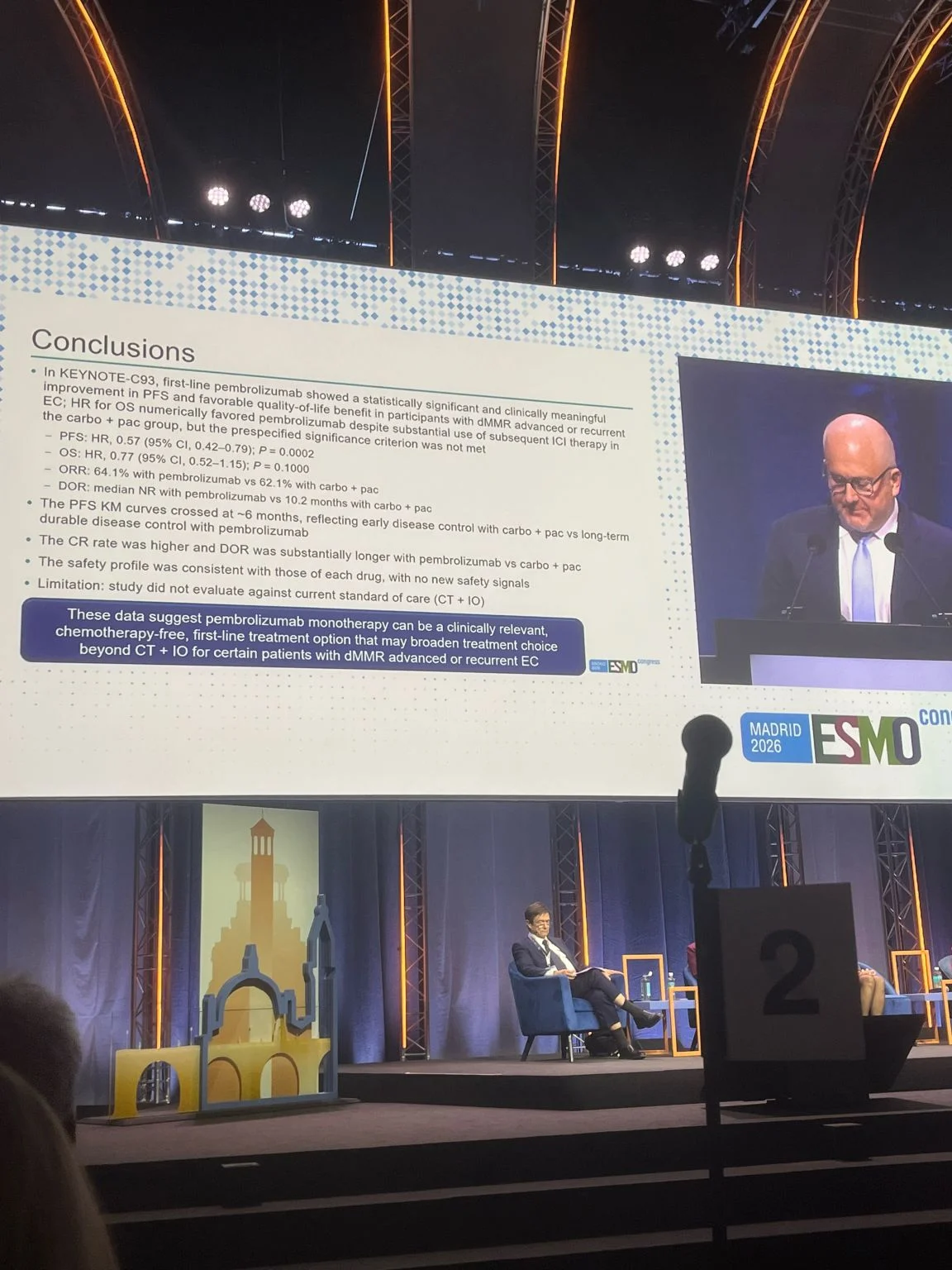
- Progression-free survival: Median PFS was 38.2 months (95% CI 17.9–not reached) with pembrolizumab versus 8.4 months (95% CI 6.8–10.4) with chemotherapy. The HR was 0.57 (95% CI 0.42–0.79; one-sided P = 0.0002), meeting the prespecified statistical criterion.
- Three-year PFS: Estimated 36-month PFS was 52.8% versus 30.0%, respectively.
- Early versus longer-term disease control: The presentation reported that the PFS curves crossed at approximately six months, reflecting better early disease control with chemotherapy followed by more durable long-term disease control with pembrolizumab.
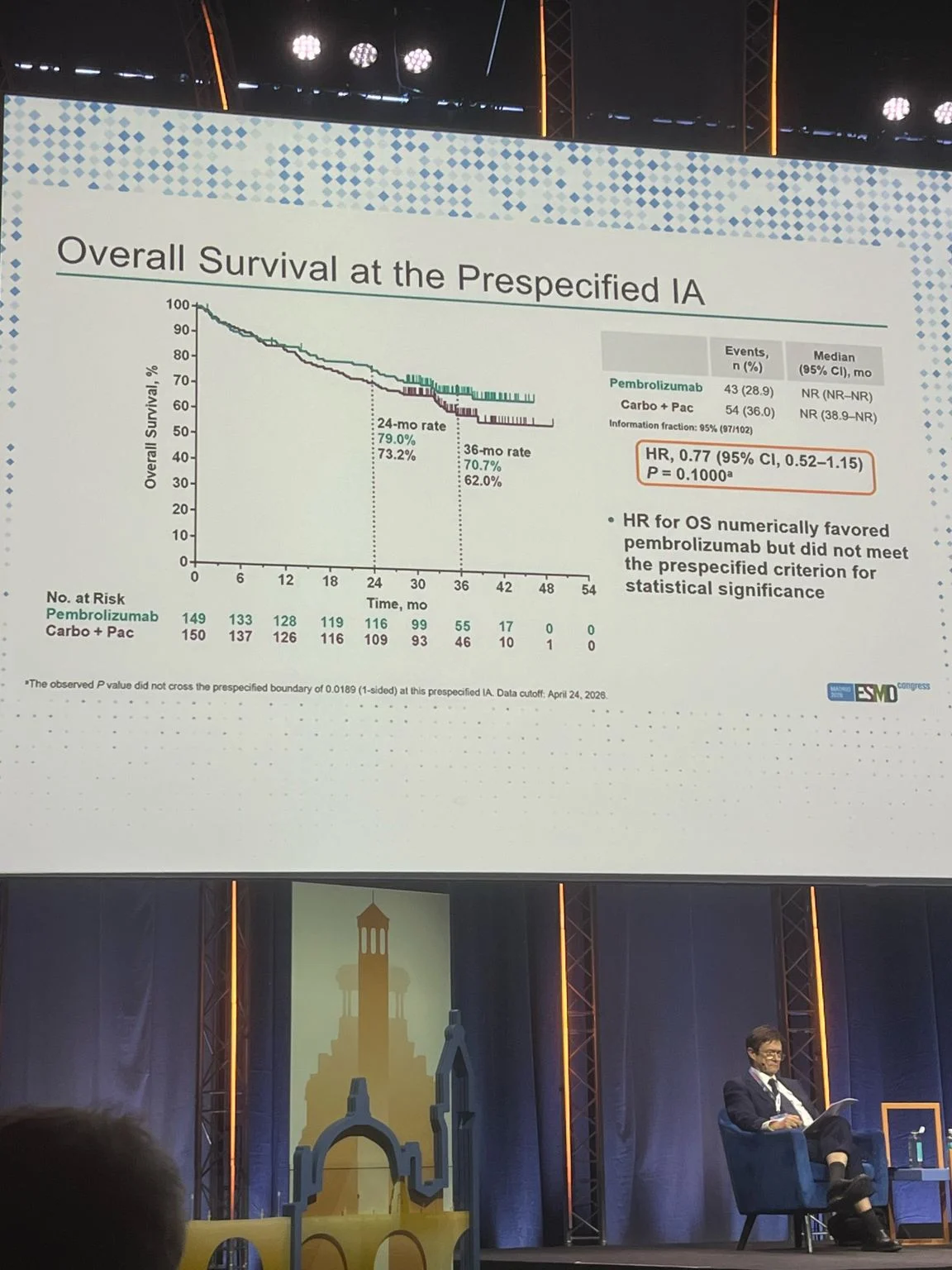
- Overall survival: Median OS was not reached in either arm. Deaths occurred in 43 patients (28.9%) receiving pembrolizumab and 54 (36.0%) receiving chemotherapy. The OS HR was 0.77 (95% CI 0.52–1.15; one-sided P = 0.1000), which did not meet the prespecified interim significance boundary of 0.0189.
- Landmark OS: Estimated 24-month OS was 79.0% versus 73.2%, and 36-month OS was 70.7% versus 62.0%.
- Objective response: Among patients with measurable disease at baseline, ORR was 64.1% with pembrolizumab versus 62.1% with chemotherapy. Complete response rates were 33.8% versus 26.2%.
- Response durability: Median duration of response was not reached with pembrolizumab versus 10.2 months with chemotherapy. Estimated ongoing-response rates at 24 months were 77.0% versus 41.3%, and at 36 months were 70.7% versus 40.0%.
- Subsequent treatment: Among chemotherapy-arm patients with BICR-confirmed progression, 85.2% received crossover pembrolizumab or subsequent PD-(L)1 inhibitors. Among pembrolizumab-arm patients with progression, 47.6% received subsequent platinum chemotherapy.
- Quality of life: At week 12, the between-group difference in change from baseline in global health status/quality-of-life score was 7.02 points (95% CI 2.54–11.50), favoring pembrolizumab.
Safety
Grade ≥3 treatment-related adverse events occurred in 18.1% of patients receiving pembrolizumab versus 50.7% receiving chemotherapy.
Grade ≥3 immune-mediated adverse events and infusion reactions occurred in 7.4% versus 3.5%, respectively. Thus, the lower overall rate of severe treatment-related toxicity with pembrolizumab should be distinguished from its immune-mediated toxicity profile.
No new safety signals were reported.
Interpretation
Pembrolizumab significantly improved PFS compared with carboplatin–paclitaxel alone, with substantially more durable responses despite similar overall response rates.
However, the crossing PFS curves indicate that the overall benefit should not be interpreted as superior disease control at every timepoint. The presentation described an early disease-control advantage with chemotherapy and longer-term durability with pembrolizumab.
OS numerically favored pembrolizumab but did not meet the prespecified statistical criterion. Substantial subsequent immunotherapy use in the chemotherapy arm is relevant to interpretation, but does not establish why the OS comparison was not significant.
The findings support pembrolizumab monotherapy as a potential chemotherapy-free first-line option for selected patients with dMMR advanced or recurrent endometrial cancer. They do not establish equivalence or superiority to contemporary chemotherapy–immunotherapy combinations.
Conclusion
KEYNOTE-C93 demonstrated significantly longer PFS, more durable responses, and fewer grade ≥3 treatment-related adverse events with pembrolizumab monotherapy compared with carboplatin–paclitaxel alone in dMMR advanced or recurrent endometrial cancer.
An OS benefit has not been established at this interim analysis. The early disease-control pattern and the chemotherapy-only comparator remain important when interpreting the regimen’s potential clinical role.