
At the ESMO Congress 2026, Jian Zhou (Shanghai, China) presented results from the Phase III HARMONi-GI1 trial (NCT06591520), evaluating ivonescimab plus chemotherapy versus durvalumab plus chemotherapy as first-line treatment for patients with unresectable locally advanced or metastatic biliary tract cancer (BTC).
The preplanned interim analysis, presented during Presidential Symposium II as Late-Breaking Abstract LBA8, assessed overall survival (OS), progression-free survival (PFS), objective response rate (ORR), and safety.
Why Was HARMONi-GI1 Conducted?
Durvalumab plus chemotherapy is a standard first-line treatment for advanced biliary tract cancer. Ivonescimab is a bispecific antibody targeting PD-1 and VEGF. The Phase III HARMONi-GI1 trial was conducted in China to evaluate whether ivonescimab combined with chemotherapy could improve efficacy compared with durvalumab plus chemotherapy in patients with advanced BTC.
HARMONi-GI1 Study Design and Methods
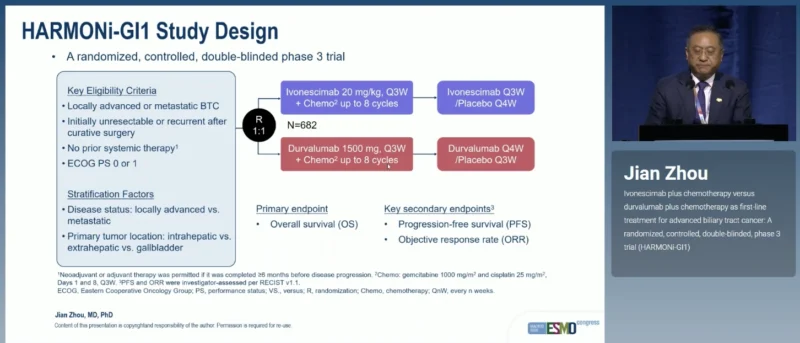
HARMONi-GI1 was a randomized, controlled, double-blind Phase III trial enrolling patients with unresectable locally advanced or metastatic BTC. Patients were randomized in a 1:1 ratio to receive either ivonescimab or durvalumab combined with gemcitabine and cisplatin every three weeks for up to eight cycles, followed by maintenance therapy with ivonescimab or durvalumab, respectively.
Randomization was stratified by disease status (locally advanced versus metastatic) and primary tumour location (intrahepatic cholangiocarcinoma, extrahepatic cholangiocarcinoma, or gallbladder cancer). The primary endpoint was OS, while key secondary endpoints included PFS and ORR.
Key Findings from HARMONi-GI1
A total of 682 patients were randomized, including 340 assigned to ivonescimab plus chemotherapy and 342 to durvalumab plus chemotherapy. Baseline characteristics were balanced between treatment groups. Median follow-up was 14.3 months.
Overall Survival
The trial met its primary endpoint, demonstrating a statistically significant improvement in OS with ivonescimab plus chemotherapy compared with durvalumab plus chemotherapy. Median OS was 14.9 months with ivonescimab plus chemotherapy versus 12.1 months with durvalumab plus chemotherapy (HR 0.75; 95% CI 0.61–0.92; p=0.0031). These findings represented a 25% lower estimated hazard of death with ivonescimab plus chemotherapy compared with the control regimen.
Progression-Free Survival
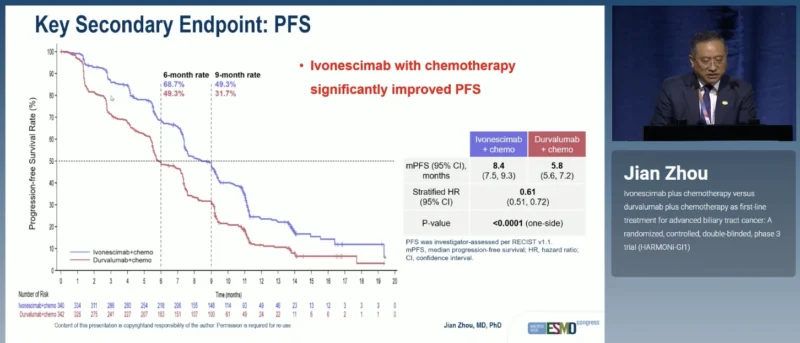
Ivonescimab plus chemotherapy also demonstrated a statistically significant improvement in PFS. Median PFS was 8.4 months with ivonescimab plus chemotherapy compared with 5.8 months with durvalumab plus chemotherapy (HR 0.61; 95% CI 0.51–0.72; p<0.0001).
Objective Response Rate
The objective response rate was higher with ivonescimab plus chemotherapy than with durvalumab plus chemotherapy. ORR was 53.8% versus 32.5%, respectively (p<0.0001), representing a statistically significant difference between treatment groups.
Safety Outcomes
The investigators reported a manageable safety profile with ivonescimab plus chemotherapy. The most common treatment-emergent adverse events (TEAEs) were haematological toxicities. Grade 3 or 4 TEAEs occurred in 82.0% of patients receiving ivonescimab plus chemotherapy and 72.3% receiving durvalumab plus chemotherapy. Serious TEAEs occurred in 43.4% versus 43.7%, respectively. Grade 3 or higher immune-related adverse events occurred in 4.1% of patients in each treatment group. No new safety signals were identified.
Conclusions
The preplanned interim analysis of the Phase III HARMONi-GI1 trial demonstrated statistically significant improvements in OS, PFS, and ORR with ivonescimab plus chemotherapy compared with durvalumab plus chemotherapy as first-line treatment for advanced biliary tract cancer.
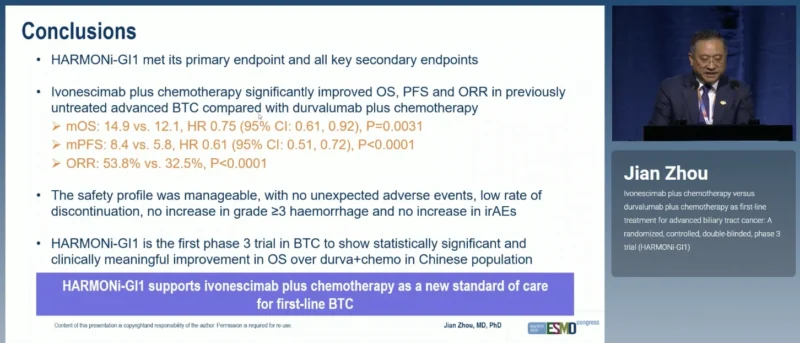
Median OS was 14.9 versus 12.1 months (HR 0.75; 95% CI 0.61–0.92; p=0.0031), while median PFS was 8.4 versus 5.8 months (HR 0.61; 95% CI 0.51–0.72; p<0.0001). Objective response rates were 53.8% with ivonescimab plus chemotherapy and 32.5% with durvalumab plus chemotherapy (p<0.0001). The investigators reported a manageable safety profile, with no new safety signals identified for ivonescimab.
These findings support ivonescimab plus chemotherapy as a potential new first-line standard-of-care option for patients with advanced biliary tract cancer, based on the results of this Phase III study conducted in China.
Source: ESMO Congress 2026 – LBA8, Phase III HARMONi-GI1
Read more about ACTICCA-1 at ESMO 2026 on OncoDaily.