At the ESMO Congress 2026, Henning Wege (Hamburg, Germany) presented results from the Phase III ACTICCA-1 trial (NCT02104882), evaluating adjuvant gemcitabine plus cisplatin compared with capecitabine following curative-intent resection of cholangiocarcinoma or gallbladder carcinoma.
The analysis, presented as Late-Breaking Abstract LBA21 in the Proffered Paper session, assessed disease-free survival (DFS), with additional findings on overall survival (OS) and treatment-related safety.
Why Was ACTICCA-1 Conducted?
Despite surgery and adjuvant capecitabine, approximately 50% of patients with biliary tract cancer (BTC) experience disease recurrence or death within two years. Gemcitabine plus cisplatin is an established chemotherapy regimen for advanced BTC, providing the rationale for evaluating this combination in the adjuvant setting.
The Phase III ACTICCA-1 trial investigated whether adjuvant gemcitabine plus cisplatin could improve outcomes compared with capecitabine following curative-intent surgery.
ACTICCA-1 Study Design and Methods
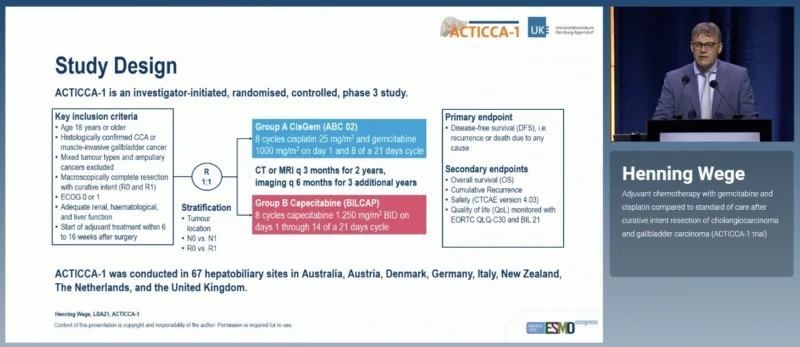
ACTICCA-1 was an investigator-initiated, randomized Phase III trial conducted at 67 hepatobiliary sites across eight countries, with patient recruitment from September 2017 to January 2023. Patients who had undergone curative-intent resection of cholangiocarcinoma or gallbladder carcinoma were randomized to receive adjuvant gemcitabine plus cisplatin (Arm A) or capecitabine (Arm B), both administered for 24 weeks.
The primary endpoint was DFS, assessed in the modified intention-to-treat population. Secondary endpoints included OS, chemotherapy safety and tolerability, quality of life, and patterns of disease recurrence. The data cutoff was December 31, 2025.
Key Findings from ACTICCA-1
A total of 601 patients were randomized to gemcitabine plus cisplatin (n=301) or capecitabine (n=300). The modified intention-to-treat population included 591 patients (n=297 and n=294, respectively), after excluding 10 patients with recurrence at inclusion. Median follow-up was 4.8 years (95% CI 4.6–4.9). The median patient age was 63 years, and 46.9% were female. The median interval between surgery and trial enrolment was 67 days. Primary tumour locations included intrahepatic cholangiocarcinoma (28.3%), perihilar cholangiocarcinoma (19.0%), distal cholangiocarcinoma (36.5%), and gallbladder carcinoma (16.2%). Node-positive disease was reported in 47.9% of patients.
Disease-Free Survival
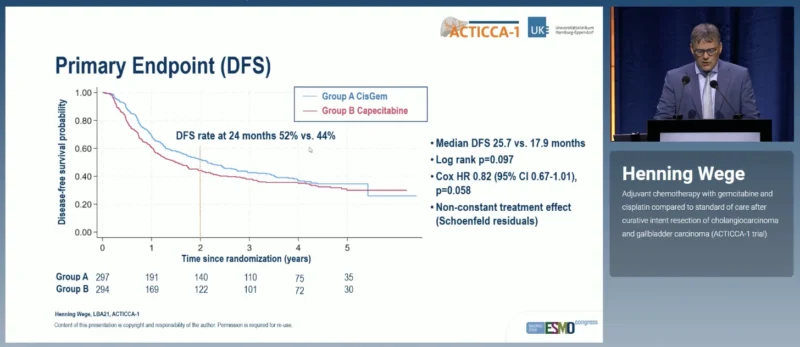
Median DFS was 25.7 months with gemcitabine plus cisplatin compared with 17.9 months with capecitabine. At 24 months, DFS rates were 52% versus 44%, respectively (log-rank p=0.097). The Cox hazard ratio was 0.82 (95% CI 0.67–1.01; p=0.058). However, the analysis identified a non-constant treatment effect, indicating a violation of the proportional hazards assumption.
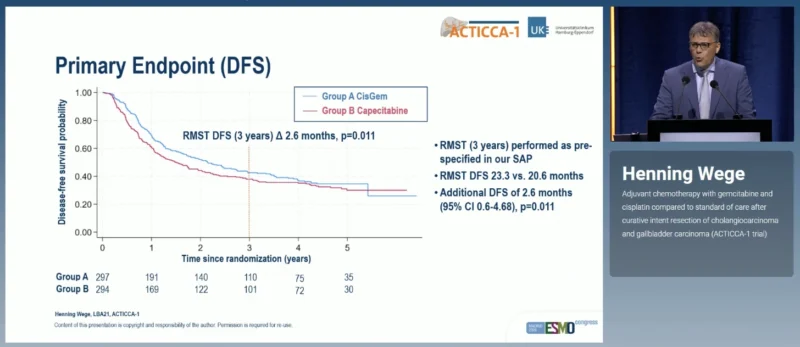
As prespecified in the statistical analysis plan, restricted mean survival time (RMST) was used to assess DFS over the first three years. The three-year restricted mean DFS was 23.3 months with gemcitabine plus cisplatin versus 20.6 months with capecitabine, representing an additional 2.6 months of DFS (95% CI 0.6–4.68; p=0.011). Although the log-rank comparison did not reach statistical significance, the prespecified RMST analysis showed a difference favouring gemcitabine plus cisplatin.
Overall Survival
Median OS was 58.1 months with gemcitabine plus cisplatin compared with 48.2 months with capecitabine (Cox HR 0.82; p=0.103). Over the first three years, the restricted mean overall survival time was 1.44 months longer with gemcitabine plus cisplatin (RMST analysis, p=0.076). Neither analysis demonstrated a statistically significant overall survival improvement.
Safety Outcomes
The gemcitabine plus cisplatin arm had a higher number of severe adverse events than the capecitabine arm (130 vs 113), including 51 versus 47 treatment-related events. The investigators reported increased toxicity with gemcitabine plus cisplatin, predominantly involving haematological adverse events.
Conclusions
The Phase III ACTICCA-1 trial reported longer median disease-free survival with adjuvant gemcitabine plus cisplatin compared with capecitabine following curative-intent resection of biliary tract cancer (25.7 vs 17.9 months). However, the log-rank comparison did not reach statistical significance (p=0.097).
Because the proportional hazards assumption was violated, the prespecified RMST analysis was performed, showing an additional 2.6 months of disease-free survival over the first three years with gemcitabine plus cisplatin (p=0.011).
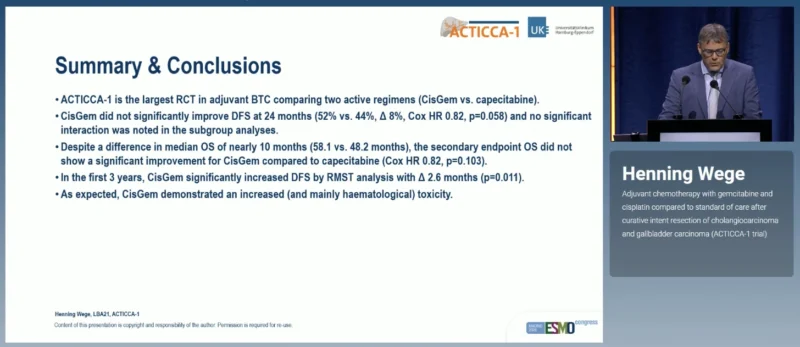
Median overall survival was 58.1 versus 48.2 months, although the difference was not statistically significant (Cox HR 0.82; p=0.103). Gemcitabine plus cisplatin was associated with increased toxicity, predominantly haematological. The investigators reported no significant evidence of treatment-effect heterogeneity in the exploratory subgroup analyses. These findings show a difference favouring gemcitabine plus cisplatin in the prespecified RMST analysis, without statistically significant improvements in DFS by the log-rank test or in overall survival.
Source: ESMO Congress 2026 – LBA21, ACTICCA-1
Read more about RAMIRIS Trial at ESMO 2026 on OncoDaily.