At the ESMO Congress 2026, Magdalena Scheck presented the final results of the Phase III IKFs602/AIO RAMIRIS study, evaluating FOLFIRI plus ramucirumab versus paclitaxel plus ramucirumab as second-line treatment in taxane-pretreated patients with advanced or metastatic gastroesophageal adenocarcinoma (GEA).
The analysis, presented in the Rapid Oral session (2878RO), assessed overall survival (OS), objective response rate (ORR), progression-free survival (PFS), and safety.
Why Was RAMIRIS Conducted?
Ramucirumab plus paclitaxel is an established second-line treatment option for metastatic gastroesophageal adenocarcinoma. However, patients previously exposed to taxane-based chemotherapy during perioperative or first-line treatment may benefit from a non-cross-resistant chemotherapy regimen. The Phase II RAMIRIS study showed numerically favourable PFS and ORR outcomes with FOLFIRI plus ramucirumab compared with paclitaxel plus ramucirumab in docetaxel-pretreated patients. These findings provided the rationale for further evaluation in the Phase III study.
RAMIRIS Study Design and Methods
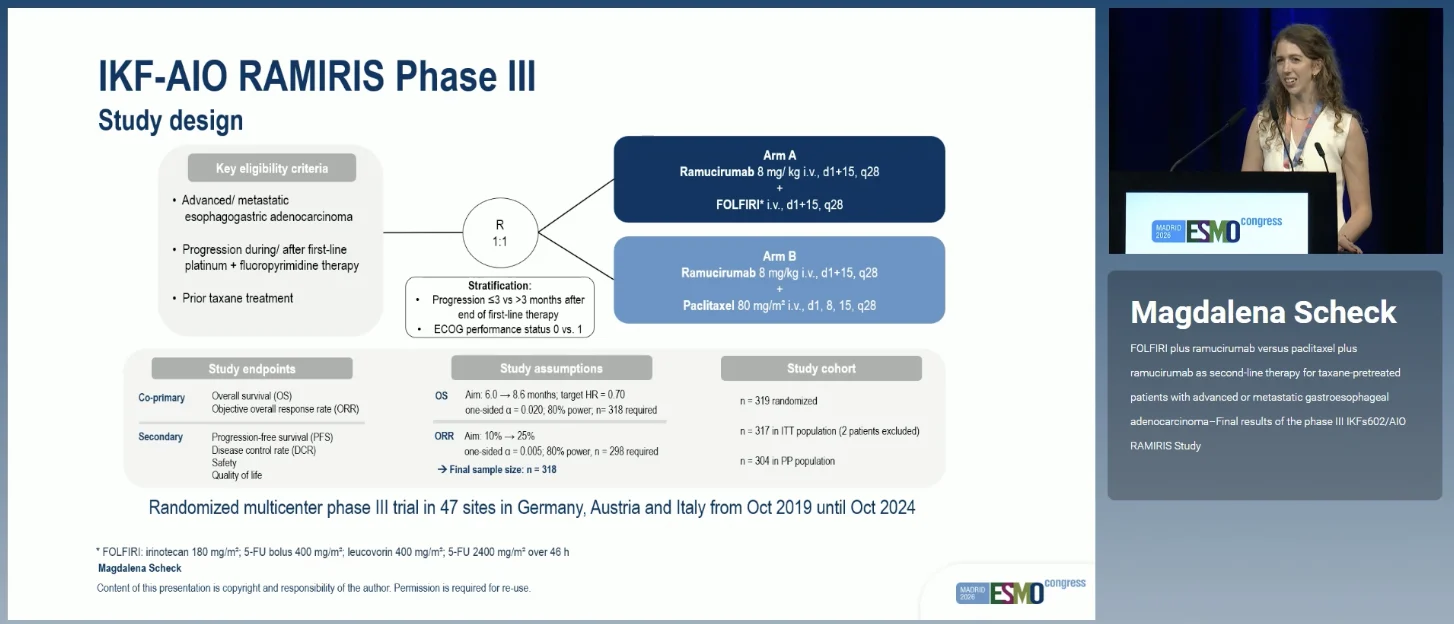
RAMIRIS was a randomized, multicentre Phase III trial conducted at 47 sites in Germany, Austria, and Italy between October 2019 and October 2024.
Eligible patients had advanced or metastatic gastroesophageal adenocarcinoma, disease progression during or after first-line platinum- and fluoropyrimidine-based chemotherapy, and prior exposure to taxane treatment.
Patients were randomized 1:1 to receive FOLFIRI plus ramucirumab (Arm A) or paclitaxel plus ramucirumab (Arm B). Ramucirumab was administered at 8 mg/kg intravenously on days 1 and 15 of each 28-day cycle. FOLFIRI was administered on days 1 and 15, while paclitaxel was given at 80 mg/m² intravenously on days 1, 8, and 15.
The co-primary endpoints were OS and ORR. Secondary endpoints included PFS, disease control rate (DCR), safety, and quality of life. A total of 319 patients were randomized, of whom 317 were included in the intention-to-treat (ITT) population and 304 in the per-protocol (PP) population.

Key Findings from RAMIRIS
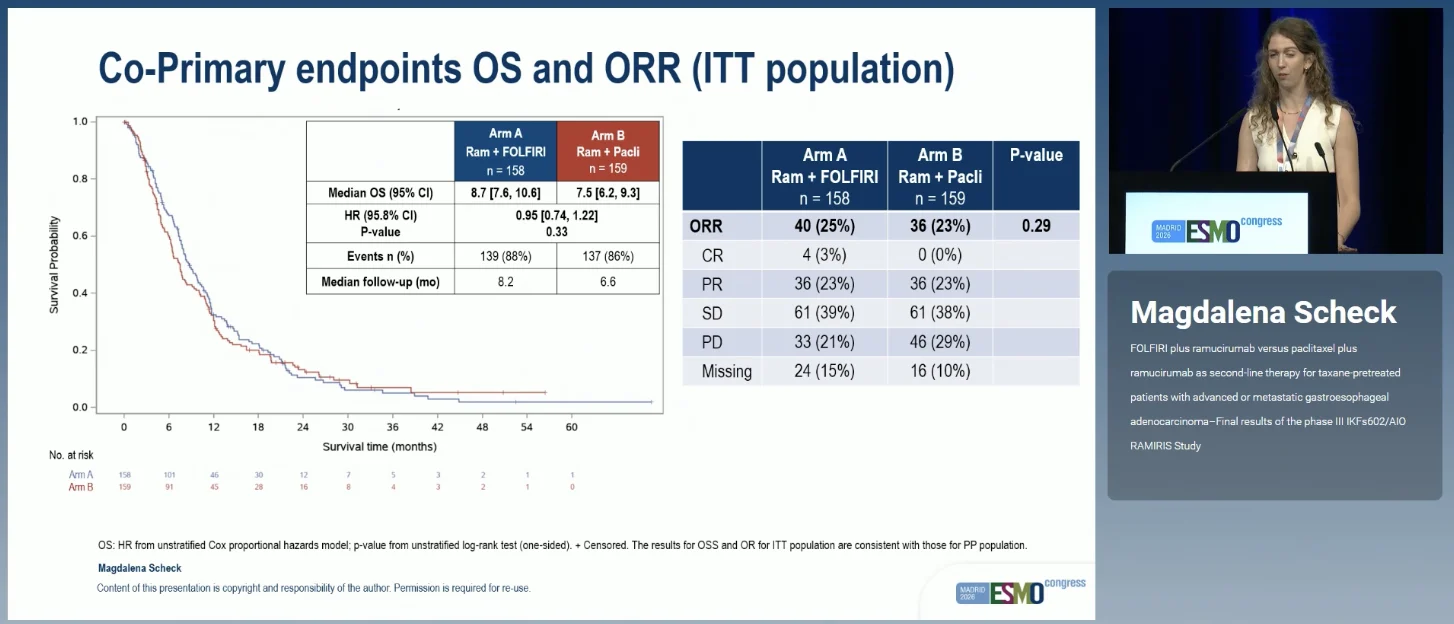
The ITT population included 158 patients receiving FOLFIRI plus ramucirumab and 159 receiving paclitaxel plus ramucirumab. Median age was 59 and 61 years, respectively. Most patients had metastatic disease, and baseline characteristics were generally similar between treatment groups.
Overall Survival and Objective Response
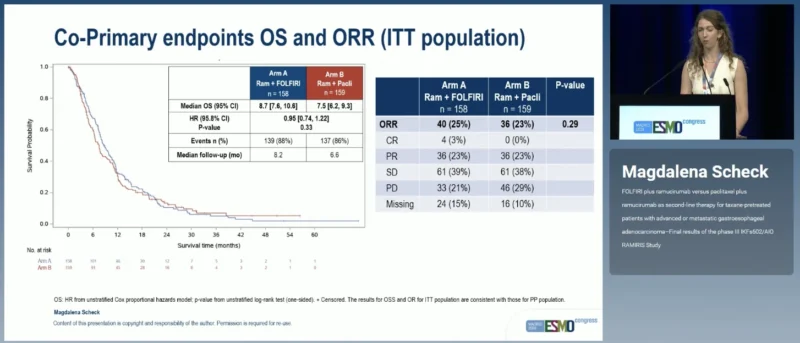
Median OS was 8.7 months (95% CI 7.6–10.6) with FOLFIRI plus ramucirumab compared with 7.5 months (95% CI 6.2–9.3) with paclitaxel plus ramucirumab (HR 0.95; 95.8% CI 0.74–1.22; one-sided P=0.33). OS events occurred in 139 patients (88%) in Arm A and 137 (86%) in Arm B. Median follow-up was 8.2 months and 6.6 months, respectively.
The ORR was 25% (40/158) with FOLFIRI plus ramucirumab versus 23% (36/159) with paclitaxel plus ramucirumab (P=0.29). Complete responses were reported in four patients (3%) in Arm A and none in Arm B. Neither co-primary endpoint demonstrated a statistically significant difference between treatment groups.
Progression-Free Survival
In the ITT population, median PFS was 5.5 months (95% CI 4.0–6.3) with FOLFIRI plus ramucirumab compared with 3.7 months (95% CI 2.9–4.2) with paclitaxel plus ramucirumab (HR 0.71; 95.8% CI 0.56–0.90; one-sided P=0.002).
The per-protocol analysis showed similar results, with median PFS of 5.6 versus 3.7 months (HR 0.69; 95.8% CI 0.55–0.88; one-sided P=0.001). PFS was longer with FOLFIRI plus ramucirumab, although the trial did not achieve its co-primary endpoints of OS or ORR.
Safety Outcomes
No new safety signals were observed with either treatment regimen. FOLFIRI plus ramucirumab was associated with more frequent treatment-related gastrointestinal adverse events. Grade 1–2 nausea occurred in 31% versus 15% of patients, while grade 1–2 diarrhoea occurred in 31% versus 11%, respectively.
In contrast, grade 1–2 peripheral sensory neuropathy was less frequent with FOLFIRI plus ramucirumab (8% versus 20%). Grade 3 or higher peripheral sensory neuropathy was reported in 1% of patients in each arm. The investigators reported increased rates of all-grade gastrointestinal toxicity but reduced rates of peripheral neuropathy with FOLFIRI plus ramucirumab.
Conclusions
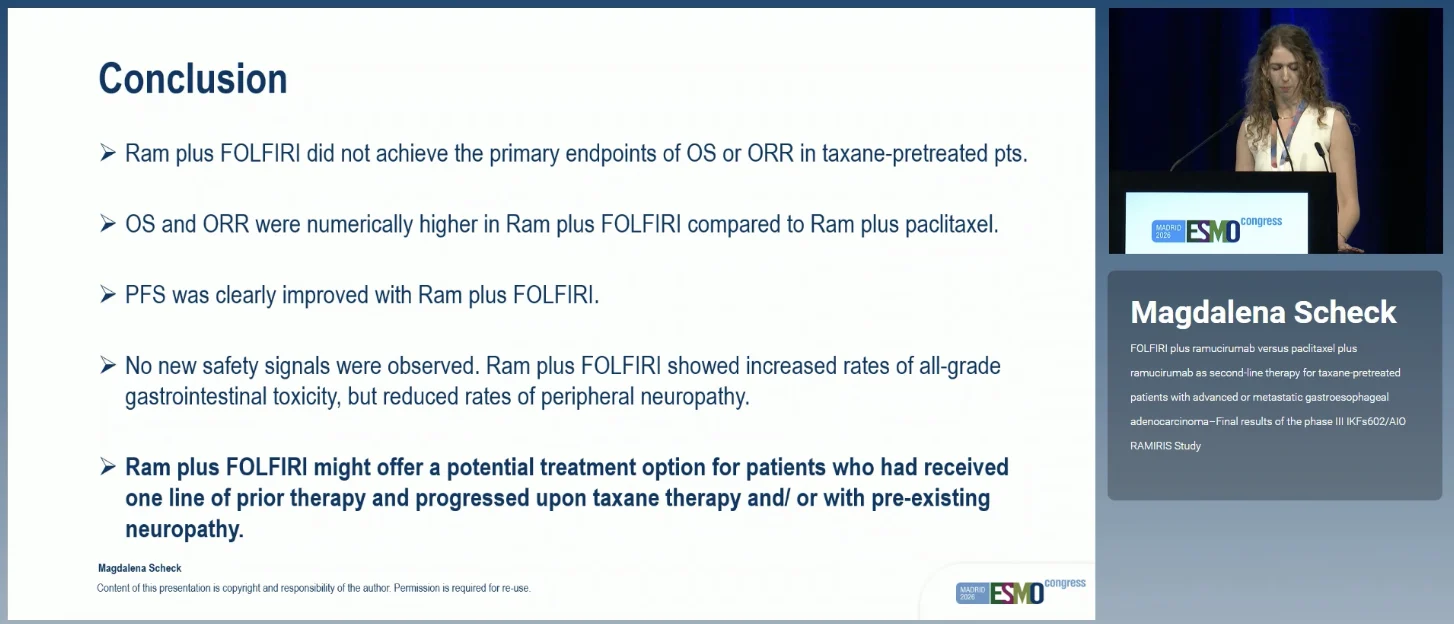
The Phase III RAMIRIS trial did not meet its co-primary endpoints of OS or ORR in taxane-pretreated patients with advanced or metastatic gastroesophageal adenocarcinoma.
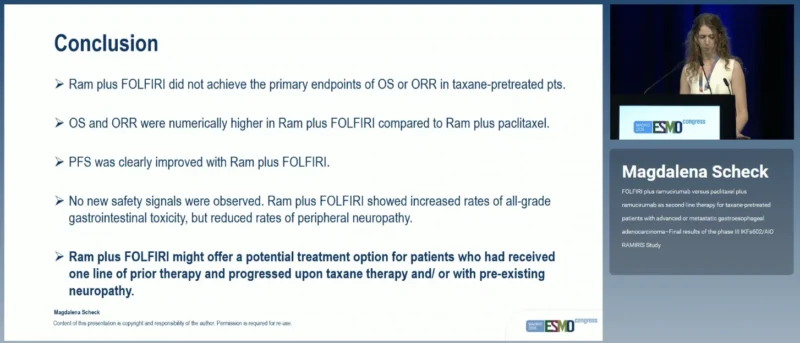
Although OS and ORR were numerically higher with FOLFIRI plus ramucirumab, neither difference was statistically significant. PFS was longer with FOLFIRI plus ramucirumab compared with paclitaxel plus ramucirumab. No new safety signals were observed. FOLFIRI plus ramucirumab was associated with increased gastrointestinal toxicity but reduced peripheral neuropathy.
The investigators concluded that FOLFIRI plus ramucirumab may offer a potential treatment option for patients who have received one prior line of therapy and progressed following taxane treatment and/or have pre-existing neuropathy.
Source: ESMO Congress 2026 – Abstract 2878RO, RAMIRIS

Read more about RASolute 302 at ESMO 2026 on OncoDaily.