
At the ESMO Congress 2026, Thomas B. Powles (London, United Kingdom) presented results from the Phase III VOLGA trial (NCT04960709), evaluating perioperative durvalumab with or without tremelimumab plus neoadjuvant enfortumab vedotin compared with a surgery-based control approach in patients with muscle-invasive bladder cancer (MIBC) who were ineligible for or refused cisplatin-based treatment.
The analysis, presented as Late-Breaking Abstract LBA2 in the Proffered Paper session, reported findings from a preplanned interim analysis assessing event-free survival (EFS), overall survival (OS), pathological complete response (pCR), and safety.
Why Was VOLGA Conducted?
The standard of care for muscle-invasive bladder cancer continues to evolve, with ongoing research evaluating perioperative treatment strategies. The Phase III VOLGA trial investigated whether adding neoadjuvant enfortumab vedotin to perioperative durvalumab, with or without tremelimumab, could improve treatment outcomes in patients with MIBC who were ineligible for or refused cisplatin-based therapy and were planned for radical cystectomy.
VOLGA Study Design and Methods
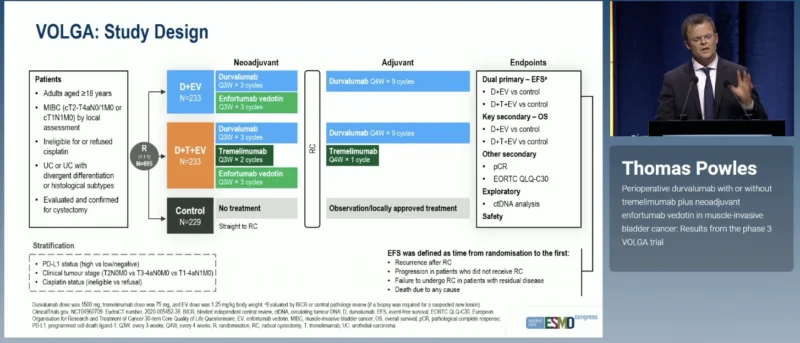
VOLGA was a randomized, open-label Phase III trial enrolling patients with MIBC (cT2–T4aN0/1M0 or cT1N1M0) who were ineligible for or refused cisplatin-based treatment and were planned for radical cystectomy. Patients were randomized in a 1:1:1 ratio to three treatment arms:
- Durvalumab plus enfortumab vedotin (D+EV): Three cycles of neoadjuvant durvalumab and enfortumab vedotin, followed by radical cystectomy and nine cycles of adjuvant durvalumab.
- Durvalumab, tremelimumab, and enfortumab vedotin (D+T+EV): Three cycles of neoadjuvant durvalumab, two cycles of tremelimumab, and three cycles of enfortumab vedotin, followed by radical cystectomy and adjuvant treatment with nine cycles of durvalumab and one cycle of tremelimumab.
- Control: Radical cystectomy followed by observation or locally approved adjuvant treatment.
The dual primary endpoints were EFS for D+EV versus control and EFS for D+T+EV versus control. Overall survival was the key secondary endpoint, and safety was also assessed. The results were based on a preplanned interim analysis with a data cutoff of March 2, 2026.
Key Findings from VOLGA
A total of 695 patients were randomized, including 233 patients in the D+EV arm, 233 in the D+T+EV arm, and 229 in the control arm. Radical cystectomy was completed in 85% of patients receiving D+EV, 79% receiving D+T+EV, and 78% in the control arm. Adjuvant treatment was completed by 55% of patients in the D+EV arm and 42% in the D+T+EV arm. Median EFS follow-up was 22.9 months.
Event-Free Survival
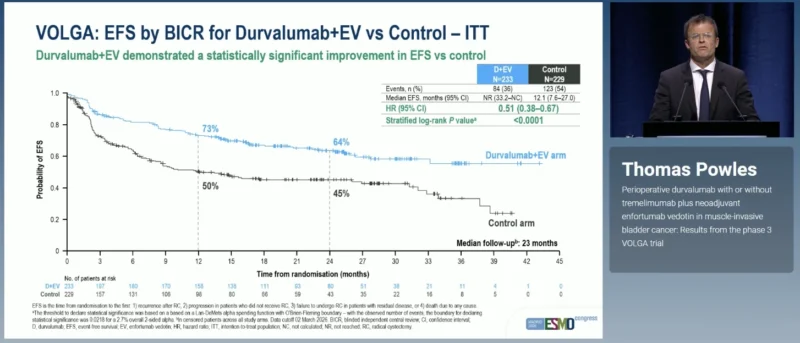
Both experimental treatment arms met their respective primary EFS endpoints compared with control. D+EV demonstrated a statistically significant improvement in EFS compared with control (HR 0.51; 95% CI 0.38–0.67; p<0.0001). The estimated 24-month EFS rate was 64% with D+EV versus 45% with control.
Durvalumab, Tremelimumab, and Enfortumab Vedotin vs Control
D+T+EV also demonstrated a statistically significant improvement in EFS compared with control (HR 0.61; 95% CI 0.47–0.80; p=0.0004). The estimated 24-month EFS rate was 60% with D+T+EV versus 45% with control.
Overall Survival and pCR
The D+EV arm demonstrated a statistically significant improvement in OS compared with control (HR 0.58; 95% CI 0.40–0.83; p=0.0027). The estimated 24-month OS rate was 78% with D+EV versus 69% with control. Although D+T+EV significantly improved EFS, the OS comparison with control did not meet statistical significance at this interim analysis. Overall survival follow-up is ongoing. Pathological complete response was assessed by local review. The pCR rate was 45% (95% CI 38.6–51.7%) in the D+EV arm compared with 10% (95% CI 6.1–14.2%) in the control arm.
Safety Outcomes
Maximum Grade 3 or 4 adverse events assessed as possibly treatment-related occurred in 30% of patients receiving D+EV and 42% receiving D+T+EV. Serious adverse events assessed as possibly treatment-related were reported in 20% and 31% of patients, respectively. Adverse events assessed as possibly treatment-related and leading to death occurred in one patient (0.4%) in the D+EV arm and five patients (2%) in the D+T+EV arm. The investigators reported that the safety profiles were consistent with those of the individual agents.
Conclusions
The preplanned interim analysis of the Phase III VOLGA trial demonstrated statistically significant improvements in event-free survival with both perioperative durvalumab plus neoadjuvant enfortumab vedotin and the regimen additionally incorporating tremelimumab, compared with the control approach, in patients with MIBC who were ineligible for or refused cisplatin-based treatment.
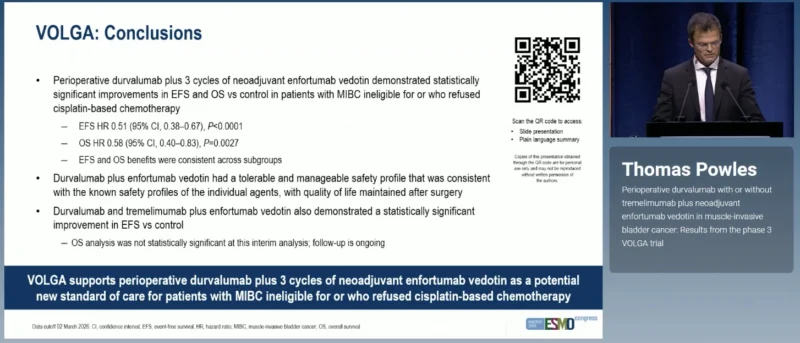
D+EV demonstrated an EFS benefit (HR 0.51; p<0.0001) and a statistically significant OS benefit (HR 0.58; p=0.0027), with estimated 24-month EFS and OS rates of 64% and 78%, respectively, compared with 45% and 69% in the control arm. The D+T+EV regimen also improved EFS (HR 0.61; p=0.0004), although its OS comparison with control did not meet statistical significance at this interim analysis.
Pathological complete response was observed in 45% of patients receiving D+EV compared with 10% in the control arm. The reported safety profiles were consistent with those of the individual agents. Both primary EFS endpoints were met, while a statistically significant OS improvement was demonstrated for D+EV versus control. Overall survival follow-up for D+T+EV is ongoing.
Source: ESMO Congress 2026 – LBA2, Phase III VOLGA

Read more about KEYNOTE-905 at ESMO 2026 on OncoDaily.