At the ESMO Congress 2026, Tamim Niazi (Montreal, Canada) presented results from the Phase III DASL-HiCaP trial (ANZUP1801; NCT04136353), evaluating the addition of darolutamide to androgen deprivation therapy (ADT) and definitive or salvage locoregional radiotherapy (RT) in patients with very high-risk localised or biochemically persistent or recurrent prostate cancer.
The analysis, presented as Late-Breaking Abstract LBA4 during Presidential Symposium I, reported findings from a prespecified interim analysis assessing metastasis-free survival based on conventional imaging (MFS-CI), alongside prostate-specific antigen progression-free survival (PSA-PFS), prostate cancer-specific survival (PCSS), overall survival (OS), and safety.
Why Was DASL-HiCaP Conducted?
The Phase III DASL-HiCaP trial investigated whether adding darolutamide to standard-of-care ADT and radiotherapy could improve outcomes in patients with very high-risk localised prostate cancer or biochemically persistent or recurrent disease within one year after radical prostatectomy. The study evaluated metastasis-free survival using conventional imaging as its primary endpoint, with additional assessments of disease progression, survival, and safety.
DASL-HiCaP Study Design and Methods
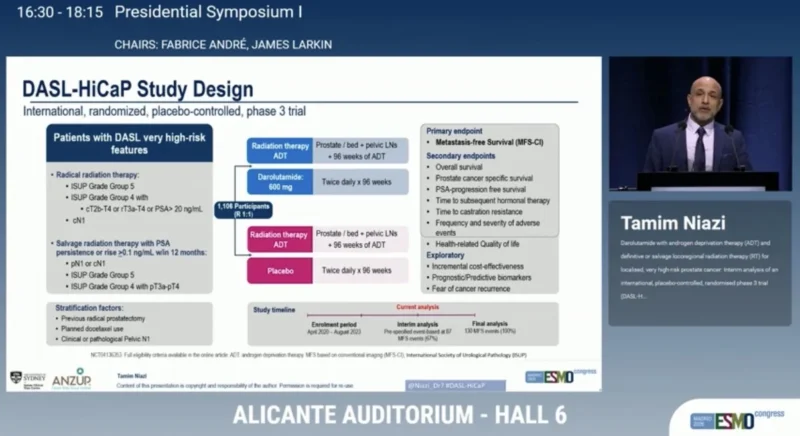
DASL-HiCaP (ANZUP1801) was an international, randomized, placebo-controlled Phase III trial. Patients received an LHRH analogue for 96 weeks and radiotherapy to the prostate or prostate bed and pelvic lymph nodes. They were randomized in a 1:1 ratio to receive:
- Darolutamide arm: Darolutamide 600 mg twice daily for 96 weeks, combined with ADT and radiotherapy.
- Placebo arm: Placebo twice daily for 96 weeks, combined with ADT and radiotherapy.
The primary endpoint was metastasis-free survival based on conventional imaging (MFS-CI), assessed using CT and/or technetium bone scans. Secondary endpoints included PSA-PFS, prostate cancer-specific survival, and overall survival. The study protocol specified a single interim analysis after 87 MFS-CI events, with independent data and safety monitoring committee review for external disclosure if the two-sided, stratified log-rank p value was below 0.012.
Key Findings from DASL-HiCaP
Between April 30, 2020, and August 9, 2023, a total of 1,106 patients were randomized, with 553 patients assigned to darolutamide and 553 to placebo. The median age was 71 years (interquartile range [IQR] 65–75). Pelvic nodal involvement on CT was reported in 29% of patients, while 73% had a Gleason score of 9–10. Overall, 15% had previously undergone radical prostatectomy. At the interim analysis, median follow-up was 3.8 years (IQR 3.3–4.5).
Metastasis-Free Survival
Darolutamide significantly improved metastasis-free survival based on conventional imaging compared with placebo when added to ADT and radiotherapy. The estimated four-year MFS-CI rate was 95% with darolutamide versus 88% with placebo (HR 0.42; 95% CI 0.27–0.66; p=0.0001). A total of 27 MFS-CI events occurred in the darolutamide arm compared with 63 events in the placebo arm. The result met the prespecified interim statistical significance threshold.
PSA Progression-Free Survival
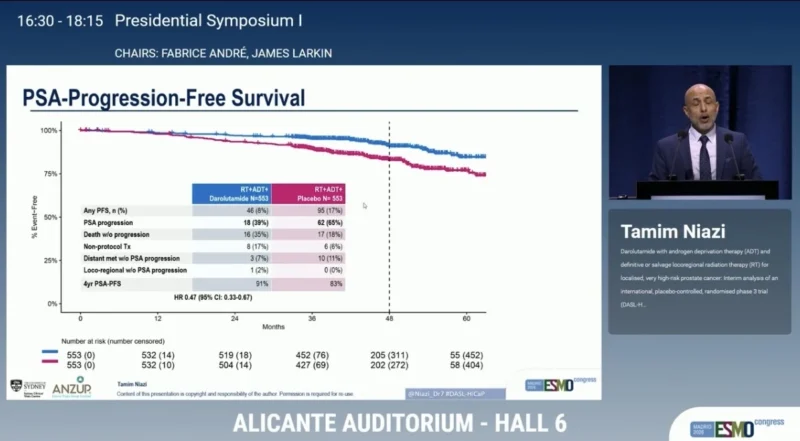
Darolutamide was also associated with improved PSA progression-free survival. The estimated four-year PSA-PFS rate was 91% with darolutamide compared with 83% with placebo (HR 0.47; 95% CI 0.33–0.67). PSA-PFS events occurred in 46 patients receiving darolutamide versus 95 patients receiving placebo.
Prostate Cancer-Specific Survival
At four years, the estimated prostate cancer-specific survival rate was 99% in both treatment groups. There were four prostate cancer-specific survival events in the darolutamide arm compared with seven in the placebo arm (HR 0.58; 95% CI 0.17–1.97). The confidence interval included 1, and a statistically significant difference in PCSS was not established.
Overall Survival
The estimated four-year overall survival rate was 97% with darolutamide versus 95% with placebo. A total of 21 OS events occurred in the darolutamide arm compared with 24 in the placebo arm (HR 0.88; 95% CI 0.49–1.59). The analysis did not establish a statistically significant overall survival benefit, and follow-up remains ongoing.
Safety Outcomes
The investigators reported the following rates of Grade 2 or higher adverse-event clusters of special interest:
- Fatigue or asthenia: 14% with darolutamide versus 10% with placebo.
- Hypertension: 7% versus 9%.
- Fractures: 2% versus 3%.
- Cardiac adverse events: 3% versus 3%.
Adverse events of Grade 3 or higher occurred in 43% of patients receiving darolutamide compared with 36% receiving placebo.
Conclusions
The prespecified interim analysis of the Phase III DASL-HiCaP trial demonstrated a statistically significant improvement in metastasis-free survival based on conventional imaging with darolutamide added to ADT and locoregional radiotherapy in patients with very high-risk localised or biochemically persistent or recurrent prostate cancer.
At four years, MFS-CI was 95% with darolutamide compared with 88% with placebo (HR 0.42; 95% CI 0.27–0.66; p=0.0001). PSA progression-free survival also favoured darolutamide, with four-year rates of 91% versus 83% (HR 0.47; 95% CI 0.33–0.67).
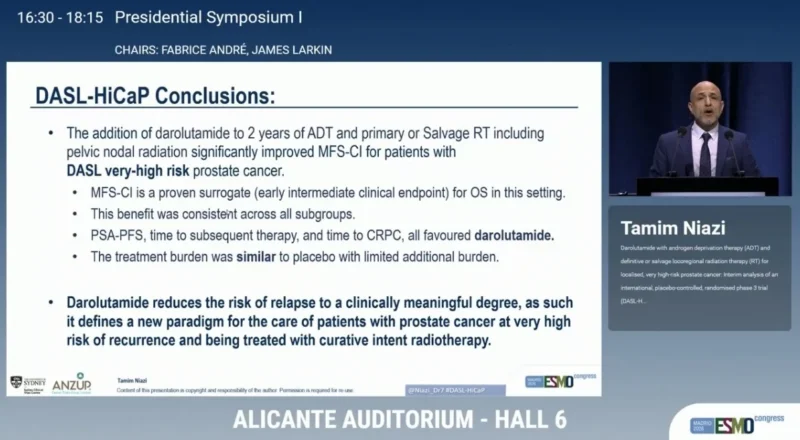
However, statistically significant improvements in prostate cancer-specific survival and overall survival were not established at this interim analysis. Grade 3 or higher adverse events were reported in 43% of patients receiving darolutamide compared with 36% receiving placebo. The investigators concluded that adding darolutamide to ADT and locoregional radiotherapy significantly improved MFS-CI in this patient population. Longer follow-up is ongoing to assess overall survival outcomes.
Source: ESMO Congress 2026 – LBA4, DASL-HiCaP (ANZUP1801)
Read more about VOLGA at ESMO 2026 on OncoDaily.