The phase III Krascendo 1 trial has demonstrated statistically significant improvements in both progression-free survival (PFS) and overall survival (OS) with divarasib compared with the approved KRAS G12C inhibitors sotorasib or adagrasib in patients with previously treated advanced or metastatic KRAS G12C-mutated non-small cell lung cancer (NSCLC).
Presented by Ferdinandos Skoulidis, MD, PhD, at the ESMO Congress 2026 Presidential Symposium in Madrid, the global randomized study provides direct phase III evidence comparing a next-generation KRAS G12C inhibitor with established targeted treatments.
Among 338 randomized patients, median PFS reached 9.8 months with divarasib versus 5.7 months with sotorasib or adagrasib, corresponding to a 42% reduction in the hazard of disease progression or death (HR 0.58; 95% CI 0.44–0.76; p<0.0001).
Importantly, this benefit extended to overall survival. Median OS was 17.7 months versus 12.0 months, respectively, representing a 5.7-month difference and a 44% reduction in the hazard of death (HR 0.56; 95% CI 0.41–0.78; p=0.0005).
Divarasib also nearly doubled the confirmed objective response rate while demonstrating fewer grade 3–4 treatment-related adverse events and fewer treatment discontinuations due to toxicity.
These findings represent an important development in KRAS-targeted therapy, demonstrating that clinically meaningful differences in efficacy and tolerability can exist between inhibitors directed against the same oncogenic alteration.
Why Krascendo 1 Matters: Advancing KRAS G12C Inhibition
KRAS mutations are among the most common oncogenic alterations in NSCLC, with KRAS G12C representing a clinically actionable molecular subgroup.
For decades, KRAS was considered difficult to target pharmacologically. The development of covalent inhibitors capable of selectively binding the KRAS G12C mutant protein transformed this therapeutic landscape.
Sotorasib and adagrasib established KRAS G12C inhibition as a treatment strategy for previously treated advanced NSCLC. However, despite clinically meaningful response rates, most patients eventually experience disease progression, and the durability of benefit remains limited.
Divarasib is an investigational, next-generation oral KRAS G12C inhibitor designed to bind selectively to the mutant protein in its inactive state, suppressing downstream oncogenic signaling. Preclinical investigations demonstrated greater potency and selectivity than first-generation KRAS G12C inhibitors, providing the rationale for further clinical development.
Earlier studies suggested promising antitumor activity, but whether these pharmacological characteristics would translate into superior outcomes compared with approved inhibitors remained uncertain.
Krascendo 1 directly addressed this question through a randomized comparison against active KRAS G12C-targeted therapy rather than conventional chemotherapy.
Study Design and Patient Population
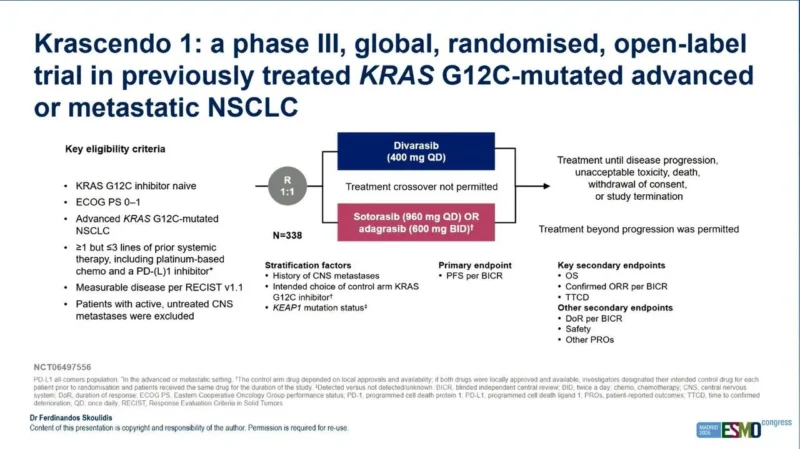
Krascendo 1 (NCT06497556) was a global, randomized, open-label phase III trial enrolling patients with advanced or metastatic KRAS G12C-mutated NSCLC who had received one to three prior lines of systemic therapy.
Eligible patients had ECOG performance status 0–1 and had previously received platinum-based chemotherapy and an anti-PD-1 or anti-PD-L1 inhibitor. Patients were required to be KRAS G12C inhibitor-naive. Patients with active, untreated central nervous system metastases were excluded.
A total of 338 patients were randomized 1:1 to receive divarasib 400 mg orally once daily (n=167) or investigator’s choice of sotorasib 960 mg once daily or adagrasib 600 mg twice daily (n=171).
Within the control arm, 156 patients received sotorasib and 15 received adagrasib. Randomization was stratified according to prior CNS metastases, intended control treatment, and KEAP1 mutation status.
Treatment continued until disease progression, unacceptable toxicity, death, withdrawal of consent, or study termination, with treatment beyond progression permitted when clinically appropriate. Crossover between treatment arms was not allowed.
The primary endpoint was PFS assessed by blinded independent central review (BICR). Key secondary endpoints included OS, confirmed objective response rate (ORR), and time to confirmed deterioration. Duration of response (DoR), safety, and patient-reported outcomes were also evaluated. At the May 19, 2026 data cutoff, median follow-up was 14.3 months.
Primary Endpoint: Divarasib Reduces the Hazard of Progression or Death by 42%
Krascendo 1 met its primary endpoint, demonstrating a statistically significant and clinically meaningful PFS advantage for divarasib.
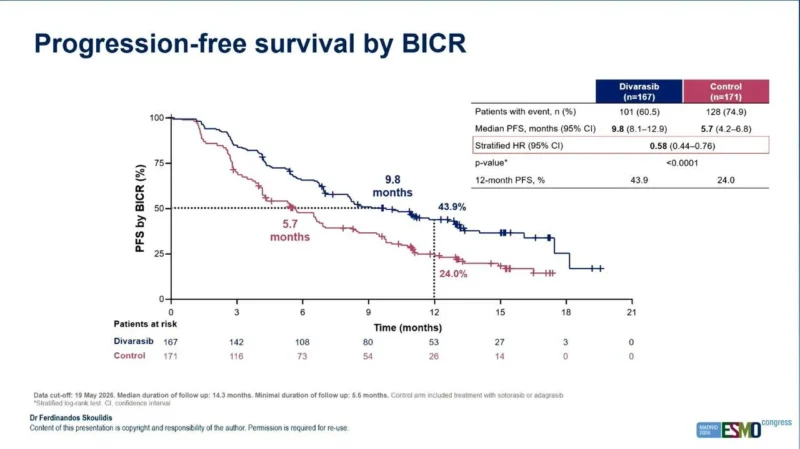
Median PFS by BICR was 9.8 months (95% CI 8.1–12.9) with divarasib compared with 5.7 months (95% CI 4.2–6.8) with sotorasib or adagrasib. The stratified HR was 0.58 (95% CI 0.44–0.76; p<0.0001), corresponding to a 42% reduction in the hazard of progression or death.
Progression or death events occurred in 101 patients (60.5%) receiving divarasib and 128 patients (74.9%) in the control group. The difference was particularly evident at longer follow-up. At 12 months, the estimated PFS rate was 43.9% with divarasib versus 24.0% with control, an absolute difference of 19.9 percentage points.
These findings indicate that the benefit was not limited to a shift in median PFS. Divarasib increased the proportion of patients maintaining progression-free disease control beyond one year.
The magnitude of improvement is clinically relevant because both treatment groups received active KRAS G12C inhibitors. The results therefore establish superiority against existing targeted agents within the same therapeutic class.
Overall Survival: A Significant 44% Reduction in the Hazard of Death
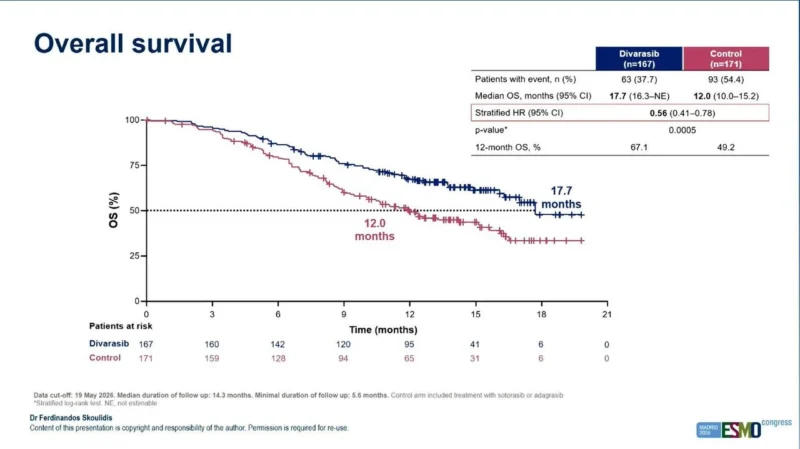
One of the most important findings from Krascendo 1 was the statistically significant improvement in overall survival. Median OS was 17.7 months (95% CI 16.3–not estimable) with divarasib compared with 12.0 months (95% CI 10.0–15.2) with sotorasib or adagrasib.
The stratified HR was 0.56 (95% CI 0.41–0.78; p=0.0005), representing a 44% reduction in the hazard of death. At 12 months, estimated overall survival was 67.1% with divarasib compared with 49.2% with control, an absolute difference of 17.9 percentage points.
By the analysis cutoff, 63 patients (37.7%) in the divarasib group and 93 (54.4%) in the control group had died. The OS analysis achieved statistical significance at the reported interim assessment. Although additional follow-up will refine longer-term survival estimates, the findings already provide randomized evidence of a survival advantage.
This is particularly consequential in KRAS G12C-mutated NSCLC, where previous targeted therapy development established the activity of KRAS inhibition but left important questions about comparative survival outcomes.
The concordant improvements in PFS and OS strengthen confidence that the benefit observed with divarasib is clinically meaningful rather than restricted to radiographic disease control.
Objective Response and Duration of Response
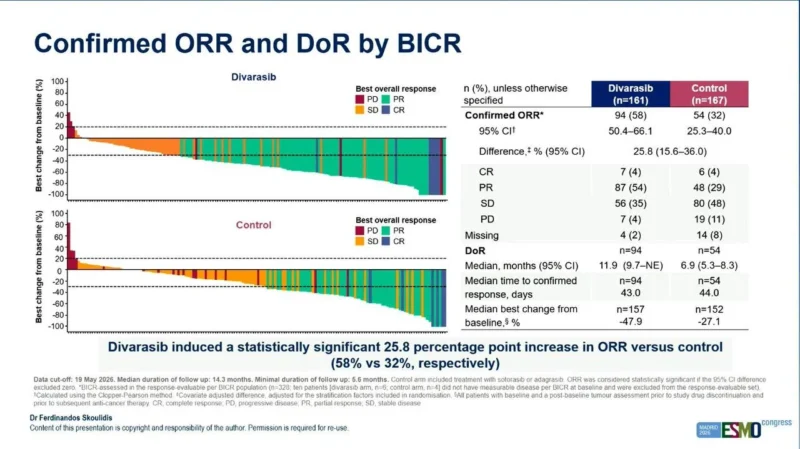
Tumor response outcomes also favored divarasib. Among response-evaluable patients, confirmed ORR by BICR was 58.4% (94 of 161 patients) with divarasib compared with 32.3% (54 of 167 patients) in the control arm.
This represented an absolute improvement of 25.8 percentage points (95% CI 15.6–36.0). Complete responses occurred in 4% of patients in each group, while partial responses were substantially more frequent with divarasib (54% versus 29%).
Responses were also more durable. Median DoR was 11.9 months (95% CI 9.7–not estimable) with divarasib compared with 6.9 months (95% CI 5.3–8.3) with control.
The median time to confirmed response was similar between groups, at 43 and 44 days, respectively. Among patients evaluable for tumor shrinkage, the median best percentage change from baseline was −47.9% with divarasib versus −27.1% with control.
These findings suggest that divarasib’s efficacy advantage was driven not by substantially faster responses, but by a higher probability of tumor response, greater tumor shrinkage, and more durable disease control.
Biomarker Considerations: KEAP1, PD-L1, and CNS Disease
Krascendo 1 incorporated several clinically relevant factors into its design, including KEAP1 mutation status and history of CNS metastases. KEAP1 alterations have been associated with adverse outcomes in KRAS-mutated NSCLC and represent an important consideration when evaluating the effectiveness of targeted treatment.
The reported PFS and OS advantages were generally consistent across clinically relevant subgroups, including patients categorized according to KEAP1 mutation status and PD-L1 expression.
However, subgroup consistency should not be interpreted as definitive evidence of equivalent efficacy across all molecular backgrounds, particularly where subgroup sizes and confidence intervals are limited.
The exclusion of patients with active, untreated CNS metastases also restricts conclusions regarding intracranial efficacy. Dedicated CNS analyses will be important for determining whether the improved systemic outcomes translate into meaningful intracranial disease control.
Safety: Fewer Severe Treatment-Related Events Despite Longer Exposure
The efficacy advantages of divarasib were accompanied by a favorable comparative safety profile in several clinically important categories. Any-grade adverse events occurred in 99.4% of patients receiving divarasib and 97.7% receiving control treatment.
Any-grade treatment-related adverse events were more frequent with divarasib, occurring in 92.8% versus 80.1% of patients. However, grade 3–4 treatment-related adverse events were less frequent with divarasib: 24.6% versus 34.5%.
Similarly, serious treatment-related adverse events occurred in 7.8% versus 15.2% of patients. Treatment-related adverse events leading to discontinuation were reported in 4.8% with divarasib versus 11.7% with control.
No grade 5 treatment-related adverse events were reported in either arm. The most common treatment-related toxicities were consistent with the KRAS G12C inhibitor class, particularly gastrointestinal adverse events, including diarrhea, nausea, and vomiting, as well as hepatotoxicity.
Importantly, median treatment duration was substantially longer with divarasib, reaching 11.3 months compared with 5.0 months in the control group.
The lower frequency of severe treatment-related toxicity and discontinuation despite longer exposure strengthens the comparative tolerability findings. Nevertheless, the high overall incidence of adverse events emphasizes the continued importance of gastrointestinal and hepatic monitoring.
Clinical Interpretation: Superior Efficacy Within the KRAS G12C Inhibitor Class
Krascendo 1 addresses a question that has become increasingly relevant as multiple KRAS-targeted therapies enter clinical development: whether newer inhibitors can deliver substantial clinical improvements over established agents targeting the same mutation.
The trial’s active comparator design is a major strength. Rather than demonstrating superiority over chemotherapy, divarasib showed statistically significant improvements in PFS, OS, and response outcomes compared with existing KRAS G12C inhibitors. However, the interpretation requires one important distinction.
Although the control arm permitted either sotorasib or adagrasib, approximately 91% of control patients received sotorasib. Consequently, the randomized evidence predominantly reflects a comparison with sotorasib, while the small adagrasib subgroup limits definitive conclusions about the magnitude of benefit relative to adagrasib individually.
Nevertheless, the overall efficacy findings are compelling. The 5.7-month difference in median OS, substantial improvement in response durability, and lower rates of severe treatment-related toxicity collectively support divarasib as a potential preferred KRAS G12C inhibitor in this setting.
At the time of presentation, divarasib remained investigational. Its integration into routine clinical practice will depend on regulatory authorization, availability, and subsequent guideline updates.
Limitations and Future Directions
Several limitations should be considered when translating Krascendo 1 into clinical practice. The study was open-label, although blinded independent central review reduced potential assessment bias for the primary endpoint.
The control arm was heavily weighted toward sotorasib, limiting conclusions regarding the relative efficacy of divarasib versus adagrasib specifically. The median follow-up of 14.3 months also means that longer-term OS, durability, and safety assessments remain relevant, despite the statistically significant survival result.
Patients with active, untreated CNS metastases were excluded, leaving uncertainty about efficacy in this clinically important population.
Finally, the study evaluated patients who had already received platinum-based chemotherapy and immunotherapy. Its findings should not be extrapolated directly to first-line treatment or to patients previously exposed to KRAS G12C inhibitors.
Future studies will determine whether divarasib can improve outcomes in earlier treatment lines, in combination with immunotherapy, or as part of broader approaches designed to prevent or overcome KRAS inhibitor resistance.
OncoDaily Takeaway
Krascendo 1 represents a major advance in KRAS G12C-targeted treatment development by demonstrating that a next-generation inhibitor can achieve statistically significant improvements in both progression-free and overall survival compared with established agents within the same class.
The 44% reduction in the hazard of death, together with a 42% reduction in the hazard of progression or death, provides compelling phase III evidence supporting the clinical effectiveness of divarasib. The nearly doubled response rate and longer duration of response further demonstrate the depth and durability of benefit.
The safety findings are equally relevant. Although any-grade treatment-related events were common, grade 3–4 treatment-related toxicity, serious treatment-related events, and discontinuations were less frequent with divarasib despite substantially longer treatment exposure.
For oncologists, the central message is that KRAS G12C inhibitors should no longer be viewed as necessarily interchangeable. Molecular target specificity alone does not guarantee equivalent clinical outcomes, and Krascendo 1 provides evidence that therapeutic differences within the class can translate into meaningful survival advantages.
Nevertheless, the predominance of sotorasib in the comparator arm, limited follow-up, uncertain intracranial efficacy, and pending regulatory decisions remain important considerations.
Krascendo 1 positions divarasib as a strong candidate to become a preferred KRAS G12C inhibitor for previously treated advanced NSCLC, while reinforcing the broader principle that precision oncology must continue to evaluate not only whether a molecular target can be inhibited, but how effectively and safely different agents can achieve sustained clinical benefit.
Source
- Skoulidis F, et al. Krascendo 1: Efficacy and safety of divarasib versus sotorasib or adagrasib in previously treated locally advanced or metastatic KRAS G12C-mutated NSCLC.