At the ESMO Congress 2026 Presidential Symposium III, Lu Xie (Beijing, China) presented primary results from the phase III ARTEMIS-011 trial (NCT06935409), evaluating risvutatug rezetecan (Ris-Rez; HS-20093/GSK5764227), a B7-H3-targeted antibody–drug conjugate (ADC), compared with gemcitabine and docetaxel in patients with heavily pretreated relapsed or refractory osteosarcoma.
The investigational therapy demonstrated a statistically significant improvement in median progression-free survival (PFS) of 5.5 months versus 1.4 months with chemotherapy, representing a 67% relative reduction in the hazard of disease progression or death (HR 0.33; p<escape><</escape>0.0001).
Methods
ARTEMIS-011 is a multicenter, randomized, open-label phase III trial evaluating the efficacy and safety of risvutatug rezetecan compared with gemcitabine plus docetaxel in patients with relapsed or refractory osteosarcoma.
Eligible patients were aged 12 years or older, had pathologically confirmed osteosarcoma with disease progression or intolerance following at least two prior lines of systemic therapy, at least one measurable lesion according to RECIST v1.1, and an ECOG performance status of 0–1.
A total of 122 patients were randomized 2:1 to receive:
- Risvutatug rezetecan: 12.0 mg/kg intravenously on day 1 of each three-week cycle.
- Control: Gemcitabine 1,000 mg/m² intravenously on days 1 and 8, plus docetaxel 75 mg/m² intravenously on day 8, every three weeks.
Treatment continued until disease progression, unacceptable toxicity, or withdrawal of consent. Patients in the chemotherapy group meeting prespecified criteria were permitted to cross over to Ris-Rez following objective disease progression.
Randomization was stratified by age (12 to under 18 years versus 18 years or older) and the presence of lung metastases.
The primary endpoint was progression-free survival assessed by blinded independent central review (BICR) according to RECIST v1.1. Secondary endpoints included overall survival, investigator-assessed PFS, objective response rate, disease control rate, duration of response, and safety.
Key Takeaways
At the June 17, 2026, data cutoff, 80 patients had been randomized to risvutatug rezetecan and 42 to gemcitabine plus docetaxel. Median follow-up was 7.1 months.
- Progression-free survival: Median BICR-assessed PFS was 5.5 months with Ris-Rez versus 1.4 months with chemotherapy (HR 0.33; p<0.0001).
- Investigator-assessed PFS: Median PFS was 5.6 months versus 1.0 month, supporting the primary analysis.
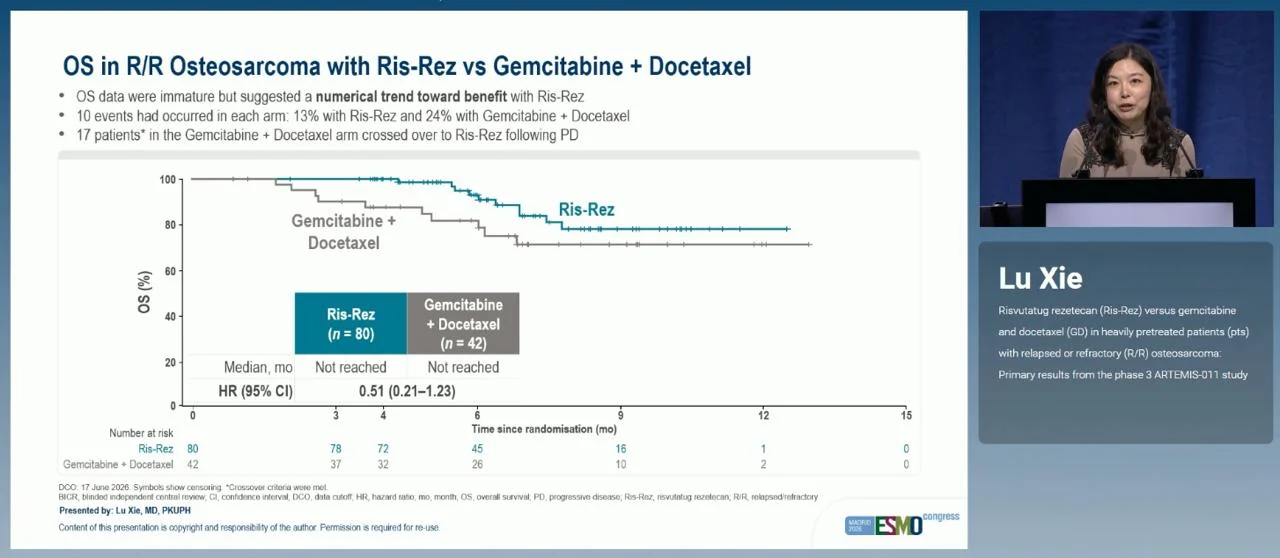
- Overall survival: OS data remained immature, although a favorable trend was observed with Ris-Rez (HR 0.51).
- Adolescent population: The median age was 21 years, with 25.4% of patients aged 12–18 years.
- Grade ≥3 adverse events: Treatment-emergent adverse events occurred in 92.5% of patients receiving Ris-Rez versus 83.3% receiving chemotherapy.
- Serious treatment-related adverse events: Reported in 63.8% of patients receiving Ris-Rez compared with 28.6% in the chemotherapy group, primarily driven by hematologic toxicities.
- Treatment discontinuation: Treatment-related adverse events led to discontinuation in 3.8% of patients receiving Ris-Rez versus 2.4% receiving chemotherapy.
- Interstitial lung disease: One grade 2 treatment-related ILD event occurred in the Ris-Rez group and subsequently resolved.
- Treatment-related mortality: No treatment-related deaths were reported.
- Objective response rate: BICR-assessed ORR was 15% with Ris-Rez versus 2% with gemcitabine plus docetaxel.
- Disease control rate: BICR-assessed DCR reached 76% with Ris-Rez compared with 33% in the chemotherapy group.
- Duration of response: Median DoR was 7.6 months with Ris-Rez and was not reached in the control group, where only one patient achieved a partial response.
- Four-month PFS: Rates were 65% with Ris-Rez versus 33% with gemcitabine plus docetaxel.
- Dose reductions: Treatment-related adverse events led to dose reductions in 71% of patients receiving Ris-Rez compared with 26% receiving chemotherapy.
Conclusion
The phase III ARTEMIS-011 trial demonstrated a statistically significant and clinically meaningful improvement in progression-free survival with risvutatug rezetecan compared with gemcitabine and docetaxel in heavily pretreated patients with relapsed or refractory osteosarcoma.
The 5.5-month median PFS versus 1.4 months with chemotherapy, together with a 67% reduction in the hazard of disease progression or death, highlights the potential of B7-H3-directed ADC therapy in this difficult-to-treat population. Higher objective response and disease control rates further support its antitumor activity.
Although overall survival showed a favorable numerical trend (HR 0.51; 95% CI, 0.21–1.23), the data remain immature, and an OS benefit has not been established. Higher rates of serious treatment-related adverse events and dose reductions with Ris-Rez also warrant careful consideration.
These findings support risvutatug rezetecan as a promising investigational treatment option for relapsed or refractory osteosarcoma, while longer follow-up is needed to clarify its survival benefit and long-term safety.
Source: ESMO Congress 2026, ARTEMIS-011 Abstract; ARTEMIS-011 (NCT06935409).