An interim analysis of the phase III MOIO trial did not establish progression-free survival (PFS) non-inferiority for immune checkpoint inhibitors administered every 12 weeks compared with standard schedules in responding patients with advanced solid tumors.
Reduced-frequency treatment was associated with a concerning overall survival (OS) signal, while reported rates of severe immune-related adverse events and serious adverse events were similar between groups.
Gwenaëlle Gravis presented the findings during Presidential Symposium III at ESMO Congress 2026 (abstract LBA10).
Background
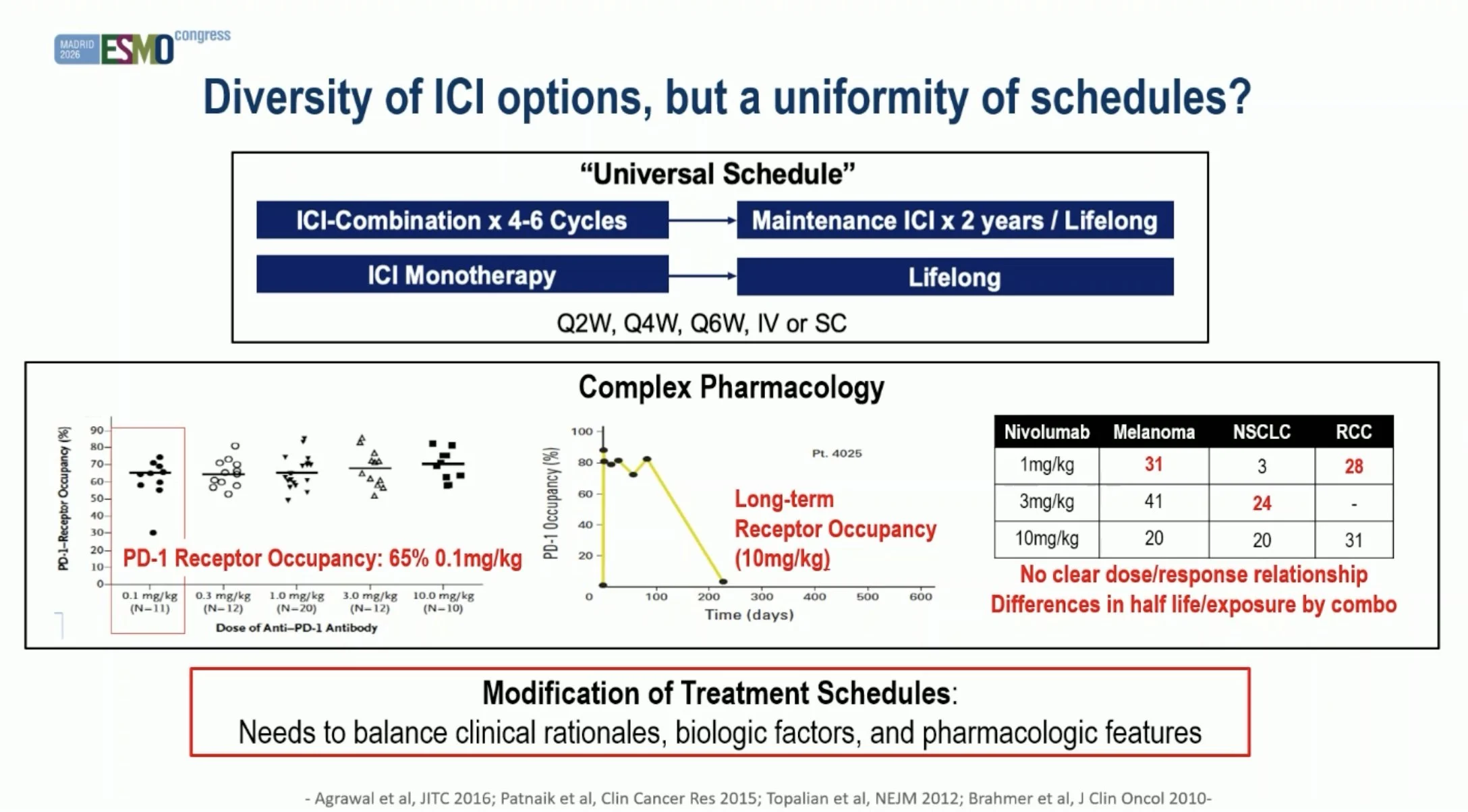
Durable responses and prolonged immune checkpoint inhibitor target engagement have prompted investigation of less frequent treatment administration. Extending treatment intervals could reduce treatment burden, but requires evidence that efficacy is preserved.
MOIO evaluated whether patients responding after six months of immunotherapy could receive treatment every 12 weeks without an unacceptable loss of disease control.
Methods and Study Design
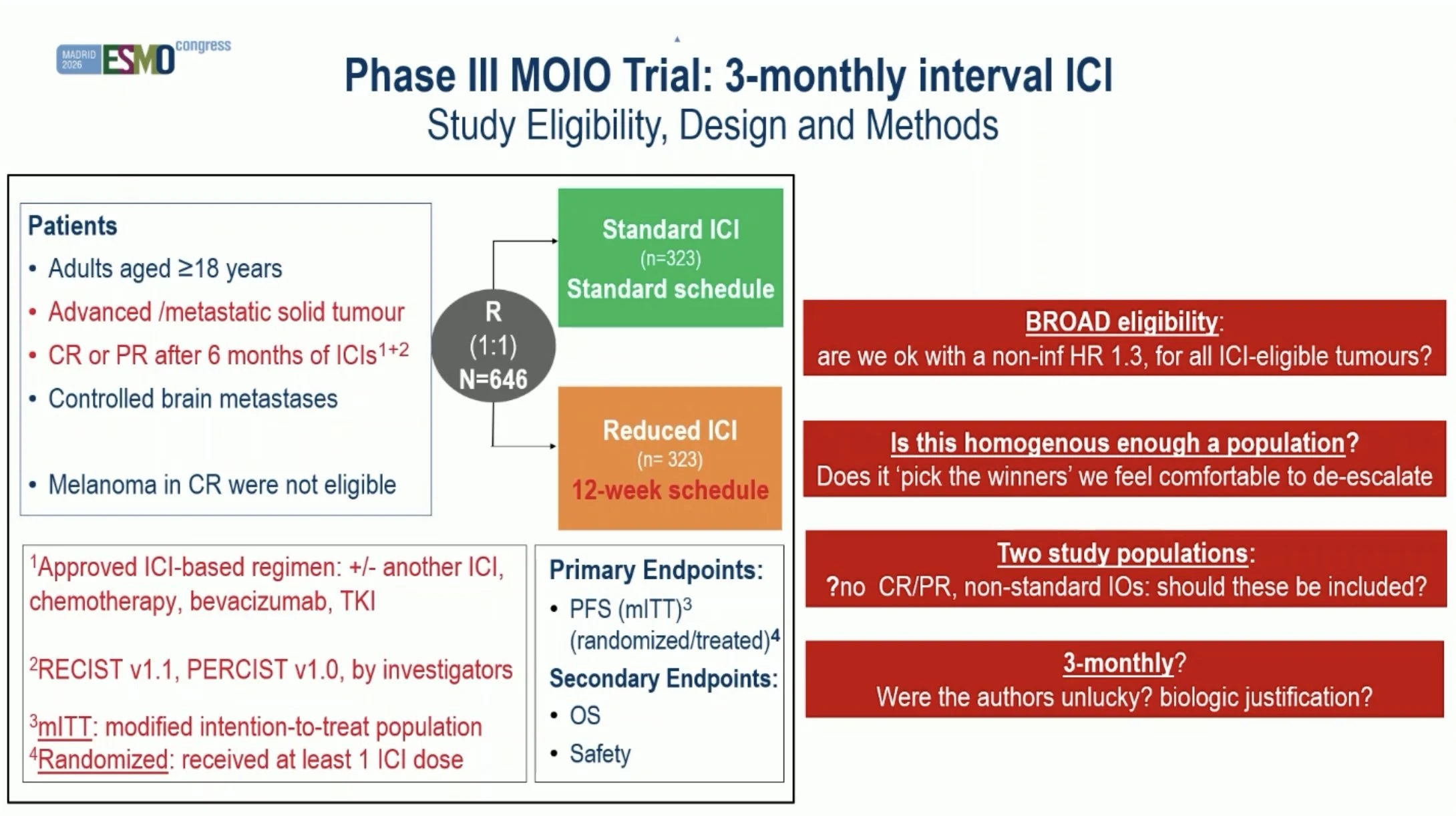
MOIO (NCT05078047) is an academic, multicenter, randomized phase III non-inferiority trial conducted at 36 French centers.
Eligible adults had locally advanced or metastatic solid tumors and a complete or partial response after six months of an approved immune checkpoint inhibitor–based regimen. Patients with controlled brain metastases were eligible, while patients with melanoma in complete response were excluded.
The planned enrollment was 646 patients, randomized 1:1 to:
- Standard treatment: Immune checkpoint inhibitors continued according to their standard dosing schedules.
- Reduced-frequency treatment: The same dose administered every 12 weeks.
Randomization was stratified by complete versus partial response, PD-1 versus PD-L1 treatment, tumor type, and first versus later treatment line.
The primary PFS assessments included the modified intention-to-treat population and the randomized-and-treated population. The non-inferiority HR margin was 1.30. Two interim futility analyses were planned at 25% and 50% of the 498 anticipated PFS events.
Secondary endpoints included OS and safety. PFS was measured from randomization to progression or death from any cause.
Results
Between March 2022 and November 2025, 340 patients were randomized. The reported modified intention-to-treat analysis included 308 patients, with median follow-up of 18.6 months.
- Progression-free survival: Median PFS was 25.0 months (95% CI 19.4–not estimable) with standard treatment versus 21.9 months (95% CI 12.1–31.6) with reduced-frequency treatment. The HR for reduced-frequency versus standard treatment was 1.35 (95% CI 0.90–2.00). Non-inferiority was not established.
- Overall survival: Reduced-frequency treatment was associated with a higher hazard of death (HR 2.00; 95% CI 1.10–3.90; reported P = 0.0143). This secondary-endpoint finding raises concern about reduced efficacy and requires interpretation in the context of the interim analysis.
- Tumor-specific findings: PFS HRs for reduced-frequency versus standard treatment were 2.9 in urothelial cancer (95% CI 1.3–6.7), 1.6 in lung cancer (95% CI 0.8–3.1), 0.7 in renal cell carcinoma (95% CI 0.3–1.5), and 0.6 in head and neck cancer (95% CI 0.1–2.4). These subgroup estimates were imprecise and do not establish tumor-specific suitability for reduced-frequency treatment.
- Immune-related toxicity: Grade 3–4 immune-related adverse events occurred in 10.5% of patients receiving standard treatment versus 9.5% receiving reduced-frequency treatment.
- Serious adverse events: Rates were 26.3% versus 25.0%, respectively. These observed rates did not indicate an apparent safety improvement with the longer interval.
Interpretation
The interim analysis did not demonstrate that administering immune checkpoint inhibitors every 12 weeks preserved PFS within the prespecified non-inferiority margin.
Failure to establish non-inferiority should be distinguished from proving statistically significant PFS inferiority: the PFS confidence interval included both 1 and the non-inferiority margin of 1.30. Nevertheless, the OS finding raises concern about the reduced-frequency strategy.
The study included different tumor types, treatment lines, and immunotherapy regimens. The subgroup results do not identify populations in which extending treatment to every 12 weeks can be considered established practice.
The reported severe immune-related and serious adverse-event rates were similar between groups. These findings do not establish safety equivalence, and fewer administrations should not be assumed to provide a clinical safety benefit.
Conclusion
The interim MOIO findings do not support routinely extending immune checkpoint inhibitor administration to every 12 weeks in responding patients across advanced solid tumors.
PFS non-inferiority was not established, and the observed OS signal raises concern about reduced efficacy without an apparent reduction in the reported severe immune-related adverse events or serious adverse events. Further follow-up and disease-specific investigation are needed to clarify whether selected patients can safely receive less frequent treatment.