The randomized phase II Combi-TED study reported one-year overall survival (OS) proportions of 47% with OSE2101 plus docetaxel and 46% with OSE2101 plus nivolumab, compared with 29% with docetaxel alone, in HLA-A2-positive patients with advanced non-small cell lung cancer (NSCLC) progressing after first-line chemo-immunotherapy.
Both vaccine-containing arms exceeded the prespecified 20% one-year survival benchmark. However, the study used a non-comparative statistical design, and the findings do not establish superiority over docetaxel.
Federico Cappuzzo presented the findings at ESMO 2026 (abstract 2661RO).
Background
Outcomes remain poor after progression on first-line chemo-immunotherapy in advanced NSCLC. OSE2101 is a neo-epitope vaccine designed to induce antigen-specific cytotoxic T-cell responses in HLA-A2-positive patients.
Combi-TED investigated OSE2101 combined with docetaxel or nivolumab in this setting. Patients with primary resistance to immunotherapy were excluded, which is important when interpreting the results.
Methods and Study Design
Combi-TED was a randomized, non-comparative phase II study with three parallel treatment arms.
Eligible patients had metastatic or unresectable HLA-A2-positive NSCLC without actionable EGFR mutations or ALK/ROS1 rearrangements and had progressed after first-line chemo-immunotherapy.
A total of 106 patients were randomized to:
- OSE2101 plus docetaxel (n = 36): Docetaxel 60 mg/m² intravenously every three weeks for up to six cycles, combined with subcutaneous OSE2101 every three weeks for six cycles.
- OSE2101 plus nivolumab (n = 35): Intravenous nivolumab plus subcutaneous OSE2101 every three weeks for six cycles.
- Docetaxel alone (n = 35): Docetaxel 75 mg/m² intravenously every three weeks for up to six cycles.
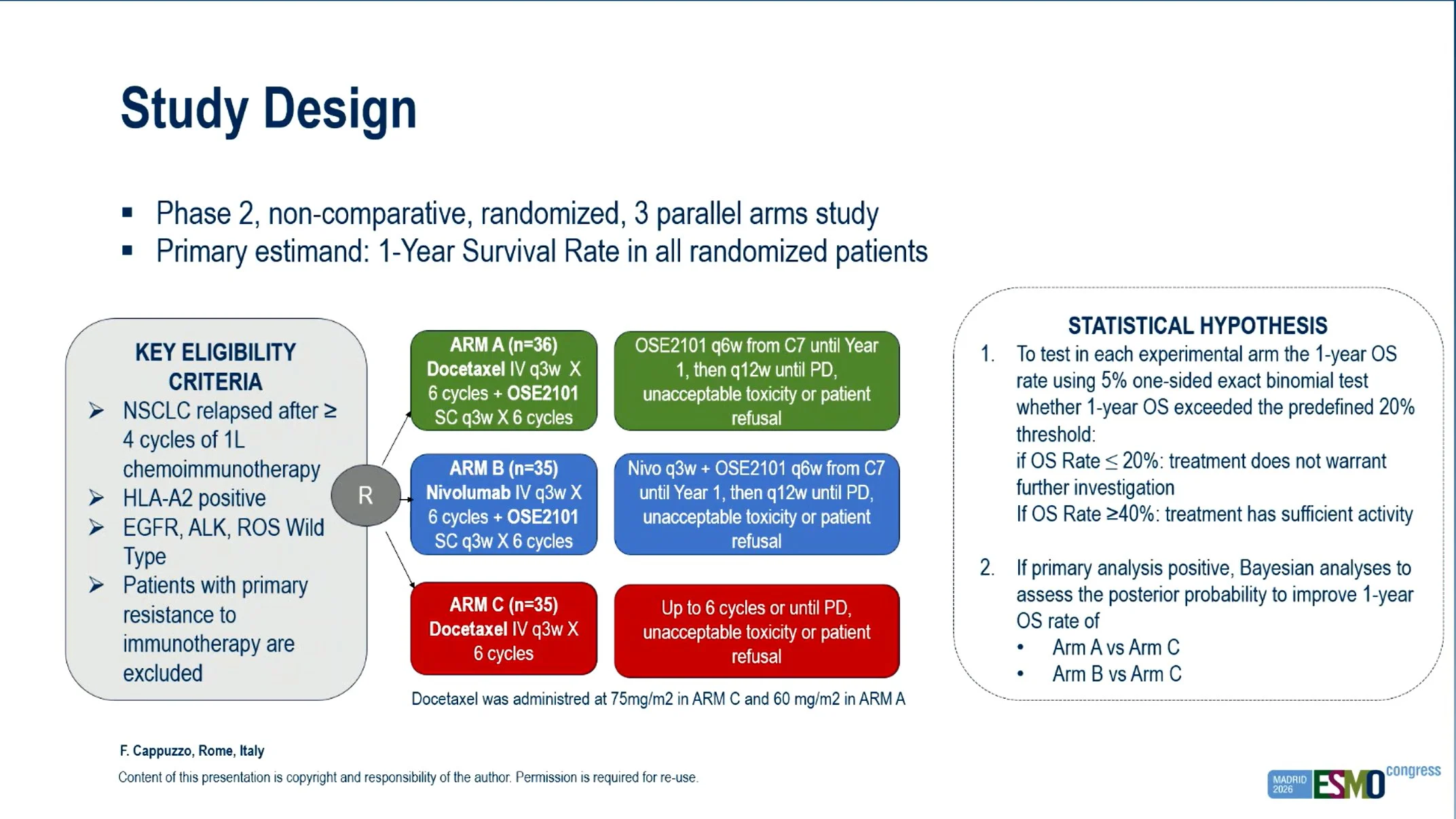
From cycle 7, OSE2101 was administered every six weeks until year 1, then every 12 weeks. Nivolumab continued every three weeks in the corresponding combination arm. Treatment continued according to the protocol until progression, unacceptable toxicity, or patient refusal.
The primary endpoint was one-year OS. Each experimental arm was tested against a predefined 20% survival benchmark using a one-sided exact binomial test at a 5% significance level.
Bayesian analyses assessed the posterior probability of improved one-year OS with each experimental regimen versus docetaxel alone. The presentation described a probability greater than 95% as the criterion for considering an experimental arm promising.
Additional outcomes included OS, progression-free survival (PFS), tumor response, and safety.
Results
The updated presentation used an October 1, 2026 data snapshot, with median follow-up of 27 months.
Primary One-Year Survival Analysis
- OSE2101 plus docetaxel: One-year OS was 47% (17/36; 90% CI 33–62), exceeding the predefined 20% benchmark (one-sided P <0.001).
- OSE2101 plus nivolumab: One-year OS was 46% (16/35; 90% CI 31–61), also exceeding the benchmark (one-sided P <0.001).
- Docetaxel alone: One-year OS was 29% (10/35; 90% CI 16–44), which did not significantly exceed the benchmark (one-sided P = 0.15).
Four patients withdrew consent before the one-year timepoint and had insufficient follow-up.
The P values refer to comparisons against the 20% benchmark, rather than direct comparisons between treatment arms.
Bayesian Analyses
The posterior probability of improved one-year OS versus docetaxel alone was:
- 94.6% for OSE2101 plus docetaxel.
- 92.8% for OSE2101 plus nivolumab.
Both analyses numerically favored the experimental combinations, but neither reached the greater-than-95% criterion described in the presentation.
Overall Survival
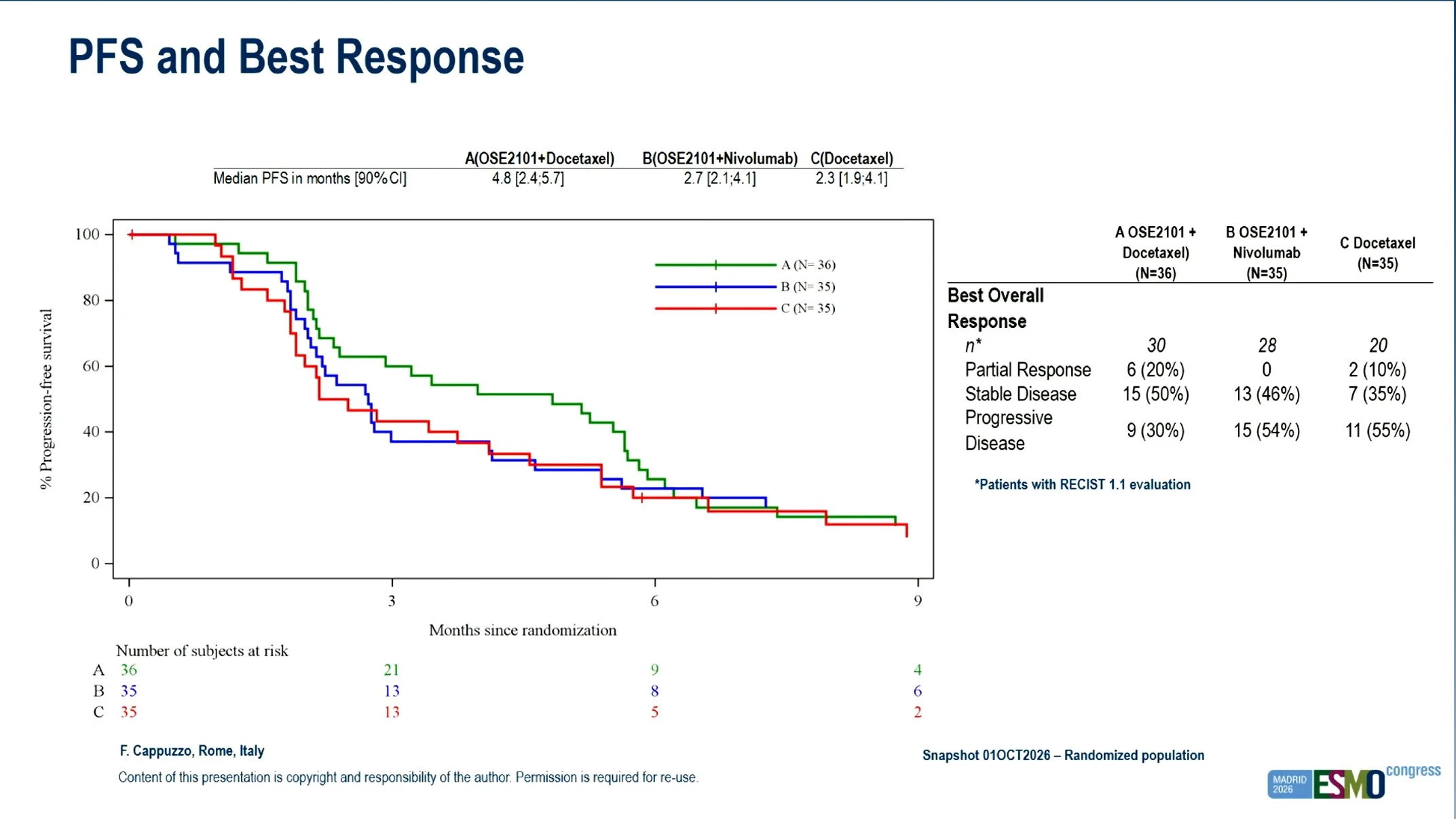
Median OS was:
- 11.9 months (90% CI 8.9–15.3) with OSE2101 plus docetaxel.
- 11.3 months (90% CI 6.1–13.3) with OSE2101 plus nivolumab.
- 6.4 months (90% CI 5.2–9.0) with docetaxel alone.
The Kaplan–Meier analysis separately estimated one-year OS at 47%, 48%, and 31%, respectively. These estimates differ from the proportions used in the primary binomial analysis because the methods handle follow-up and censoring differently.
Subsequent systemic anticancer treatment was administered to 66%, 53%, and 41% of patients, respectively.
Progression-Free Survival and Response
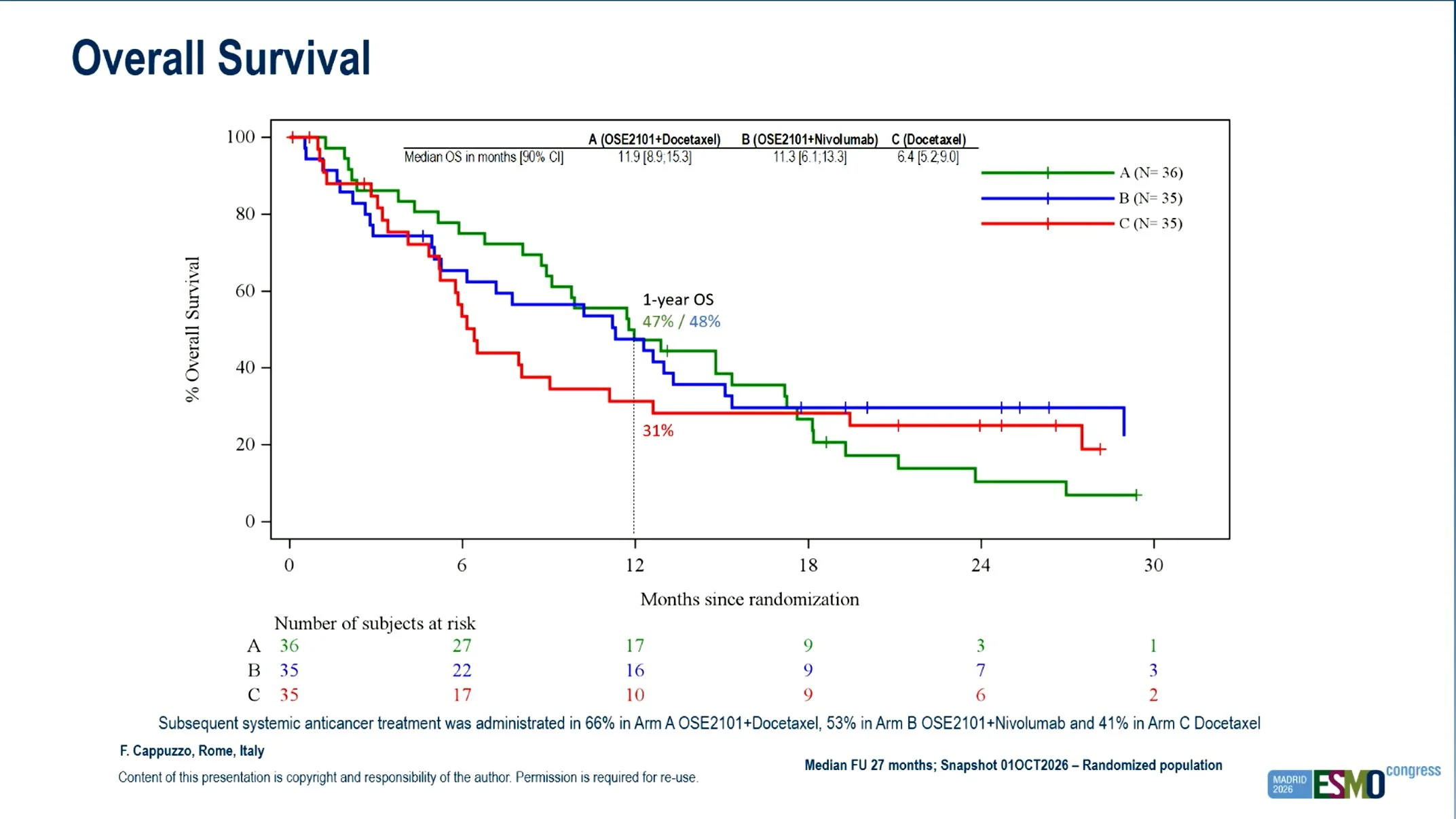
Median PFS was:
- 4.8 months (90% CI 2.4–5.7) with OSE2101 plus docetaxel.
- 2.7 months (90% CI 2.1–4.1) with OSE2101 plus nivolumab.
- 2.3 months (90% CI 1.9–4.1) with docetaxel alone.
Among patients with RECIST 1.1 response assessments, partial responses occurred in 6 of 30 patients (20%) receiving OSE2101 plus docetaxel, none of 28 receiving OSE2101 plus nivolumab, and 2 of 20 (10%) receiving docetaxel alone.
Stable disease was reported in 50%, 46%, and 35% of these response-evaluable populations, respectively. These response denominators were smaller than the randomized populations.
Safety
In the earlier abstract analysis, treatment-related adverse events were reported in 89% of patients receiving OSE2101 plus docetaxel, 82% receiving OSE2101 plus nivolumab, and 79% receiving docetaxel alone.
Drug-related serious adverse events occurred in 17%, 24%, and 17%, respectively. The abstract reported no unexpected safety signals.
These safety figures come from the earlier abstract analysis rather than the updated October presentation slides supplied for review. They do not establish equivalent toxicity between regimens. Docetaxel dosing also differed between the combination and monotherapy arms.
Interpretation
Both OSE2101-containing regimens met the study’s benchmark-based assessment of one-year survival. Median OS was numerically longer in the experimental arms than with docetaxel alone.
However, randomization should be distinguished from the study’s non-comparative statistical design. The primary tests assessed each experimental regimen against a historical survival threshold and did not establish superiority over the control arm. Neither Bayesian comparison reached the greater-than-95% criterion described in the presentation.
The small treatment groups, exclusion of patients with primary immunotherapy resistance, different docetaxel doses, and differences in subsequent treatment use also limit interpretation.
Conclusion
Combi-TED identified survival signals with OSE2101 plus docetaxel or nivolumab after first-line chemo-immunotherapy in selected HLA-A2-positive patients with advanced NSCLC.
Both combinations exceeded the prespecified 20% one-year OS benchmark, supporting further investigation. Confirmatory comparative studies are needed to establish whether either regimen improves survival over existing treatment options.
PERSEE Trial: Pembrolizumab With or Without Chemotherapy in PD-L1–High NSCLC