
Muna Al-Khaifi, GP Oncologist at Mount Sinai Hospital (Toronto), Sinai Health. This article explores why cancer survivorship should begin at diagnosis rather than after treatment ends, emphasizing that survival alone is no longer an adequate measure of successful cancer care. Drawing on contemporary evidence, it examines the growing burden of long-term physical, psychological, cognitive, and social effects experienced by cancer survivors, highlights the importance of early multidisciplinary survivorship care, and outlines practical recommendations for integrating survivorship into routine oncology practice to improve long-term health, function, and quality of life across the cancer continuum.
Cancer Survivorship Starts Before Treatment Ends: Why Early Survivorship Care Must Become the Standard
Cancer survivorship is a state of being that encompasses the perspectives, needs, health, and the physical, psychological, social, and economic challenges experienced by individuals following a cancer diagnosis, as well as those faced by their care partners and family members. The importance of delivering comprehensive survivorship care continues to grow as the global cancer burden increases.
More than 20 million new cancer cases are diagnosed worldwide each year, and this number is projected to rise to 35 million by 2050. At the same time, advances in early detection, surgery, chemotherapy, radiotherapy, immunotherapy, and targeted therapies have substantially improved survival, resulting in a rapidly expanding population of cancer survivors. While these advances represent remarkable progress, survival alone is no longer an adequate measure of successful cancer care. Increasingly, attention must shift toward optimizing long-term health, functioning, and quality of life throughout the cancer continuum.
For many individuals, the completion of treatment does not signify the end of the cancer experience but rather the beginning of a new phase of care. Survivorship is frequently accompanied by persistent physical, psychological, cognitive, and social consequences that may continue for months or years after treatment and require proactive, coordinated management. Common long-term concerns include fatigue, chronic pain, peripheral neuropathy, cognitive impairment, sleep disturbances, anxiety, depression, and reduced physical functioning, many of which persist well beyond the completion of treatment.
Evidence consistently demonstrates that survivorship needs are common and frequently unmet. Approximately 70–80% of cancer survivors experience at least one long-term or late effect related to cancer or its treatment. Survivors report an average of 4.9 unmet survivorship needs, with 67% experiencing at least one unmet need, most commonly related to fear of cancer recurrence, psychological distress, care coordination, and the adverse effects of endocrine therapies.
Similarly, 72.1% of survivors report at least one unmet supportive care need, with the greatest needs relating to health system and information (57.6%), psychological support (50.6%), physical and daily living concerns (39.4%), patient care and support (30.4%), and sexuality (27.3%). Collectively, these findings demonstrate that survival is only one component of successful cancer care and highlight the importance of integrating comprehensive survivorship care early in the cancer journey to address evolving patient needs and optimize long-term quality of life.
Why Early Survivorship Care Matters
Survivorship care should no longer be viewed as a phase that begins after treatment completion but rather as a continuous, proactive process that starts at diagnosis and extends across the entire cancer continuum. Delaying survivorship care until the end of treatment often means that treatment-related toxicities, functional decline, and psychosocial concerns have already become established and more difficult to manage. Integrating survivorship care early provides an opportunity to prevent complications, optimize health outcomes, and improve quality of life while patients are receiving active cancer treatment.
Early survivorship care should encompass
- routine screening for physical, psychological, cognitive, sexual, and functional concerns using standardized assessments and patient-reported outcome measures to facilitate early detection of treatment-related effects;
- individualized survivorship care planning that is initiated at diagnosis and updated throughout treatment to address patients’ evolving needs;
- timely referral to multidisciplinary supportive care services, including rehabilitation, physiotherapy, occupational therapy, nutrition, psychosocial care, sexual health services, fertility counselling, and palliative care;
- patient education regarding expected short- and long-term treatment effects to promote self-management and informed decision-making; and
- coordinated follow-up between oncology, primary care, and allied health professionals to ensure continuity of care throughout survivorship.
This proactive approach is supported by the growing burden of survivorship needs. Approximately 70-80% of cancer survivors experience at least one long-term or late effect of cancer or its treatment, while 72.1% report at least one unmet supportive care need. Early identification of impairments and prompt referral to appropriate supportive care services can improve symptom management, preserve physical function and independence, reduce preventable complications and healthcare utilization, and ultimately enhance long-term survivorship outcomes across the cancer continuum.
Table 1. Recommendations for Integrating Early Survivorship Care into Routine Oncology Practice
| Recommendation | Priority for Early Survivorship Care |
| Recognize survivorship as a continuous phase of cancer care that begins at diagnosis and integrate survivorship principles into routine oncology care across the entire cancer continuum. | Recognition and integration. Establish a shared definition of survivorship that begins at diagnosis and encompasses the physical, psychological, social, functional, and financial needs of patients and their caregivers. This definition should be embedded within institutional policies, clinical guidelines, healthcare systems, and professional practice to ensure survivorship is recognized as a core component of oncology care rather than a post-treatment service. |
| Integrate routine evidence-based screening for physical, psychosocial, cognitive, and functional concerns into active cancer treatment to enable early identification and management of survivorship needs. | Early identification of survivorship needs. Implement standardized screening tools and patient-reported outcome measures (PROMs) throughout treatment to identify treatment-related toxicities, psychosocial distress, functional decline, cognitive impairment, and unmet supportive care needs. Routine assessment should trigger timely referral and intervention before complications become chronic. |
| Develop and expand coordinated multidisciplinary models that integrate oncology, primary care, rehabilitation, psychosocial services, and palliative care throughout the cancer continuum. | Coordinated multidisciplinary care and early referral. Establish integrated care pathways that promote early referral to rehabilitation, physiotherapy, occupational therapy, nutrition, psychology, social work, sexual health, fertility, and palliative care services. Collaborative care models should ensure continuity of care across the cancer continuum and improve quality of life, symptom management, and functional outcomes. |
| Expand survivorship education, training, and competency development across the multidisciplinary healthcare workforce to support the delivery of early survivorship care. | Education and workforce development. Introduce survivorship education early in undergraduate curricula, residency and fellowship training, and continuing professional development. Training should extend beyond oncology specialists to include primary care physicians, nurses, allied health professionals, pharmacists, and community providers to ensure competency in recognizing and managing survivorship needs throughout the cancer continuum. |
| Prioritize research evaluating the effectiveness, implementation, and sustainability of early survivorship interventions and models of care. | Research focused on early survivorship. Future research should evaluate interventions initiated during active treatment, identify optimal timing for supportive care referral, develop validated early survivorship outcome measures, investigate implementation strategies across healthcare settings, and assess cost-effectiveness and long-term patient-centred outcomes beyond survival. Research should also prioritize reducing disparities and addressing unmet survivorship needs across diverse populations. |
| Establish standardized quality indicators that evaluate the delivery and outcomes of early survivorship care across the cancer continuum. | Quality improvement and accountability. Develop quality indicators that measure timely screening, early referral to supportive care services, multidisciplinary care coordination, patient-reported outcomes, symptom burden, quality of life, functional recovery, and equitable access to survivorship services. These measures should support benchmarking, continuous quality improvement, and healthcare system accountability for delivering early survivorship care. |
The Role of Healthcare Institutions
Healthcare institutions play a central role in ensuring survivorship care is embedded as a standard component of high-quality cancer care rather than an optional service delivered after treatment completion. As the number of cancer survivors continues to rise, institutions should implement comprehensive, standardized survivorship pathways that begin at diagnosis and extend across the cancer continuum.
This includes routine screening for physical, psychological, cognitive, functional, and social concerns; the development of individualized survivorship care plans that are regularly updated; timely referral to multidisciplinary supportive care services; and coordinated communication between oncology specialists, primary care providers, and allied health professionals. Institutions should also expand access to dedicated survivorship clinics where appropriate, invest in workforce education, and support research that advances evidence-based survivorship care and long-term outcomes.
Although many cancer centres provide important survivorship services, considerable variation remains in their availability and delivery. Preventive services such as screening for new cancers, nutritional counselling, and referrals to specialist services are commonly available, whereas treatment summaries, survivorship care plans, sexual health support, and fertility services are offered less consistently. Furthermore, survivorship care is predominantly delivered within oncology treatment teams rather than through dedicated survivorship clinics, highlighting opportunities to strengthen specialized survivorship programs and improve care coordination. Standardizing survivorship services across healthcare systems, while ensuring equitable access regardless of geographic location, socioeconomic status, or background, will help reduce disparities, facilitate early referral to supportive care services, and improve long-term outcomes.
Strengthening Survivorship Research
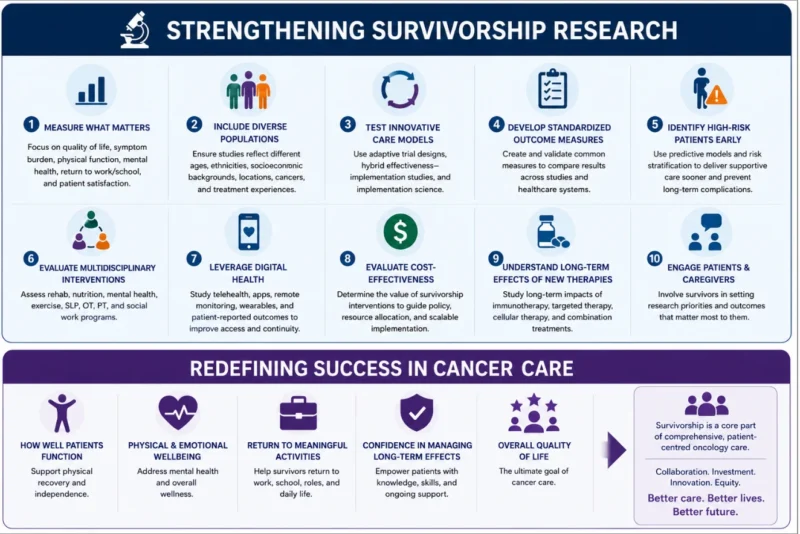
Future research should prioritize outcomes that reflect high-quality survivorship care, including symptom burden, physical function, psychological wellbeing, quality of life, return to work or education, functional independence, and patient-reported outcomes. Greater emphasis is also needed on identifying and addressing unmet survivorship needs, understanding disparities in access and outcomes across diverse populations, and ensuring that research findings are representative of different cancer types, treatment modalities, age groups, and socioeconomic and geographic settings. Developing standardized survivorship outcome measures will enable meaningful comparisons across studies and facilitate consistent evaluation of survivorship care across healthcare systems.
Research should also focus on evaluating innovative and sustainable models of survivorship care that can be integrated into routine clinical practice. This includes assessing multidisciplinary survivorship programs, early rehabilitation, supportive care interventions, digital health technologies, telehealth, remote symptom monitoring, and personalized risk-stratified approaches that enable earlier identification of patients at risk of long-term treatment-related complications. As novel therapies, including immunotherapy, targeted therapies, and cellular therapies, continue to transform cancer care, understanding their long-term effects and survivorship implications will become increasingly important. Equally important is engaging patients and caregivers as research partners to ensure future studies address outcomes that are meaningful to those living with and beyond cancer.
Strengthening survivorship research will provide the evidence needed to improve clinical practice, inform healthcare policy, optimize resource allocation, and reduce disparities in survivorship care. As survival continues to improve worldwide, research should increasingly focus on understanding, preventing, and addressing the unmet physical, psychological, functional, and social needs experienced across the cancer continuum. Generating robust evidence on interventions that improve long-term health, function, and quality of life will be essential to ensuring that every cancer survivor receives comprehensive, equitable, and evidence-based survivorship care.
Survivorship Research for People Living with Advanced and Metastatic Cancers
Survivorship research has historically focused on individuals with early-stage cancers, leaving the needs of those living with advanced and metastatic disease comparatively underrepresented. However, as advances in targeted therapies and immunotherapies continue to improve survival, the population of people living with incurable cancers is increasing, with over 18.6 million cancer survivors currently living in the United States. Survivorship for this population extends beyond survival itself and includes managing long-term treatment, symptom burden, psychosocial challenges, financial toxicity, caregiver needs, and ongoing prognostic uncertainty. Recognition of these needs has grown, reflected by an increase in National Cancer Institute-funded survivorship research from to 25 grants in, alongside the development of multidisciplinary survivorship care standards that promote patient-centred care.
Important research priorities include improving methods to identify people living with advanced and metastatic cancers within healthcare databases, integrating survivorship, primary, and palliative care, and addressing the long-term financial, physical, and psychosocial impacts experienced by both patients and caregivers. Additional priorities include incorporating biomarker and longitudinal symptom data into survivorship research, evaluating innovative care models such as telehealth and peer navigation, and developing interventions that better support individuals experiencing prognostic uncertainty. Greater emphasis on communication strategies, validated patient-reported outcome measures, and early palliative care integration will help ensure care is aligned with the complex and evolving needs of this growing patient population.
The Bottom Line: Redefining Success in Cancer Care
The success of cancer care can no longer be measured by survival alone. As the global number of cancer survivors continues to rise, high-quality cancer care must also be evaluated by how well individuals live after diagnosis and treatment. This includes preserving physical function, psychological wellbeing, quality of life, the ability to return to meaningful daily activities, and confidence in managing the long-term effects of cancer and its treatment.
Achieving this vision requires a fundamental shift in how survivorship is delivered. Survivorship care should begin at diagnosis, be integrated throughout the entire cancer continuum, and include proactive assessment, early referral to multidisciplinary supportive care services, individualized care planning, and coordinated long-term follow-up. Continued investment in survivorship research, standardized models of care, healthcare workforce education, and equitable access to services will be essential to meeting the needs of the growing survivor population.
Survivorship is not an optional phase of cancer care but an essential component of comprehensive, patient-centred oncology practice. The future of oncology depends not only on helping people live longer but on ensuring they live healthier, more functional, and more fulfilling lives after cancer. Success should be defined not only by years of survival, but by the quality of those years.
References (selected)
Mollica, M. A., Feldman, J., Gallicchio, L., Tonorezos, E. S., Petrillo, L. A., & El-Jawahri, A. (2026). Beyond Diagnosis: Survivorship Research for People Living with Advanced and Metastatic Cancers. Cancer epidemiology, biomarkers & prevention : a publication of the American Association for Cancer Research, cosponsored by the American Society of Preventive Oncology, 35(5), 692–697. https://doi.org/10.1158/1055-9965.EPI-25-1721
Nekhlyudov, L., Anampa-Guzmán, A., Awati, N., Vos, J., & Ganschow, P. S. (2026). Description of Survivorship Recommendations in Disease-Based NCCN Guidelines. Journal of the National Comprehensive Cancer Network, 24(3), Article e257101, e257101. Retrieved Jul 14, 2026, from https://doi.org/10.6004/jnccn.2025.7101
Michael Jefford et al. Still Lost in Transition? A 20-Year Reflection on Cancer Survivorship Care. J Clin Oncol 0, JCO-26-00759
Gomez, S.L., Shariff-Marco, S., Cortella, A. et al. Survivorship care guidance in a diverse cancer survivor population: Cancer Registry for Understanding and Improving Survivorship Experiences (CRUISE) Study. J Cancer Surviv (2026). https://doi.org/10.1007/s11764-026-01970-1
Springer, F., Mehnert-Theuerkauf, A., Gebhardt, C., Stolzenburg, J. U., & Briest, S. (2024). Unmet supportive care needs among cancer patients: exploring cancer entity-specific needs and associated factors. Journal of cancer research and clinical oncology, 150(4), 190. https://doi.org/10.1007/s00432-024-05715-4
Figure 1. Framework for improving cancer survivorship through research innovation, equitable care delivery, and outcome measures that reflect long term health and quality of life.
You can also read: Muna Al-Khaifi Explores Financial Toxicity in Cancer Care