
Muna Al-Khaifi, GP Oncologist at Mount Sinai Hospital (Toronto), Sinai Health. This article examines the growing global challenge of financial toxicity in cancer care, highlighting how the economic burden of a cancer diagnosis extends far beyond medical expenses to include lost income, caregiving responsibilities, travel costs, and other indirect financial hardships. Drawing on recent systematic reviews and contemporary evidence, it explores the prevalence of catastrophic health expenditures among patients with cancer, the factors associated with increased financial vulnerability, and the disproportionate impact on individuals in low- and middle-income countries and other underserved populations.
The article also discusses the broader psychosocial consequences of financial toxicity, including its effects on treatment adherence, quality of life, emotional well-being, and survivorship outcomes. Finally, it outlines practical strategies to reduce financial hardship through routine screening, financial navigation services, patient support programs, and health policy initiatives, emphasizing that addressing financial toxicity is an essential component of comprehensive, patient-centered cancer care.
Recognizing Financial Toxicity in Cancer Care
Financial toxicity refers to the financial distress experienced by patients and their families as a result of a cancer diagnosis and its treatment. It encompasses both the objective financial burden of cancer care and the subjective stress of managing these costs.
The financial impact extends well beyond medical bills. Direct expenses include diagnostic testing, hospitalizations, surgery, chemotherapy, radiation therapy, medications, and supportive care. Patients also face substantial indirect costs, including lost income due to time away from work, reduced productivity, travel and accommodation expenses, childcare, and the need for ongoing caregiving and support.
Together, these financial demands can create significant hardship, limiting access to treatment, affecting treatment adherence, and reducing quality of life. The burden is particularly severe in low- and middle-income countries (LMICs), where limited health insurance coverage and high out-of-pocket costs often leave patients without adequate financial protection. Consequently, many individuals are forced to delay, interrupt, or forgo potentially life-saving treatment, contributing to poorer health outcomes and increased mortality.
A Growing Global Burden
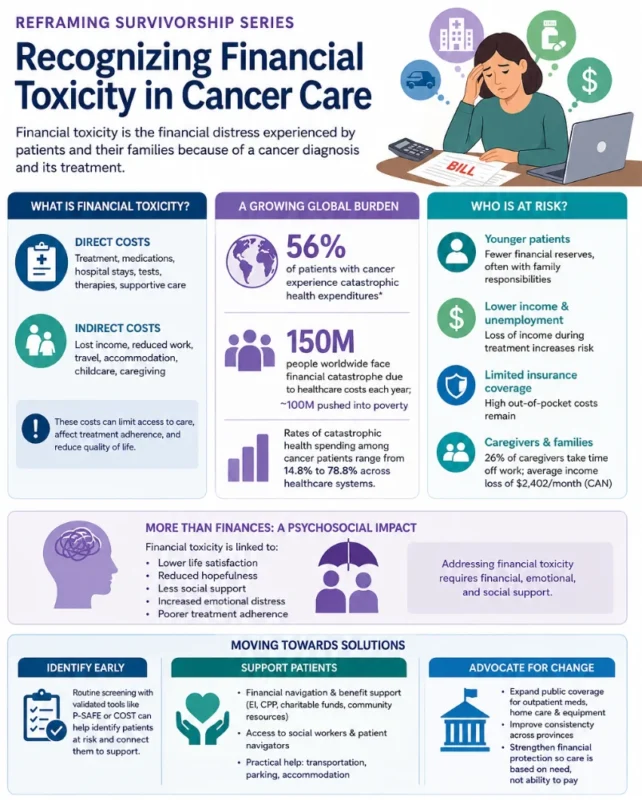
Financial toxicity has become a global public health concern. In a recent systematic review and meta-analysis of 35 observational studies involving 428,373 patients with cancer, 56.1% (95% CI 48.3%–63.8%) experienced catastrophic health expenditures, highlighting the enormous economic burden associated with cancer care. The review identified several factors associated with greater financial toxicity, including low income, lack of health insurance, larger household size, older age, longer disease duration, and receipt of multiple treatment modalities. Conversely, higher educational attainment appeared to reduce the likelihood of catastrophic spending.
More broadly, an estimated 150 million people worldwide experience financial catastrophe related to healthcare costs each year, with approximately 100 million pushed into poverty as a consequence. Across 133 countries, the incidence of catastrophic health expenditure has risen steadily over time. Among patients with cancer specifically, reported rates range from 14.8% to 78.8%, reflecting substantial variation across healthcare systems.
Studies report that between 22.5% and 64% of patients experience significant financial stress related to cancer. Nearly two-thirds of cancer survivors worry about paying medical bills, over one-third accumulate debt, and some are forced into bankruptcy or major financial sacrifices simply to continue treatment.
Who Is at Risk?
Financial toxicity does not affect all patients equally. Sociodemographic factors play a major role in determining vulnerability.
Younger patients often experience greater financial hardship because they typically have fewer financial reserves, ongoing family responsibilities, and may not yet qualify for age-related financial supports. Individuals with lower household incomes are consistently at increased risk, while disruptions to employment during treatment can further reduce income and exacerbate financial insecurity. Although health insurance can lessen some out-of-pocket expenses, it rarely eliminates the financial burden entirely, particularly for patients requiring costly medications, supportive therapies, or prolonged treatment.
Beyond medical expenses, a cancer diagnosis is frequently accompanied by substantial indirect costs. Patients may experience job loss or reduced work hours, while also facing additional expenses related to travel and accommodation for treatment, home modifications, childcare, and caregiving. These financial consequences can be considerable; during the first year after diagnosis, self-employed and employed patients experience average reductions in earnings of 43% and 24%, respectively. The impact also extends to families and caregivers. A Canadian study found that 26% of caregivers took time away from work to provide care for a loved one with cancer, resulting in an average monthly income loss of $2,402, underscoring that the financial effects of cancer often reach well beyond the patient.
Financial Toxicity Is Also a Psychosocial Issue
Financial stress can influence treatment adherence, increase emotional distress, reduce quality of life, and negatively affect survivorship outcomes. Beyond its impact on healthcare decisions, financial toxicity can also affect personal relationships, employment, and an individual’s sense of security and control. Persistent financial strain may contribute to feelings of helplessness, social isolation, and emotional exhaustion, highlighting the importance of addressing both the practical and psychosocial dimensions of financial hardship throughout the cancer journey.
A recent cross-sectional study of 519 patients with cancer demonstrated that greater financial toxicity was associated with significantly lower life satisfaction (P < .001). Importantly, this relationship was partially explained by lower levels of hopefulness and reduced social support, suggesting that psychosocial resources may help buffer the negative effects of financial strain. These findings reinforce that addressing financial toxicity requires more than financial assistance alone; psychological support, strong social networks, and access to survivorship resources should be considered integral components of comprehensive cancer care.
Moving Towards Solutions
Reducing financial toxicity requires coordinated action across healthcare systems, cancer centres, and public policy. Early identification of patients experiencing financial hardship is an important first step. Validated screening tools, such as the Patient Self-Administered Financial Effects (P-SAFE) questionnaire and the Comprehensive Score for Financial Toxicity (COST) measure, can help healthcare teams recognize patients at risk and connect them with appropriate financial and psychosocial support.
Cancer centres can further reduce the burden by providing practical support and financial navigation services. These may include:
- Routine financial toxicity screening using validated tools such as P-SAFE or COST.
- Financial navigation services to help patients access Employment Insurance (EI) sickness benefits, Canada Pension Plan (CPP) disability benefits, charitable cancer support funds, and community resources.
- Access to social workers and patient navigators who can guide patients through available financial and emotional support programs.
- Practical assistance, including subsidized parking, transportation, or accommodation for patients who must travel frequently for treatment.
Broader policy changes are equally important. Although Canada has a publicly funded healthcare system, coverage for outpatient medications, home care services, and medical equipment varies considerably across provinces, leaving many patients with significant out-of-pocket expenses. Expanding public funding for these essential services and improving consistency across jurisdictions could substantially reduce the financial burden on patients and their families. Many Canadians also rely on employer-sponsored insurance to cover these costs, but reducing work hours or leaving employment because of cancer may result in the loss of this coverage. Strengthening public financial protections would help ensure that access to essential cancer care is based on clinical need rather than financial circumstances.
| Key Points |
|
References
Kitaw TA, Tilahun BD, Zemariam AB, Getie A, Bizuayehu MA, Haile RN. The financial toxicity of cancer: unveiling global burden and risk factors – a systematic review and meta-analysis. BMJ Glob Health. 2025 Feb 10;10(2):e017133. doi: 10.1136/bmjgh-2024-017133. PMID: 39929536; PMCID: PMC11815433.
Wood TF, Murphy RA. Tackling financial toxicity related to cancer care in Canada. CMAJ. 2024 Mar 10;196(9):E297-E298. doi: 10.1503/cmaj.230677. PMID: 38467415; PMCID: PMC10927292.
Smith GL, Feldman DB, Ma H, Checka C, Roth ME, Tucker JC, Anderson C, Xavier M, Kagihara J, Ludmir EB, Wu CF, Paredes E, Milbury K, Corn BW. Financial Toxicity, Hope, and Satisfaction With Life in Patients Receiving Ambulatory Cancer Care. JAMA Netw Open. 2026 Feb 2;9(2):e2557328. doi: 10.1001/jamanetworkopen.2025.57328. PMID: 41642625; PMCID: PMC12878433.
Figure 1. Recognizing Financial Toxicity in Cancer Care.
You Can Also Read: Muna Al-Khaifi: GLP-1 Receptor Agonists and the Future of Cancer Prevention and Survivorship