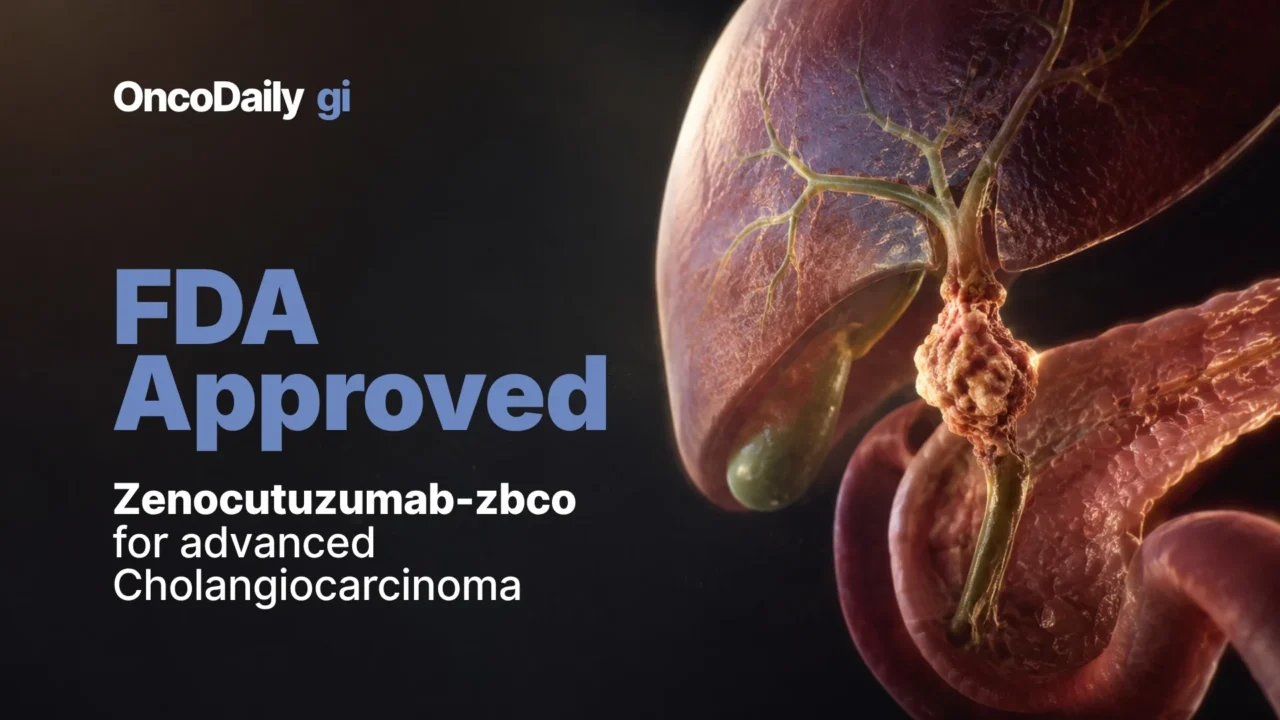
On May 8, 2026, the U.S. Food and Drug Administration approved zenocutuzumab-zbco, marketed as Bizengri by Partner Therapeutics, Inc., for adults with advanced, unresectable or metastatic cholangiocarcinoma harboring a neuregulin 1 gene fusion, also known as an NRG1 fusion, after disease progression on or after prior systemic therapy.
The FDA described NRG1 fusion-positive cholangiocarcinoma as an extremely rare and life-threatening malignancy. The approval applies to patients defined by disease stage, prior treatment history, and NRG1 fusion status.
The application was reviewed as part of the FDA Commissioner’s National Priority Review Voucher pilot program, which is designed to accelerate the review of products that may address key national priorities. According to the FDA, the application was approved more than 5 months before the FDA goal date.
What Is Zenocutuzumab-zbco?
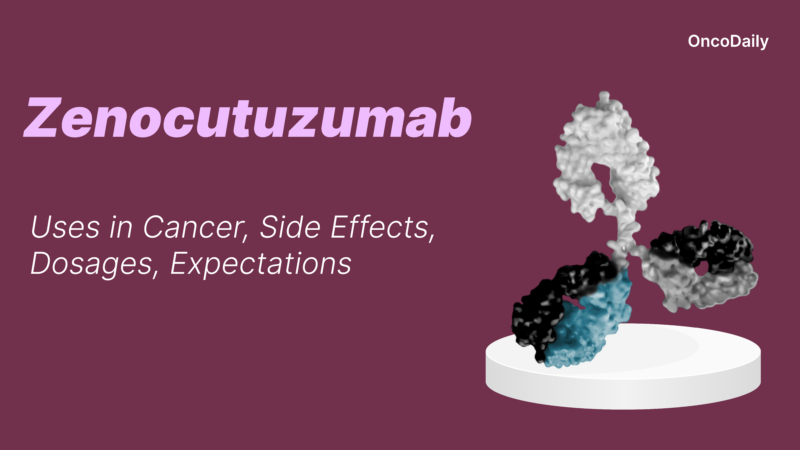
Zenocutuzumab-zbco, also known as zenocutuzumab or MCLA-128, is a HER2 × HER3 bispecific antibody developed for tumors driven by NRG1 gene fusions. These fusions can activate signaling through the HER2/HER3 pathway, supporting tumor-cell growth and survival. Bizengri is designed to interfere with this process by targeting both HER2 and HER3.
The drug has been described as acting through a “Dock & Block” mechanism. One arm of the antibody binds to HER2, while the other blocks HER3, helping prevent NRG1 from binding to HER3 and limiting HER2/HER3 dimerization. By disrupting this interaction, zenocutuzumab inhibits downstream signaling pathways associated with cancer-cell proliferation and survival.
Trial Design and Methods
The eNRGy trial, registered as NCT02912949, was the phase 2 part of an open-label, registrational phase 1–2 clinical study evaluating zenocutuzumab in patients with advanced NRG1 fusion-positive cancer.
In the phase 2 analysis eligible patients had advanced or metastatic solid tumors with an NRG1 gene fusion identified by next-generation sequencing. Patients had received standard therapy for their tumor type or were not candidates for standard therapy. They received zenocutuzumab 750 mg intravenously every 2 weeks.
The primary endpoint was overall response by investigator assessment according to RECIST version 1.1. The key secondary endpoint was duration of response. Other endpoints included response and duration of response by blinded independent central review, time to response, progression-free survival, safety, pharmacokinetics, and immunogenicity.
Clinical Trial Supporting the Approval
The FDA approval was supported by data from eNRGy. Within the trial, 22 patients with unresectable or metastatic cholangiocarcinoma harboring an NRG1 fusion were enrolled, and 19 patients were evaluable for efficacy.
The main efficacy measures were confirmed overall response rate and duration of response. Responses were assessed by blinded independent central review using RECIST version 1.1.
In the efficacy-evaluable group, zenocutuzumab-zbco achieved a confirmed overall response rate of 36.8%, with a 95% confidence interval of 16.3% to 61.6%. Duration of response ranged from 2.8 months to 12.9 months.
Safety Profile
The prescribing information for zenocutuzumab-zbco includes warnings and precautions related to infusion-related reactions, hypersensitivity, anaphylactic reactions, interstitial lung disease or pneumonitis, left ventricular dysfunction, and embryo-fetal toxicity.
The most common adverse reactions reported with zenocutuzumab-zbco were diarrhea, musculoskeletal pain, fatigue, nausea, infusion-related reactions, dyspnea, rash, constipation, vomiting, abdominal pain, and edema.
Prior Regulatory Context
Before this FDA approval, Partner Therapeutics announced on February 5, 2026, that zenocutuzumab-zbco had received FDA Orphan Drug Designation for adults with advanced unresectable or metastatic cholangiocarcinoma. The company stated that zenocutuzumab-zbco was being developed in a subset of patients with cholangiocarcinoma harboring an NRG1 gene fusion.
According to the same announcement, zenocutuzumab-zbco had previously received FDA Breakthrough Therapy Designation in October 2025 and had been granted accelerated approval in December 2024 for adults with advanced unresectable or metastatic non-small cell lung cancer and pancreatic adenocarcinoma harboring NRG1 gene fusions after prior therapy.
Previous eNRGy Results from 2025
Previous results from eNRGy were published in The New England Journal of Medicine on February 5, 2025, in the article “Efficacy of Zenocutuzumab in NRG1 Fusion–Positive Cancer.” The study evaluated zenocutuzumab in patients with advanced NRG1 fusion-positive solid tumors.
In that analysis, 204 patients with 12 tumor types were enrolled and treated. Among 158 patients with measurable disease who had been enrolled at least 24 weeks before the data cutoff, a response occurred in 30% of patients, with a 95% confidence interval of 23% to 37%. The median duration of response was 11.1 months, and 19% of responses were ongoing at the data cutoff.
Responses were reported in several tumor types. Among patients with measurable disease, responses occurred in 27 of 93 patients with non-small cell lung cancer, corresponding to 29%. In pancreatic cancer, responses occurred in 15 of 36 patients, corresponding to 42%.
The NEJM publication reported that adverse events were primarily grade 1 or 2. The most common investigator-assessed treatment-related adverse events were diarrhea, fatigue, and nausea. Infusion-related reactions were observed in 14% of patients, and one patient discontinued zenocutuzumab because of a treatment-related adverse event.
Conclusion
The FDA approval of zenocutuzumab-zbco introduces a treatment option for adults with advanced, unresectable or metastatic NRG1 fusion-positive cholangiocarcinoma after progression on or after prior systemic therapy.
The decision was supported by results from the eNRGy trial, where 19 patients were evaluable for efficacy. The confirmed overall response rate was 36.8%, and duration of response ranged from 2.8 to 12.9 months. The recommended regimen is 750 mg by intravenous infusion every 2 weeks until disease progression or unacceptable toxicity.
Full information about the zenocutuzumab-zbco approval is available on the official FDA website.