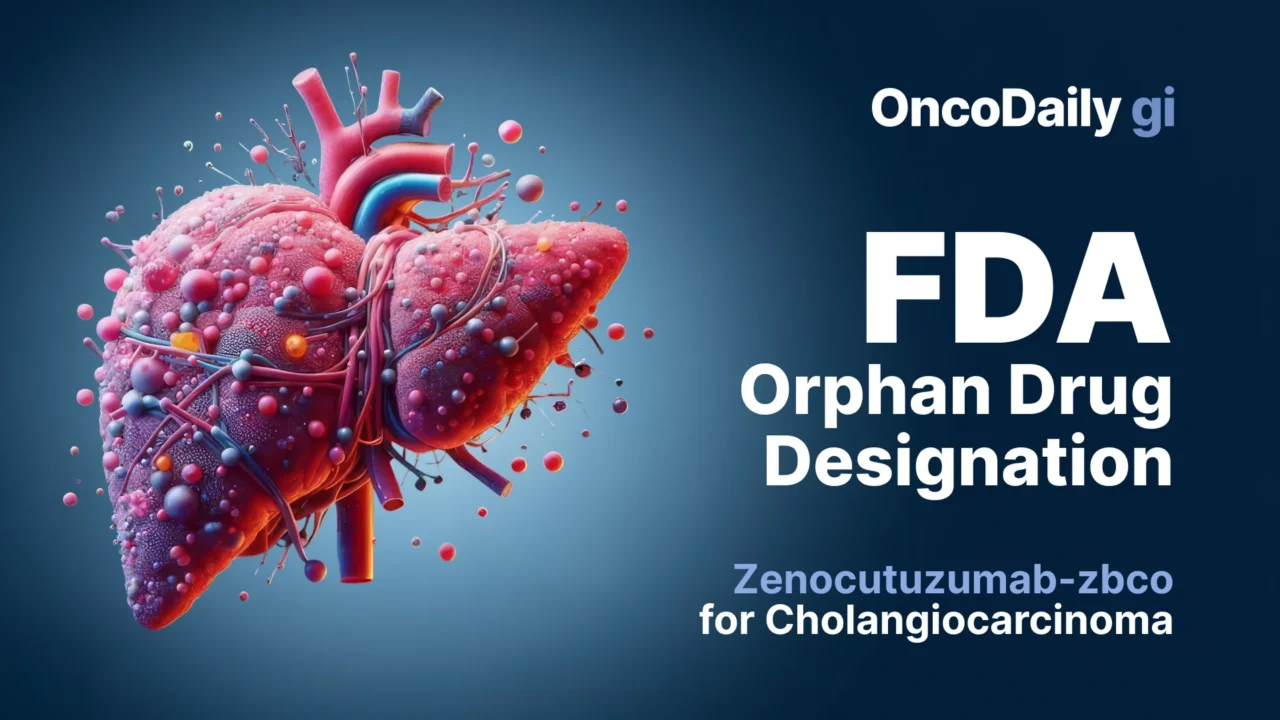
The therapeutic landscape of cholangiocarcinoma remains defined by limited efficacy and poor long-term outcomes, particularly in advanced disease. In the United States, approximately 8,000 new cases are diagnosed annually, and five-year survival across all stages remains below 15%.
On February 5, 2026, Partner Therapeutics announced that the U.S. Food and Drug Administration (FDA) has granted Orphan Drug Designation (ODD) to zenocutuzumab‑zbco (BIZENGRI®) for the treatment of adults with advanced unresectable or metastatic cholangiocarcinoma harboring NRG1 gene fusions.
What is Zenocutuzumab‑zbco?
Zenocutuzumab‑zbco is a bispecific monoclonal antibody developed to treat cancers driven by neuregulin-1 (NRG1) gene fusions. These rare but potent genetic alterations activate abnormal growth signaling through the HER2–HER3 receptor axis and are found in tumors such as non-small cell lung cancer and pancreatic adenocarcinoma.
NRG1 Fusions: A Rare But Actionable Driver
NRG1 gene fusions represent a distinct oncogenic mechanism, characterized by chimeric ligands rather than chimeric receptors (NTRK, RET, ROS1, ALK, and FGFR fusions). These fusions activate downstream signaling through HER3 binding and HER2/HER3 heterodimerization, driving tumor growth in the absence of other dominant oncogenic alterations.
Because NRG1 fusions are rare and structurally complex, their detection requires comprehensive molecular profiling, ideally using a combination of tissue-based DNA and RNA next-generation sequencing. While uncommon, NRG1 fusions have emerged as actionable drivers across multiple tumor types, including cholangiocarcinoma.
How does Zenocutuzumab‑zbco work?
NRG1 fusion–positive tumors rely on aberrant signaling mediated by HER2/HER3 receptor interactions. Zenocutuzumab-zbco is a bispecific antibody designed to block HER2/HER3 dimerization and to inhibit NRG1 fusion interactions with HER3, thereby suppressing the oncogenic signaling processes associated with NRG1 fusion–positive tumors.
Through simultaneous engagement of HER2 and HER3, BIZENGRI interferes with the receptor interactions that drive tumor growth and disease progression in this molecularly defined subset.
Read more about Zenocutuzumab: Uses in Cancer, Side Effects, Dosages, Expectations on OncoDaily.
An Unmet Need in Advanced Cholangiocarcinoma
Cholangiocarcinoma is a rare but highly aggressive bile duct cancer, frequently diagnosed at an advanced stage when curative options are no longer feasible. Outcomes with first-line systemic therapy in advanced cholangiocarcinoma remain modest, particularly beyond the first line.
Current systemic therapies for cholangiocarcinoma offer limited benefit. In the first-line setting, overall response rates generally range from 26% to 29%, with median overall survival of approximately 11.7–12.8 months. Outcomes are even more modest after progression, with second-line FOLFOX achieving response rates of around 5%, a median progression-free survival of 4.0 months, and a median overall survival of 6.2 months. In this context of high unmet need, zenocutuzumab-zbco has demonstrated activity in patients with NRG1 fusion–positive cholangiocarcinoma.
Regulatory Approvals and Key Designations
BIZENGRI has achieved multiple regulatory milestones that underscore its role as a precision therapy for NRG1 fusion–positive cancers.
In December 2024, the U.S. Food and Drug Administration granted accelerated approval to zenocutuzumab for adults with advanced unresectable or metastatic non-small cell lung cancer (NSCLC) and pancreatic ductal adenocarcinoma (PDAC) harboring NRG1 gene fusions, following disease progression on prior systemic therapy. These approvals were based on meaningful and durable responses observed in biomarker-selected populations, with continued approval contingent on confirmatory clinical benefit.
Read more about Efficacy of Zenocutuzumab in NRG1 Fusion–Positive Cancer on OncoDaily.
Building on this foundation, the FDA subsequently awarded Breakthrough Therapy Designation (BTD) for zenocutuzumab in NRG1 fusion–positive advanced cholangiocarcinoma, supported by Phase 2 eNRGy trial data demonstrating a 37% overall response rate and a median duration of response of 7.4 months. These results are being presented at the AACR–NCI–EORTC International Conference on Molecular Targets and Cancer Therapeutics.
Read about FDA Grants Breakthrough Therapy Designation to Zenocutuzumab-zbco for NRG1-Positive Cholangiocarcinoma on OncoDaily.
Regulatory Implications of Orphan Drug Designation
Orphan Drug Designation is granted to therapies intended for rare diseases affecting fewer than 200,000 individuals in the United States. Beyond its symbolic importance, ODD provides tangible development incentives, including eligibility for tax credits on clinical trial costs, exemption from certain FDA user fees, and up to seven years of market exclusivity upon approval.
For BIZENGRI, this designation strengthens the ongoing development program in cholangiocarcinoma and reinforces the broader shift toward biomarker-driven drug development in rare gastrointestinal cancers.
Read more about eNRGy Trial: Zenocutuzumab in NRG1 Fusion–Positive Gastrointestinal Cancers on OncoDaily.
Expert Perspective
Juan W. Valle, Chief Medical Officer of the Cholangiocarcinoma Foundation, shared the update on his LinkedIn page, saying:
“Great news for the end of the week! Partner Therapeutics, Inc. announced that the FDA and has granted Orphan Drug Designation to zenocutuzumab‑zbco for the treatment of adults with advanced unresectable or metastatic cholangiocarcinoma.
Patients with cholangiocarcinoma face a particularly aggressive cancer with a poor prognosis and limited treatment options. Receiving Orphan Drug Designation for zenocutuzumab in patients with CCA harboring the NRG1 gene fusion is a significant regulatory milestone for Partner Therapeutics and highlights the urgent need for new and effective treatment options for patients with this disease.”
Looking Ahead
As molecular profiling becomes increasingly embedded in routine oncology practice, rare but actionable alterations such as NRG1 fusions are gaining clinical relevance. The FDA’s decision highlights both the unmet need in advanced cholangiocarcinoma and the growing role of precision oncology strategies tailored to defined oncogenic drivers.
Further clinical data will be required to clarify the magnitude and durability of benefit in this population, but the designation represents a meaningful step forward for patients with few effective therapeutic options.
Read full article in Partner Therapeutics, Inc.