





George Kumar, Senior Director at AstraZeneca, shared a post on LinkedIn:
”Mapping Triple-Negative Breast Cancer at Single-Cell Resolution – A 427,000-Cell Atlas
Triple-negative breast cancer is one of the hardest subtypes to treat – no hormone receptors, no HER2, and chemotherapy is often the only option.
But only about half of patients respond well. A massive new study asks: why?
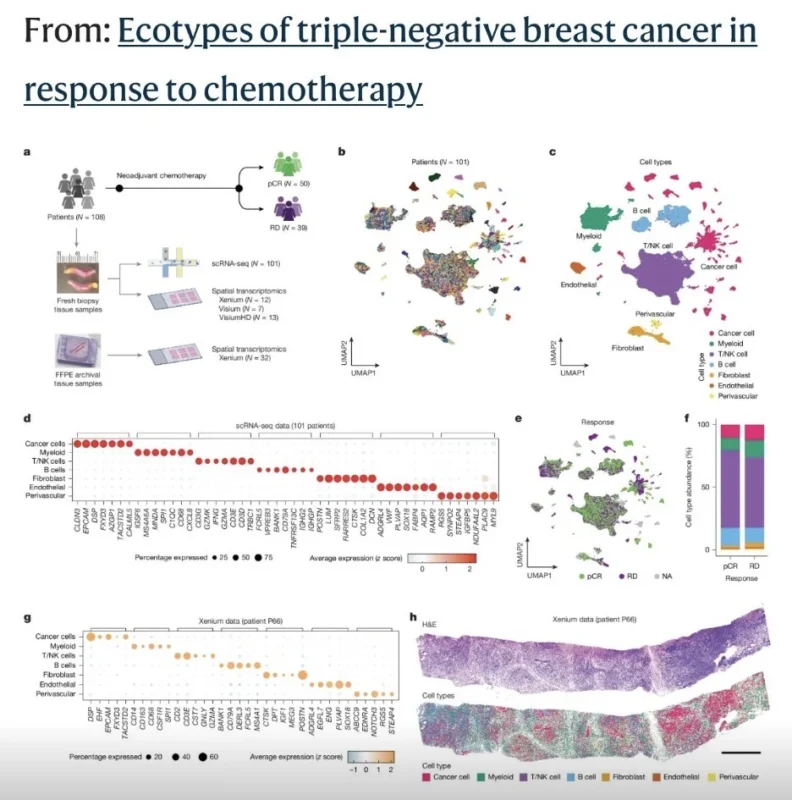
Researchers analyzed nearly 428,000 cells from 101 treatment-naive TNBC patients using both single-cell and spatial transcriptomics – one of the largest efforts of its kind in this cancer type.
What they found reshapes how we think about treatment response:
Rather than one disease, TNBC breaks into 4 distinct tumor archetypes based on cancer-cell gene expression, with 13 underlying programs capturing how heterogeneous individual tumors can be. The tumor microenvironment is equally complex – 49 distinct immune and stromal cell states, many dramatically reprogrammed compared to normal breast tissue.
Spatially, the team identified 8 cellular ‘ecotypes’ – recurring communities of cancer and immune cells with distinct tissue organization patterns.
The headline finding: contrary to prior studies that emphasized T cells as the key predictor of chemo response, this data puts macrophage subtypes and cancer-cell programs – particularly those governing interferon signaling, HLA expression, and cell cycle activity – at the center of the story.
This atlas gives researchers a new biological map of untreated TNBC, and a fresh set of targets to explore for predicting – and eventually improving – chemotherapy response.”
Title: Ecotypes of triple-negative breast cancer in response to chemotherapy
Authors: Yun Yan, Yiyun Lin, Tapsi Kumar, Shanshan Bai, Aatish Thennavan, Jianzhuo Li, Emi Sei, Tuan Tran, Min Hu, Mitchell Rao, Chenling Tang, Siyuan He, Anna Casasent, Elizabeth Ravenberg, Gaiane Margishvili Rauch, Alyson R. Clayborn, Debu Tripathy, Alastair Thompson, Bora Lim, Lei Huo, Stacy Moulder, Clinton Yam, Nicholas Navin
Other Articles Featuring George Kumar on OncoDaily.