
Blastic plasmacytoid dendritic cell neoplasm (BPDCN) is an ultra-rare hematologic malignancy that remains unfamiliar to many clinicians because of its heterogeneous presentation and limited clinical exposure. Ongoing clinical and translational research continues to expand our understanding of BPDCN and refine its management, while contributing to the growing recognition of this malignancy.
BPDCN as a Distinct Hematologic Entity
In the fifth edition of the WHO Classification of Haematolymphoid Tumours, BPDCN is recognized as a distinct entity within the category of myeloid and histiocytic/dendritic neoplasms.
BPDCN can occur at any age, but it is most prevalent in older adults, with a median age at diagnosis of 65-67 years and a slight male predominance (2.5:1). It does not appear to have any racial or geographic predisposition. Likewise, no environmental, inherited, or acquired genetic factors have been found to increase risk.
Tracing the Origins
Phenotypically different from other myeloid neoplasms, BPDCN arises from plasmacytoid dendritic cells (pDCs), a specialized subset of immune cells best known for their capacity to produce type I interferons in response to viral infection. However, a metagenomic analysis of BPDCN to identify an infectious trigger found no bacterial or viral RNA suggesting specific inciting pathogens in the skin or bone marrow. Current evidence suggests that BPDCN originates from resting pDCs of predominantly myeloid lineage.
The development and maintenance of normal pDCs are governed by a transcriptional program centered on factors such as TCF4, BCL11A, and IRF8, which regulate lineage commitment and cellular identity. Consistent with its cellular origin, BPDCN retains expression of several pDC-associated markers and transcription factors, particularly TCF4 and BCL11A.
Disruption of the molecular networks that control pDC differentiation, together with the accumulation of genetic and epigenetic alterations, is thought to contribute to malignant transformation and disease progression.
Differential Considerations
BPDCN may not be an independent presentation, as many as 10-20% of patients with BPDCN have a previous diagnosis of AML, CML, CMML, or MDS, termed prior or concomitant hematologic malignancy. The interplay or transition between myeloid neoplasms and BPDCN, if any, has yet to be described.
Other myeloid neoplasms, namely CML and RUNX1-mutant AML, have been known to show propagation of mature CD56-negative pDCs, underscoring the importance of differentiating these disease entities from BPDCN.
The differential diagnosis also includes B- and T-cell ALL, extranodal NK/T-cell lymphoma, nasal type, adult T-cell leukemia/lymphoma, and large cell lymphoma. Non-hematopoietic neoplasms that may mimic BPDCN include angiosarcoma, Kaposi sarcoma, Merkel cell carcinoma, and melanoma. In addition, BPDCN has been reported to resemble a variety of non-neoplastic dermatologic conditions.
The Spectrum of Clinical Presentation
Despite being a hematologic malignancy, the most prominent characteristic of BPDCN is skin involvement, followed by bone marrow infiltration and lymphadenopathy. The disease can rarely present without cutaneous manifestations. The expression of skin-homing molecules, particularly cutaneous lymphoma-associated antigen and CD56, has been proposed to explain the marked tropism of BPDCN for the skin.
Phylogenomic and single-cell studies suggest that premalignant bone marrow clones serve as the origin of BPDCN skin tumors. Histologically, the skin typically shows substantial dermal infiltration extending into the subcutaneous fat. The epidermis and adnexal structures are usually spared, and angioinvasion or coagulative necrosis are generally absent.
Cutaneous involvement most commonly presents as solitary, localized, or generalized violaceous plaques or tumors on the head and neck or upper trunk. Notably, skin lesions may persist despite bone marrow remission.

There is diffuse involvement of the interfollicular regions and medulla in lymph nodes, with B-cell follicles being more commonly unaffected. Bone marrow involvement could range from slight infiltration to extensive marrow replacement.
Hepatic involvement is more common in patients with extensive BM disease, and may be accompanied by splenomegaly. These patients can present with significant coagulopathy and can develop life-threatening DIC.
BPDCN can infiltrate a wide range of extramedullary tissues and organs, including the orbital area, lacrimal ducts, nasopharynx, lungs, uterus, and ovaries. Patients can present with vision loss and periorbital ecchymosis, or “raccoon eyes”.
CNS Involvement
Reported rates of CNS involvement in BPDCN range from 20% to 60%, although the true prevalence remains uncertain because lumbar puncture has not historically been part of the standard diagnostic workup. While some patients present with headaches, confusion, seizures, syncope, intracranial hypertension, or visual disturbances, CNS disease may also be clinically silent and detected only through cerebrospinal fluid analysis. Rates may be even higher in relapsed disease, with some studies reporting CNS involvement in nearly all assessed patients at relapse.
Establishing the Diagnosis
Skin biopsy with histologic and immunohistochemical evaluation remains central to the diagnosis of BPDCN in patients with suspicious cutaneous lesions. Yet, the absence of skin involvement does not exclude the disease, and BPDCN should be considered in patients with poorly differentiated leukemia and an ambiguous immunophenotype. Bone marrow examination is important for assessing disease extent and excluding other hematologic malignancies.
Immunohistochemistry is central. According to WHO criteria, diagnosis is supported by expression of CD123 together with at least one additional plasmacytoid dendritic cell marker (TCF4, TCL1, CD303, or CD304) and CD4 and/or CD56. Alternatively, the diagnosis can be established by expression of multiple plasmacytoid dendritic cell markers in the absence of lineage-specific myeloid, B-cell, and T-cell markers.
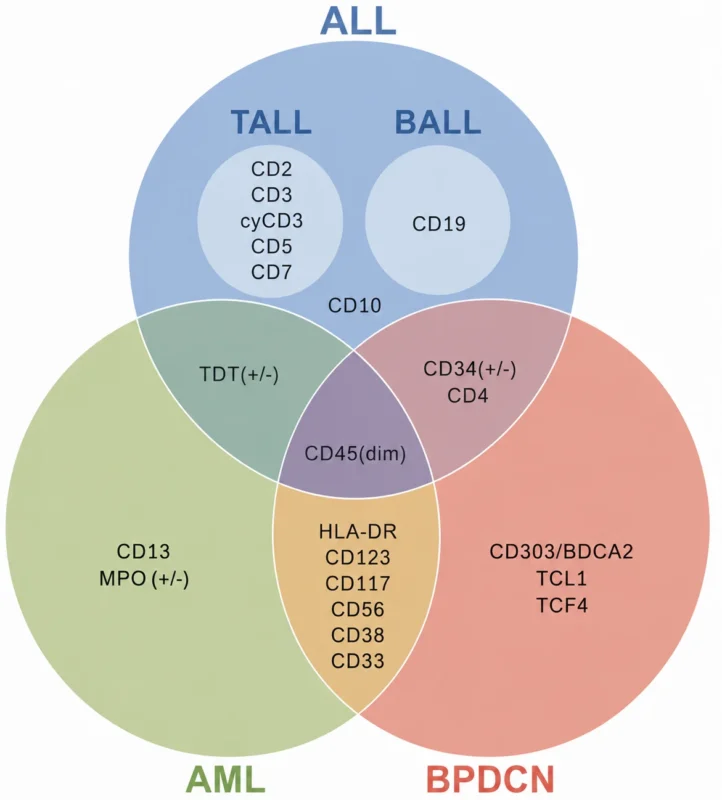
nature.com
The Pediatric-AYA Interface
The incidence of BPDCN in pediatrics is extremely low – with fewer than 100 cases reported – and overall, little is known about the disease. Pediatric BPDCN is believed to be clinically less aggressive but often with more dissemination at presentation than adult cases.
A literature review of 69 reported cases showed that skin involvement was the most frequent finding (94%), followed by bone marrow (83%), lymph node (62%), and peripheral blood involvement (55%). CNS involvement was less common, occurring in 22%.
While it can be typical for trials to focus on either the youngest or oldest populations, there has been a growing trend to explicitly illustrate the outcome variations within the adolescent and young adult (AYA) population in numerous diseases.
Many have demonstrated AYA patients to have superior outcomes relative to their older counterparts, especially when utilizing pediatric based regimens but, these patients often experience unique challenges, both psychosocially and secondary to treatment-related toxicities.
Navigating Treatment Options
Given the rarity of this disease, there have been limited multi-center and collaborative group trials dedicated to this disease leading to a lack of a standardized treatment approach in both adults and children.
Historically, treatment of BPDCN relied on conventional chemotherapy regimens adapted from AML, ALL, and lymphoma protocols. The response rates have been suboptimal, with a median survival of 8.7 months in one multicenter retrospective study of 43 cases.
That same study also found an advantage for the ALL/LBL regimens over the AML regimen, with better CR rates (67% vs. 27%) and better OS (12.3 months vs. 7.1 months, P = .02). Though, the relapse rate was higher in the ALL/LBL therapy group.
Allo-HCT remains an established consolidation strategy, particularly when performed in first CR, with long-term survival exceeding 50% in several series. Autologous transplantation has also been explored, although supporting data remain more limited and outcomes appear more favorable in patients without bone marrow involvement at diagnosis and transplantation.
The First Targeted Therapy for BPDCN
The emergence of tagraxofusp, a first-in-class CD123-directed fusion protein composed of interleukin-3 and truncated diphtheria toxin, marked a major advance. Because myeloid leukemia progenitors overexpress IL-3R, tagraxofusp was initially evaluated in patients with AML and MDS and found to be well tolerated.
In a pivotal phase 2 study, tagraxofusp achieved an ORR of 90% among treatment-naïve BPDCN patients receiving the approved dose, with a 2-year OS of 52%, leading to its approval by both the US FDA and the EMA.
Togami et al. demonstrated that resistance to tagraxofusp in BPDCN is driven by DNA methylation and downregulation of diphthamide genes rather than loss of CD123 expression. Importantly, this resistance pattern was reversed by azacitidine in xenograft models.
Building on these findings, Lane et al. conducted a phase 1b trial evaluating tagraxofusp in combination with azacitidine, with or without venetoclax, in patients with myeloid neoplasms, including BPDCN. The most common adverse events were cytopenias, elevated liver enzymes, and capillary leak syndrome.

Building on Tagraxofusp
Among patients with R/R BPDCN treated with tagraxofusp, azacitidine, and venetoclax, responses were observed and enabled subsequent allogeneic HSCT in some cases. Although tumor lysis syndrome remains a concern, the study demonstrated that this combination is feasible with close monitoring and appropriate supportive care, with encouraging preliminary activity.
At the 2026 ASCO Annual Meeting, Pemmaraju et al. presented results from a phase II study evaluating tagraxofusp in combination with Hyper-CVAD and venetoclax in patients with newly diagnosed or relapsed/refractory BPDCN, further expanding the clinical investigation of multi-agent strategies in this disease.
The Arrival of a Second Targeted Agent
After all, the recent approval of pivekimab sunirine, a CD123-directed ADC, marks a significant step forward in the treatment of BPDCN. Compared with tagraxofusp, pivekimab has demonstrated a more favorable safety profile with a lower risk of capillary leak syndrome, while offering an effective treatment option that can be initiated in the outpatient setting, potentially expanding treatment accessibility and flexibility.

FDA Approved Decnupaz (pivekimab sunirine-pvzy), the First ADC for Adults With BPDCN
And in Pediatric Patients?
Unlike adults who almost always proceed to a hematopoietic stem cell transplantation in first complete remission if transplant-eligible, the majority of children can be cured with a high-risk ALL-like regimen. HSCT is recommended for children with high-risk disease, the definition of which continues to evolve, or those in relapse and refractory settings. Venetoclax has also been combined with hyper-CVAD-based regimens in pediatric patients, with encouraging results.
Pemmaraju et al. reported a multicenter retrospective case series that included six pediatric patients aged 10-21 years, among whom one achieved a CR with tagraxofusp, two had stable disease, and three did not respond. Three patients were bridged to HSCT, and five were alive at the time of reporting. This limited evidence suggests that although tagraxofusp is well tolerated and effective in the pediatric population, its effects are transient, necessitating bridge therapy and HSCT.
Can Cellular Therapies Change the Outlook?
Early clinical experience with CD123-directed CAR T-cell therapy has demonstrated antitumor activity, although significant toxicities, particularly CRS is a major concern. Despite reports of severe treatment-related complications, including a fatal case in a phase 1 study, responses have been observed, with two patients treated with the autologous CD123-directed CAR T-cell product MB-102 achieving CR with only reversible toxicities.
Strengthening the International Registry
The growing international focus on BPDCN is also reflected in the launch of the BPDCN International Registry in 2022 (NCT05430971), an initiative led by the Immune Oncology Research Institute in Armenia. The registry brings together centers across multiple countries to facilitate global collaboration, improve data collection, investigate disease characteristics and outcomes, and advance future treatment recommendations for this ultra-rare malignancy.
Written by Susanna Mikayelyan, MD
FAQ
Why is BPDCN often mistaken for a skin disease?
Although BPDCN is a hematologic malignancy, skin lesions are the most common presenting feature. Patients frequently develop violaceous plaques, nodules, or tumors, which can resemble benign dermatologic conditions or other skin cancers, contributing to delayed diagnosis.
Why does BPDCN have such a strong preference for the skin?
Researchers believe that BPDCN cells express skin-homing molecules, including cutaneous lymphoma-associated antigen and CD56, which may facilitate migration to and persistence within the skin. The exact mechanisms remain under investigation.
Can BPDCN occur without skin involvement?
Yes. While most patients present with cutaneous lesions, a minority develop BPDCN without any skin manifestations. In these cases, the disease may first be detected through bone marrow, blood, lymph node, or CNS involvement.
Is BPDCN inherited?
No inherited genetic syndrome has been consistently linked to BPDCN. Current evidence suggests that most cases arise through acquired genetic and epigenetic alterations rather than hereditary predisposition.
Why is CD123 such an important target in BPDCN?
CD123 is highly expressed on BPDCN cells and is present in the majority of cases. This has made it a central therapeutic target, leading to the development of agents such as tagraxofusp, pivekimab sunirine, and several investigational CAR T-cell therapies.
How is BPDCN different from acute myeloid leukemia (AML)?
Although BPDCN shares some clinical and biologic features with myeloid malignancies, it originates from plasmacytoid dendritic cells and has a distinct immunophenotypic profile. Accurate differentiation is critical because treatment strategies and outcomes differ substantially.