
On May 27, 2026, the U.S. FDA granted approval to pivekimab sunirine-pvzy (Decnupaz, AbbVie, Inc.), a CD123-directed antibody and alkylating agent conjugate, for the treatment of adults with blastic plasmacytoid dendritic cell neoplasm (BPDCN).
The Clinical Backdrop
BPDCN is an ultra-rare and highly aggressive hematologic malignancy derived from precursors of plasmacytoid dendritic cells, typically affecting men aged 60-70 years. It frequently presents with cutaneous lesions, often appearing as bruise-like plaques or nodules, alongside involvement of the bone marrow, peripheral blood, lymph nodes and occasionally the central nervous system.
With biologic and clinical features overlapping both leukemia and lymphoma, the disease has historically been associated with delayed diagnosis. The triple-positive CD4+CD56+CD123+ phenotype with negativity for lineage-specific markers is considered a minimum requirement for defining BPDCN.
Despite initial treatment with intensive chemotherapy, which may include stem cell transplantation, many patients experience relapse. Options are limited in relapsed or refractory disease, emphasizing the need for novel approaches.
About Decnupaz
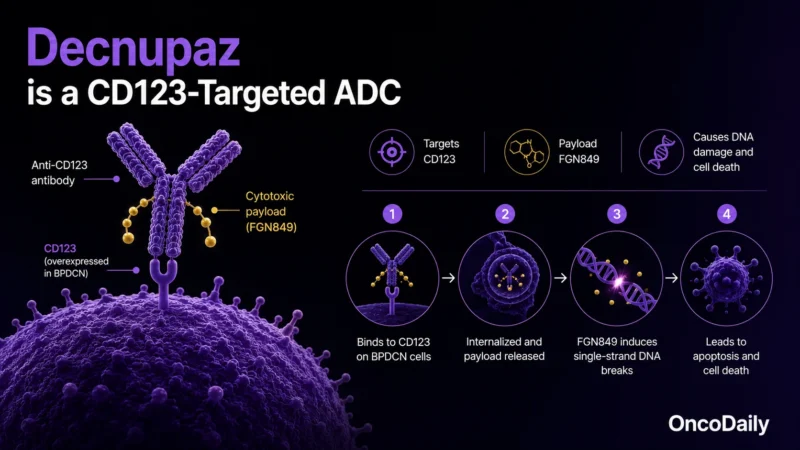
Decnupaz is an ADC designed to deliver a cytotoxic payload directly to CD123-expressing cells. CD123 (alpha-subunit of the interleukin-3 receptor) is highly overexpressed in BPDCN, making it a relevant target.
The payload (FGN849) belongs to the indolinobenzodiazepine pseudodimer class and induces single-strand DNA breaks through DNA alkylation without crosslinking, ultimately leading to apoptosis and cell death.
Decnupaz previously received FDA Breakthrough Therapy Designation for relapsed/refractory BPDCN in October 2020.
Rationale Behind the Approval
Efficacy was evaluated in CADENZA (NCT03386513), a multicenter, open-label, single-arm phase 1/2 clinical trial that enrolled adult patients with treatment-naïve (N=33) and relapsed or refractory BPDCN (N=51), without active CNS involvement.
The primary efficacy endpoint was complete remission or clinical complete remission (CR/CRc). Reported findings were as follows:
- Among treatment-naïve patients (N=33), 23 patients (69.7%; 95% CI: 51.3-84.4) achieved CR/CRc, with a median follow-up of 21.5 months. The median duration of CR/CRc in the frontline cohort was 9.7 months (95% CI: 2.9 -not estimable).
- In the relapsed or refractory cohort (N=51), 8 patients (15.7%; 95% CI: 7.0-28.6) achieved CR/CRc, with a median follow-up of 24.1 months. The median duration of CR/CRc in relapsed or refractory patients was 9.2 months (range: 2.7-27.6+).
Of Note
CADENZA was designed to evaluate the safety, tolerability, pharmacokinetics, immunogenicity, and anti-leukemic activity of pivekimab sunirine-pvzy in patients with newly diagnosed or relapsed/refractory CD123-positive myeloid malignancies (a total of 116), including BPDCN.
The trial also aimed to establish the maximum tolerated dose, recommended phase 2 dose, and dosing schedule for pivekimab sunirine-pvzy monotherapy.
Safety Considerations
The prescribing information for Decnupaz includes a Boxed Warning for hepatotoxicity, including hepatic veno-occlusive disease. Additional warnings and precautions include infusion-related reactions, edema, sulfite allergic reactions, and embryo-fetal toxicity.
The most common adverse reactions included edema, fatigue, musculoskeletal pain, hemorrhage, infusion-related reactions, nausea, and diarrhea.
The most common grade 3/4 laboratory abnormalities included decreased neutrophils, platelets, lymphocyte counts, white blood cell counts and hemoglobin levels, as well as increased glucose levels.
Dosing and Administration
The recommended dose of pivekimab sunirine-pvzy is 0.045 mg/kg administered intravenously over approximately 15-30 minutes once every 3 weeks (21-day cycle) until disease progression or unacceptable toxicity. Dosing is based on the patient’s actual body weight.
A Step Forward in BPDCN
For patients facing rare malignancies, continued advances in research can be life-changing. DECNUPAZ is the first and only ADC approved for BPDCN that can be initiated in the outpatient setting, potentially expanding treatment accessibility and flexibility. The approval also marks AbbVie’s first ADC approved for a hematologic malignancy.
A Global Effort in BPDCN Research
The growing international focus on BPDCN is also reflected in the launch of the BPDCN International Registry in 2022 (NCT05430971), an initiative led by the Immune Oncology Research Institute in Armenia. The registry brings together centers across multiple countries to facilitate global collaboration, improve data collection, investigate disease characteristics and outcomes, and advance future treatment recommendations for this ultra-rare malignancy.
Full Prescribing Information is available here.