






Runcie C.W. Chidebe, Oncology Researcher at Miami University, shared a post by The Lancet Regional Health – Africa on LinkedIn, adding:
‘We want to see evidence of engagement of authors based in HICs, including diaspora, with authors based in Africa. Equitable partnerships do not start with authorship decisions, but should be considered from the beginning stages of research when research priorities and needs are identified, and relationships are established with local researchers. When no local authors included, this prompts the question of why no one local was intentionally involved and included in the publication. African diaspora authors working in HICs can lead the way in demonstrating genuine engagement with authors in Africa, given their connection to the region.’
– Catherine Draper (PhD) and Hlengiwe Madlala.”
Quoting The Lancet Regional Health – Africa‘s post:
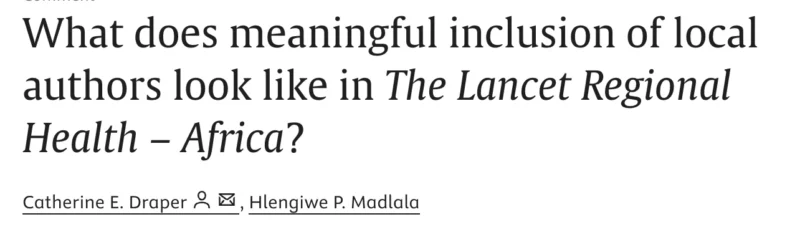
“What does meaningful inclusion of local authors look like in The Lancet Regional Health – Africa?
We answer this question in our recently published Comment, now available online.
This information is important for authors based in Africa, for African diaspora authors working elsewhere in the world, and for authors in other countries submitting to our journal on research done in Africa.
We hope this guidance provides clarity on our journal’s stance on the nuanced and complex issue of authorship. And we hope it inspires authors – both inside and outside Africa – to work together to amplify African voices and build equitable partnerships.”
Title: What does meaningful inclusion of local authors look like in The Lancet Regional Health – Africa?
Authors: Catherine E. Draper and Hlengiwe P. Madlala
Read The Full Article
Other articles about The Lancet on OncoDaily.