






Kefah Mokbel, Chair of Breast Cancer Surgery at London Breast Institute and Honorary Professor of Medicine at Cardiff University School of Medicine, shared a post on LinkedIn:
“Dato-DXd + Durvalumab: A New First-Line Standard for Metastatic TNBC?
The newly published Arms 7 and 8 of the phase Ib/II BEGONIA platform study (Schmid et al., Annals of Oncology, 2026) provide some of the most compelling first-line data yet in unresectable locally advanced or metastatic triple-negative breast cancer (TNBC) – a setting where durable responses remain elusive and PD-L1 status continues to dictate immunotherapy eligibility.
Study design
- Open-label, Simon’s 2-stage platform trial (NCT03742102)
- Datopotamab deruxtecan (Dato-DXd, TROP2-directed ADC) 6 mg/kg + durvalumab (anti-PD-L1) 1120 mg IV Q3W
- Arm 7: all-comers regardless of PD-L1 (n=62)
- Arm 8: PD-L1-high tumours by local IHC (n=33)
- Primary endpoints: safety, investigator-assessed confirmed ORR
Efficacy (data cut-off 29 Nov 2024)
Arm 7 (median follow-up 35.0 months)
- cORR 79.0% (95% CI 66.8–88.3)
- Median DoR 17.6 months
- Median PFS 14.0 months
- Median OS not reached
Arm 8 (median follow-up 10.7 months)
- cORR 81.8% (95% CI 64.5–93.0)
- DoR and PFS immature
Safety
Manageable profile consistent with prior Dato-DXd and durvalumab experience; no new safety signals identified.
Why this matters
First-line metastatic TNBC has historically been defined by short PFS (typically 7–9 months with chemo–immunotherapy in PD-L1-positive disease) and limited options for PD-L1-negative patients. BEGONIA suggests that pairing a TROP2-directed ADC with checkpoint blockade may deliver:
- High response rates (~80%) independent of PD-L1 expression – potentially expanding immunotherapy benefit beyond the CPS≥10 subset
- A median PFS of 14 months – substantially exceeding current 1L benchmarks
- Durable responses (median DoR >17 months in Arm 7)
These results provide the rationale for the ongoing phase III TROPION-Breast05 trial and may reshape the 1L mTNBC treatment paradigm if confirmed.
A significant step forward for a disease that has long needed one.
Looking ahead:
Dato-DXd’s potential extends well beyond metastatic TNBC. In node-positive early breast cancer, the phase III TROPION-Breast04 is testing neoadjuvant Dato-DXd + durvalumab against the KEYNOTE-522 standard – potentially defining the first ADC-based, chemotherapy-sparing neoadjuvant regimen for high-risk TNBC and HR-low/HER2− disease. In HR+/HER2− metastatic breast cancer, Dato-DXd is already FDA-approved (TROPION-Breast01) and is now being evaluated in earlier lines and in combination with endocrine therapy – with the potential to reshape the post-CDK4/6 landscape. Across both settings, the direction of travel is clear: TROP2-directed ADCs are moving steadily from late-line metastatic disease toward curative-intent and earlier-line treatment.”
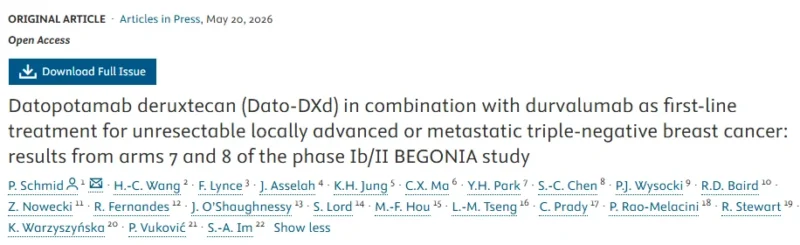
Title: Datopotamab deruxtecan (Dato-DXd) in combination with durvalumab as first-line treatment for unresectable locally advanced or metastatic triple-negative breast cancer: results from arms 7 and 8 of the phase Ib/II BEGONIA study
Authors: P. Schmid, H.-C. Wang, F. Lynce, J. Asselah, K. H. Jung, C. X. Ma, Y. H. Park, S.-C. Chen, P. J. Wysocki, R. D. Baird, Z. Nowecki, R. Fernandes, J. O’Shaughnessy, S. Lord, M.-F. Hou, L.-M. Tseng, C. Prady, P. Rao-Melacini, R. Stewart, K. Warzyszyńska, P. Vuković, S.-A. Im
Read the Full Article.
Other articles featuring Kefah Mokbel on OncoDaily.