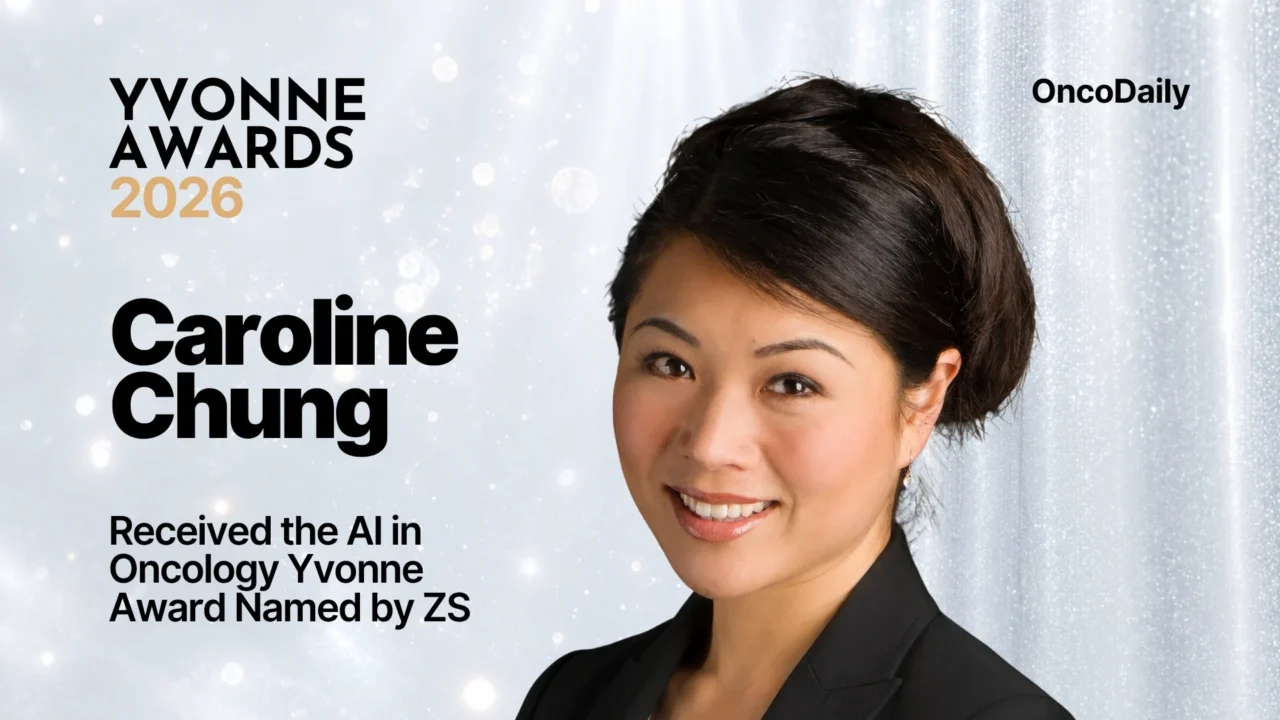
Caroline Chung, MD, MSc, was honored with the AI in Oncology Yvonne Award Named by ZS during the Yvonne Awards Ceremony at OncoDaily Party 2026, held on May 29 at Park West in Chicago.
The recognition highlights Dr. Chung’s work as a physician-scientist, executive leader, radiation oncologist, and global authority in oncology data science, artificial intelligence, quantitative imaging, digital biomarkers, and precision medicine. Her career reflects a rare ability to connect clinical oncology with enterprise-level data strategy, computational medicine, imaging science, and responsible AI implementation.
The AI in Oncology Yvonne Award Named by ZS recognizes leaders whose work is helping define how artificial intelligence can be used safely, responsibly, and meaningfully in cancer care and research. In Dr. Chung’s case, that work spans institutional transformation, global standards, clinical translation, education, governance, and the development of AI-enabled oncology platforms.
A Physician-Scientist Building the Data Future of Oncology
Caroline Chung serves as Inaugural Vice President and Chief Data & Analytics Officer at MD Anderson Cancer Center, where she has led enterprise-wide strategy for data, analytics, and artificial intelligence across one of the world’s largest cancer centers. She is also the Founding Co-Director of the Institute for Data Science in Oncology and a tenured professor in Radiation Oncology and Diagnostic Imaging.
Her work at MD Anderson has focused on building the infrastructure needed for modern oncology: high-quality data, interoperable systems, responsible governance, quantitative measurement, and platforms that can support discovery, clinical trials, biomarkers, real-world evidence, and precision medicine.
In cancer care, AI is only as strong as the data and systems behind it. Dr. Chung’s leadership has emphasized that meaningful AI implementation requires more than algorithms. It requires standards, context, validation, clinical integration, and teams that understand both medicine and data science.
Founding the Institute for Data Science in Oncology
As Founding Co-Director of the Institute for Data Science in Oncology, Dr. Chung has helped create a platform that brings together multimodal clinical data, computational modeling, translational science, and oncology expertise. The institute supports work across radiomics, digital biomarkers, genomics, real-world evidence, computational biology, and clinical data science.
This type of institutional model is increasingly important as oncology becomes more data-intensive. Cancer treatment decisions now depend on imaging, pathology, molecular testing, longitudinal clinical records, treatment response, toxicity data, and patient outcomes. Bringing these sources together in a structured and clinically meaningful way is essential for the next generation of precision oncology.
Dr. Chung’s work has helped move data science from a separate technical function into a core part of cancer research and care delivery.
Advancing Quantitative Imaging and Digital Biomarkers
A major part of Caroline Chung’s scientific contribution has been in quantitative imaging, radiomics, and computational medicine. She has built and led multidisciplinary programs focused on quantitative tumor characterization, treatment response prediction, and toxicity modeling. These efforts support biomarker-informed endpoints across early- and late-phase oncology studies.
She also developed and operationalized the Tumor Measurement Initiative, a flagship program designed to standardize quantitative tumor assessment and improve the fidelity of clinical trial endpoints and therapeutic evaluation.
This work matters because imaging remains one of the most important tools in oncology. Yet traditional tumor measurement can be limited by variability, subjectivity, and incomplete capture of tumor biology. Quantitative imaging offers a more structured path toward reproducible assessment, digital biomarkers, and more precise evaluation of treatment response.
Responsible AI, Governance, and Clinical Translation
Dr. Chung’s leadership has also focused on the responsible deployment of AI in oncology. At MD Anderson, she has helped establish enterprise data governance, compliance, interoperability frameworks, model validation processes, clinical integration governance, and regulatory alignment for oncology AI and data infrastructure.
This work reflects one of the most urgent questions in medicine today: how can AI be introduced into cancer care in a way that is safe, explainable, equitable, and clinically useful?
Dr. Chung’s approach emphasizes that responsible AI cannot be treated as a technical afterthought. It must be built into the structure of data capture, model development, validation, clinical workflow integration, and ongoing oversight. In oncology, where decisions can affect diagnosis, treatment selection, trial eligibility, and patient outcomes, these safeguards are essential.
A Global Voice in Oncology AI and Imaging Standards
Caroline Chung’s influence extends beyond MD Anderson. She has held leadership roles across major professional and scientific organizations shaping the future of oncology AI, quantitative imaging, and computational medicine.
She serves as Co-Chair of the ASCO AI Community of Practice, helping guide responsible AI adoption across oncology clinical practice and research. She is also Co-Chair of Quantitative Imaging for Assessment of Response in Oncology through the International Commission on Radiation Units and Measurements, where she contributes to global standards for quantitative imaging and response assessment.
Her external leadership also includes service as Associate Editor of the Journal of Clinical Oncology, Co-President of the Quantitative Medical Imaging Coalition, member of the National Academies of Sciences, Engineering, and Medicine Committee on Digital Twins, and member of the NIH Advisory Committee to the Director Working Group on AI.
These roles place Dr. Chung at the center of national and international conversations about how AI, digital twins, imaging biomarkers, and data science can be translated into cancer care with scientific rigor and public trust.
From Brain Metastases Care to Computational Oncology
Before her leadership at MD Anderson, Dr. Chung served at Princess Margaret Cancer Centre and the University of Toronto, where she was an Assistant Professor and clinician-scientist in Radiation Oncology and Radiology. She co-directed the Brain Metastasis Clinic and served as Founding Director of the Bob and Andree Fitzhenry Brain Metastasis Program.
There, she helped establish a multidisciplinary clinic dedicated to brain metastases, integrating neurosurgery, radiation oncology, and medical oncology. She also secured philanthropic support to develop a research and educational program, including a brain metastasis fellowship, translational research projects, and an educational website for patients and caregivers.
This earlier work reflects an important part of her career: her data science and AI leadership grew from direct clinical experience with patients facing complex cancer conditions, particularly CNS malignancies and brain metastases.
Building Literacy, Culture, and the Next Generation of Data Leaders
Caroline Chung’s work has also focused on education and cultural change. Her executive summary describes efforts to develop data and AI literacy programs, build a Data Science Fellowship within the Institute for Data Science in Oncology, and create opportunities for computational and data scientists to work closely with clinical and basic science researchers.
This is a critical part of AI implementation. Cancer centers cannot fully benefit from AI if clinicians, researchers, data scientists, and operational teams work in isolation. Dr. Chung’s leadership has emphasized shared understanding, cross-training, and team science.
Her recognition as Educator of the Quarter at UT MD Anderson in 2024 and Distinguished Mentor at UT MD Anderson in 2019 further reflects her commitment to developing people, not only platforms.
Recognition for Trailblazing Leadership
Dr. Chung’s honors include being named among Reuters Trailblazing Women of 2026 in Enterprise AI and The Top 50 Women Leaders of Houston for 2026 by Women We Admire. She has also received the Starburst Inaugural Data Rebel Award, the Andrew Sabin Family Fellowship, and the Alliance Scholar Award in Honor of Dr. Emil “Tom” Frei III from the Alliance for Clinical Trials in Oncology.
These recognitions reflect the breadth of her impact across oncology, data science, education, leadership, and AI-driven transformation.
Honoring a Leader Defining Responsible AI in Cancer Care
The AI in Oncology Yvonne Award Named by ZS recognizes Dr. Caroline Chung for her contribution to oncology through enterprise data leadership, responsible AI governance, quantitative imaging, digital biomarkers, computational medicine, clinical translation, and global standard-setting.
At OncoDaily Party 2026, her recognition highlighted one of the most important shifts in modern oncology: the movement from fragmented data toward integrated, clinically meaningful intelligence that can support research, improve trial design, personalize treatment, and strengthen cancer care delivery.
Through her work at MD Anderson Cancer Center, the Institute for Data Science in Oncology, ASCO, ICRU, QMIC, NASEM, NIH, and other major scientific platforms, Dr. Chung continues to shape a future where AI in oncology is not just powerful, but responsible, measurable, and anchored in patient care.
Written by Nare Hovhannisyan, MD