
March is Colorectal Cancer Awareness Month. It is a moment to look beyond awareness and confront a difficult reality. Colorectal cancer is increasingly diagnosed in younger patients, often at advanced stages, while outcomes in metastatic disease remain limited despite decades of chemotherapy-based treatment.
In this context, new strategies are emerging. At Duke University, an investigational immunotherapy combination of botensilimab and balstilimab is being explored as a way to move beyond traditional approaches and rethink what is possible in colorectal cancer care.
A Quiet Shift in Colorectal Cancer Treatment
At Duke, a clinical trial led by Dr. Nicholas DeVito and supported by Gateway for Cancer Research is evaluating the combination of botensilimab and balstilimab. This approach is designed to activate the immune system against tumors that have historically shown limited response to immunotherapy.

This momentum continues to build. On March 17, 2026, Agenus announced that preliminary results from an investigator-sponsored study evaluating botensilimab plus balstilimab in first-line microsatellite-stable metastatic colorectal cancer will be presented at the AACR Annual Meeting 2026 by Dr. Nicholas DeVito, reflecting growing interest in earlier, chemo-sparing immunotherapy strategies.
When Cancer Returns
Spencer Laird was only 30 years old when he learned that colorectal cancer had returned. It was not his first encounter with the disease. At 27, he had surgery to remove a tumor from his colon and was told he would not need further treatment. But two years later, a routine scan revealed 13 tumors of various sizes in his lungs.
Back home, the option offered to him was chemotherapy and radiation. For Spencer, that was an especially difficult prospect.
“My only option back at home was chemo and radiation,” he recalls. “I was more scared to go on chemo than I was to find out I had cancer again.”
Chemotherapy would have limited the amount of time he was able to spend with his daughter due to the side effects, such as fatigue.
“I didn’t want to be put in that position,” he said.
Searching for Another Option
His wife, CarleyAnn, immediately got to work researching alternative treatments and they agreed to come to Duke for a second opinion. Duke physicians offered him an option — a clinical trial testing a combination of immunotherapy drugs.
“We didn’t even know what immunotherapy was,” Spencer says. “As soon as they told us about it, we made the decision right there. When you have 13 tumors, what do you have to lose?”
The clinical trial is testing the combination of botensilimab and balstilimab. Spencer was the second patient enrolled. Today, there are 14 patients enrolled, and according to Dr. Nicholas DeVito, most are doing well.
“I don’t want to say I was a lab rat, but that’s basically what you are when you sign up for these trials,” Spencer says. “You just don’t know. But one thing is for sure, there was nothing to lose.”
“Spencer came in. He’s got lung metastasis. He’s never received chemotherapy before. He’s a perfect candidate to go on a trial where we’re giving immunotherapy alone to see if he would have a response,” says Dr. Nicholas DeVito.
Why Immunotherapy Matters
For decades, chemotherapy has been the backbone of colorectal cancer treatment. It works by damaging cancer cells’ DNA and targeting cells that divide quickly. But because healthy cells in the hair follicles, digestive tract, and bone marrow also divide rapidly, chemotherapy often harms them too. This is why patients may experience fatigue, nausea, lowered immunity, anemia, infections, and neuropathy.
Immunotherapy works differently. Rather than directly attacking cancer cells, it stimulates or enhances the body’s immune system so that it can recognize and destroy them. Because this strategy is more selective, it may spare healthy cells and, in some cases, allow patients to maintain a better quality of life.
Immunotherapy can work against cancer that has spread, as in Spencer’s case, with fewer side effects than chemotherapy.
Living With Treatment — Not Limited by It
Every two weeks, the couple makes the eight-hour round trip to Durham from Lexington, South Carolina, staying in a small camper that they haul behind their pick-up truck. Spencer gets up for early morning infusions of immunotherapy before heading back down to South Carolina.
“It’s working,” Spencer says. “And it’s become our normal.”
“it’s kind of it’s kind of scary to not have side effects because it kind of makes you wonder if it’s working still you know but um I mean I feel healthier now than I have in years.
The opportunity to come to Duke and receive immunotherapy through this research clinical trial has given me life. It’s given me the opportunity to go to work, still provide for my family, and spend time with my daughter, running around the yard, playing, doing all the things that we did before.”
Understanding the BOT/BAL Approach
Botensilimab is an Fc-enhanced anti-CTLA-4 antibody designed to stimulate both innate and adaptive anti-tumor immune responses. Its mechanism includes activation of T cells, reduction of regulatory T cells within the tumor microenvironment, engagement of myeloid cells, and induction of long-term immune memory. These properties aim to enhance immune recognition in tumors that are typically less responsive to conventional immunotherapy approaches.
Balstilimab is a fully human IgG4 monoclonal antibody targeting PD-1. By blocking the interaction between PD-1 and its ligands PD-L1 and PD-L2, it helps restore T-cell activity and supports immune-mediated tumor control.
Together, this combination is designed to generate a coordinated immune response, with the goal of improving activity in tumor types that have historically shown limited sensitivity to immunotherapy.
According to Agenus, approximately 1,200 patients have been treated with botensilimab and/or balstilimab across phase 1 and phase 2 clinical trials. Early clinical experience has reported activity across multiple advanced solid tumors, with a manageable safety profile
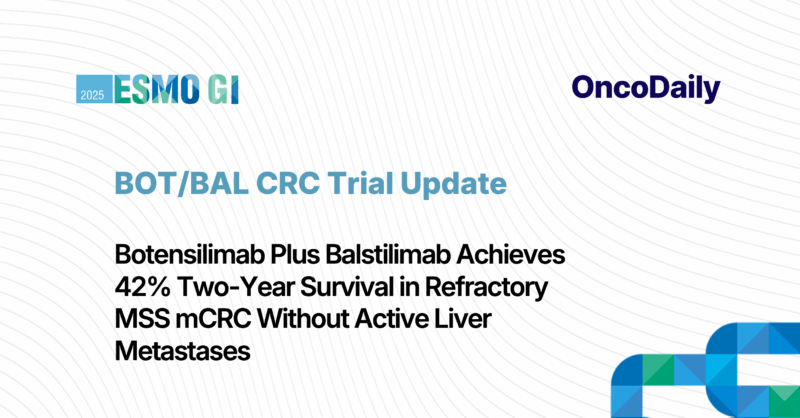
Find more information on Botensilimab and Balstilimab and their durable survival in MSS colorectal cancer: ESMO GI 2025 update on OncoDaily.
From Clinical Research to Broader Access
In September 2025, France became the first country to grant reimbursed compassionate access for botensilimab and balstilimab to patients with refractory microsatellite-stable metastatic colorectal cancer.
Approved by the French National Agency for Medicines, this program allows hospitals to prescribe this combination under a national access framework, fully reimbursed by the healthcare system.
This decision builds on data from the Phase 1b C-800-01 trial presented at ESMO GI 2025, where the combination showed objective response, encouraging overall survival, and a manageable safety profile in heavily pretreated patients.

Read about France Grants Reimbursed Compassionate Access for BOT/BAL in Refractory MSS Colorectal Cancer on OncoDaily.
A Changing Landscape in Colorectal Cancer
Colorectal cancer has long been associated with older adults, but cases among people under 50 have increased in recent years.
“The rise in colorectal cancer in younger people is certainly something that we all see in our clinics. They often present with more advanced-stage disease. That could be in part biology, but also because they’re young, busy, and their symptoms get ignored,” says Dr. Nicholas DeVito.
The challenge remains particularly significant in metastatic disease.
“If a tumor has spread, it’s evaded the immune system. Chemotherapy isn’t usually durable in that setting,” he explains.
Rethinking Treatment Strategy
The Duke trial reflects a broader effort to question long-standing treatment approaches and explore whether new strategies can be introduced earlier.
“We are seeing a cancer we’ve never treated with immunotherapy respond without ever having chemotherapy.”
“It’s important that we move these kind of options forward aggressively for patients and not accept the status quo of serial lines of chemotherapy just because that’s the way we’ve always done it.”
“And that’s one of the things that I think is really exciting is how we can develop this further by giving patients more tolerable therapies. It’s really a winwin and we can change the paradigm of how we treat micro satellite stable colon cancer,” says Dr. Nicholas DeVito.
A Story That Points Forward
Spencer’s experience reflects more than an individual response. It shows how clinical research can open new possibilities in a disease where progress has been difficult, especially in microsatellite-stable colorectal cancer.
For patients and families, participation in research is not abstract. It is a decision made in uncertainty, with the hope of something better.
“Duke has given us life. They’ve given us hope. And they’ve treated us like family.” CarleyAnn says.
Spencer’s perspective captures what that choice can mean:
“I don’t think cancer has to be a death sentence. Immunotherapy and these trials really change the outlook. Without research, there’s no new stuff. So, if nobody tries the new stuff, then what’s the point?”
Read the full article on Duke Today.