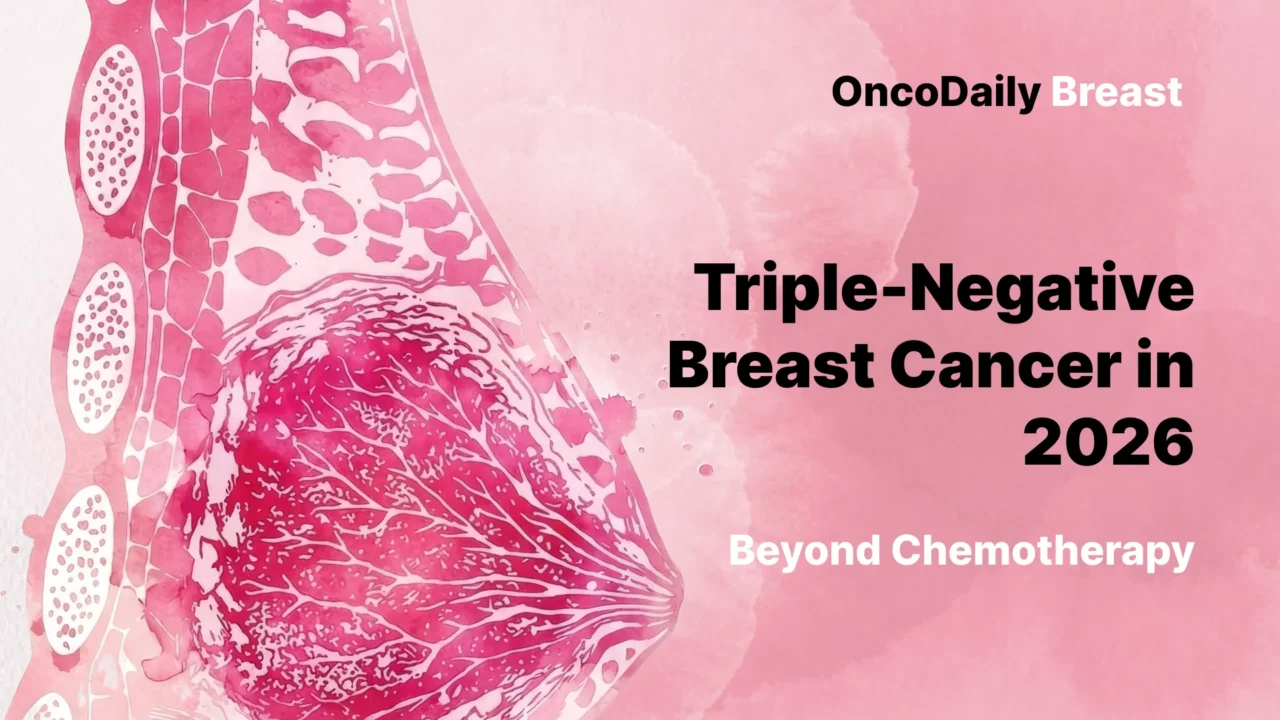
Triple-negative breast cancer (TNBC) continues to represent one of the most complex and clinically demanding subtypes in oncology. Defined by the absence of estrogen receptor, progesterone receptor, and HER2 expression, TNBC accounts for approximately 15–20% of breast cancers and is characterized by aggressive biology, early recurrence, and a historically limited therapeutic arsenal (Bianchini et al., 2016).
What has fundamentally changed in 2026 is not the definition of TNBC, but how we approach it. Management has evolved from a chemotherapy-dominated paradigm into a precision-oriented, biomarker-driven strategy, where treatment decisions are increasingly shaped by tumor biology, immune contexture, and genomic vulnerability. For clinicians, the challenge is no longer what to give, but how to sequence therapies optimally across the disease continuum.
Read About Triple-Negative Breast Cancer on OncoDaily
Step 1: Confirm the Diagnosis, But Think Beyond the Label
The initial confirmation of Triple-negative breast cancer relies on immunohistochemistry demonstrating ER-negative, PR-negative, and HER2-negative disease. While this remains the formal definition, experienced clinicians recognize that TNBC is not a single disease entity.
Behind this phenotype lies substantial heterogeneity, including basal-like tumors, immune-inflamed subtypes, and homologous recombination–deficient cancers. This biological diversity has direct therapeutic implications and should be considered from the outset. The pathology report should therefore be interpreted not only as a diagnostic tool but as the first step in therapeutic stratification (Bianchini et al., 2016).
Step 2: Stage Early and Precisely, Because Strategy Depends on It
The next decisive step is staging, which determines whether the clinical goal is cure or disease control.
Early-stage TNBC (stage I–III) is approached with curative intent, and in most cases, particularly stage II–III disease, treatment begins with systemic therapy rather than upfront surgery. This reflects the dual role of neoadjuvant therapy: improving resectability and providing an in vivo assessment of treatment sensitivity.
In contrast, metastatic TNBC requires immediate systemic treatment planning, where the sequencing of therapies becomes critical. The distinction between these two pathways must be established early, as it fundamentally alters every subsequent decision.
Step 3: Identify the Biomarkers That Change Clinical Decisions
In 2026, it is no longer acceptable to initiate treatment in TNBC without a clear understanding of key biomarkers.
Germline BRCA1/2 testing is essential, as it identifies patients who may benefit from PARP inhibition, a strategy that exploits homologous recombination deficiency and has demonstrated improved outcomes compared with chemotherapy (Tutt et al., 2021).
In metastatic disease, PD-L1 expression has become a cornerstone biomarker. Its presence determines eligibility for immunotherapy in the first-line setting, particularly with pembrolizumab-based combinations (Cortes et al., 2022).
These biomarkers are not optional, they are integral to treatment selection and should be obtained early to avoid delays in optimal therapy.
Step 4: Treat Early-Stage TNBC With an Immunotherapy-Based Neoadjuvant Strategy
For patients with high-risk early-stage TNBC, neoadjuvant therapy has become the standard of care.
The KEYNOTE-522 trial transformed this space by demonstrating that adding pembrolizumab to chemotherapy significantly improves pathologic complete response and event-free survival (Schmid et al., 2020; Schmid et al., 2022).
From a clinical perspective, this approach achieves several objectives simultaneously. It increases the likelihood of complete tumor eradication, allows real-time assessment of treatment sensitivity, and introduces immunotherapy early in the disease course, when tumor burden is lower and immune responsiveness may be greater.
Importantly, the benefit was observed regardless of PD-L1 status, which simplifies decision-making in early-stage disease.
Following surgery, pembrolizumab is continued in the adjuvant setting. Patients with residual disease represent a higher-risk group and may require additional systemic therapy, reflecting an increasingly risk-adapted post-neoadjuvant strategy.
Step 5: Define First-Line Strategy in Metastatic TNBC With Precision
In metastatic TNBC, treatment selection is no longer uniform. Instead, it is guided by biomarkers and prior treatment exposure.
The KEYNOTE-355 trial established pembrolizumab combined with chemotherapy as the standard first-line treatment for PD-L1–positive disease, demonstrating a significant overall survival benefit (Cortes et al., 2022).
For patients with germline BRCA mutations, PARP inhibitors such as olaparib provide a rational and effective targeted approach, offering improved progression-free survival and a chemotherapy-sparing option (Tutt et al., 2021).
Clinicians must therefore integrate biomarker results with clinical factors such as disease burden, prior therapies, and patient condition to select the optimal first-line strategy.
Step 6: Recognize the Shift, Antibody-Drug Conjugates as a New Backbone
The introduction of antibody-drug conjugates (ADCs) has been one of the most important advances in TNBC.
The ASCENT trial demonstrated that sacituzumab govitecan significantly improves both progression-free and overall survival compared with chemotherapy in previously treated metastatic TNBC (Bardia et al., 2021).
For clinicians, this represents more than a new drug, it represents a shift in therapeutic philosophy. Instead of non-specific cytotoxic therapy, ADCs enable targeted delivery of chemotherapy directly to tumor cells, improving efficacy while maintaining a manageable safety profile.
Step 7: Anticipate the Next Paradigm Shift: ASCENT-04
A key question in current TNBC management is whether chemotherapy can be replaced altogether in the first-line metastatic setting.
The ASCENT-04 trial directly addresses this question by evaluating sacituzumab govitecan combined with pembrolizumab versus chemotherapy plus pembrolizumab.
Updated data from 2025–2026 indicate that this combination provides a clinically meaningful improvement in progression-free survival, with median PFS approaching approximately 11 months compared with 7–8 months for chemotherapy-based regimens, corresponding to a hazard ratio in the range of 0.65–0.70. Early overall survival trends favor the experimental arm, although follow-up remains ongoing.
From a clinical standpoint, these results are highly significant. They suggest the possibility of a chemotherapy-free frontline approach, combining targeted cytotoxic delivery with immune activation. If confirmed with mature survival data, this strategy may fundamentally alter treatment sequencing in metastatic TNBC.

Read About ASCENT-04 Trial on OncoDaily
Step 8: Continuously Reassess, TNBC Is a Dynamic Disease
Perhaps the most important principle in TNBC management is that treatment is not static.
At each stage of the disease, clinicians must reassess tumor biology, prior response, toxicity, and patient condition. Resistance mechanisms evolve, and therapeutic opportunities change accordingly.
Emerging strategies, including next-generation ADCs, combination immunotherapy, and approaches targeting the tumor microenvironment, are likely to further refine this landscape. The goal is no longer simply to treat TNBC, but to adapt treatment dynamically based on evolving disease biology.
You Can Watch More on OncoDaily Youtube TV
Written by Armen Gevorgyan, MD