On July 13, 2026, Agenus Inc. announced an oversubscribed private placement expected to provide approximately $85 million in upfront gross proceeds and up to an additional $255 million upon full exercise of purchase warrants. The financing is intended to advance ROBBIN, the company’s planned registrational Phase 3 trial of neoadjuvant botensilimab plus balstilimab (BOT+BAL) in patients with high-risk Stage II or Stage III microsatellite-stable colon cancer.
Following the announcement, Agenus hosted a conference call and live webcast to discuss the financing and the clinical strategy behind the ROBBIN program. The discussion featured Myriam Chalabi, MD, PhD, of the Netherlands Cancer Institute, a leading investigator in neoadjuvant immunotherapy for colorectal cancer, and Pashtoon Kasi, MD, MS, of City of Hope Hospital, who provided independent clinical perspectives on the program.
During the webcast, Chalabi and Kasi reviewed the current treatment landscape for localized colon cancer, the rationale for administering immunotherapy before surgery, and findings from the FOxTROT, NICHE, NEST, and UNICORN studies that supported the decision to advance BOT+BAL into a randomized Phase 3 trial.

Twenty Years Without a New Curative-Intent Option
The treatment of localized colon cancer continues to rely primarily on surgery followed, when indicated, by adjuvant chemotherapy. Postoperative pathologic staging remains central to treatment decisions, and patients with high-risk Stage II or Stage III disease may receive up to six months of chemotherapy. According to Agenus, high-risk Stage II and Stage III MSS colon cancer affects an estimated 38,000 patients annually in the United States and more than 200,000 worldwide.
“It’s great to be here to discuss the exciting avenue of neoadjuvant immunotherapy in colorectal cancer, something that I think over 10 years ago, we didn’t think was possible, especially not for MSS colon cancer,” Chalabi said, opening the webcast.
MSS tumors account for approximately 85% of colon cancers and have historically demonstrated limited sensitivity to conventional immune checkpoint inhibition. Despite surgery and adjuvant chemotherapy, approximately 20%–40% of patients may still experience recurrence, while treatment can cause long-term toxicities, including polyneuropathy.
“…We still need a better treatment option for these patients, and to ultimately improve their long-term outcomes and decrease toxicities, because chemotherapy is not without side effects,” Chalabi said.
What FOxTROT Established
The FOxTROT trial helped establish the feasibility of administering chemotherapy before surgery in colon cancer. Patients selected according to clinical staging were randomized to perioperative chemotherapy or postoperative chemotherapy alone, providing an early framework for neoadjuvant treatment in this setting.
The study did not require patients to have either MSS or MSI tumors because, when FOxTROT was designed, it was not yet known whether responses to neoadjuvant chemotherapy would differ between the two molecular subtypes.
“What this study showed is that neoadjuvant chemotherapy was feasible, that it was safe, and that the rate of complications was not higher compared to adjuvant chemotherapy, but also there seemed to be ultimately an improvement in outcome for patients who received neoadjuvant chemotherapy. So there’s definitely a subset of patients that might benefit from neoadjuvant treatment,” Chalabi said.
Across FOxTROT and other studies, pathologic response rates with neoadjuvant chemotherapy in MSS colon cancer have been estimated at approximately 20%–25%, providing an important benchmark for evaluating newer preoperative strategies.
“The 85% of patients still have their chemotherapy as the standard of care, and that’s all we have. Other chemotherapies have been tried and that hasn’t worked. So there’s definitely a need for improvement for that patient population.”
NICHE: The First Signal That MSS Could Respond
The NICHE platform study was the first to evaluate neoadjuvant immunotherapy in patients with MSS colon cancer. The study was based on the hypothesis that earlier-stage disease might be more responsive to checkpoint inhibition than metastatic MSS colorectal cancer, where conventional immunotherapy had shown little activity. Investigators also recognized that a subset of MSS tumors could be immunogenic and potentially responsive.
Thirty-one patients received one dose of ipilimumab and two doses of nivolumab before undergoing surgery within six weeks. A pathologic response was observed in 26% of patients, including deep responses and pathologic complete responses, within approximately four and a half weeks from the first treatment dose to surgery.
“This was not just a little bit of response,” Chalabi said. “These were patients that had deep pathologic responses, including pCRs.”
In this small cohort, pathologic response appeared to have potential prognostic relevance.
“Patients who do have a pathologic response to that very short duration of treatment have an excellent long-term outcome without recurrences. While patients who don’t respond are at significantly higher risk of recurring,” Chalabi said.
The findings provided early proof of principle that neoadjuvant checkpoint inhibition could produce meaningful responses in a subset of patients with MSS colon cancer and supported further evaluation of more active anti–CTLA-4-based combinations.

Understanding BOT/BAL
Botensilimab is a human Fc-enhanced multifunctional anti–CTLA-4 antibody designed to activate innate and adaptive antitumor immune responses. According to Agenus, it primes and activates T cells, downregulates intratumoral regulatory T cells, activates myeloid cells, and induces long-term memory responses.
Balstilimab is a fully human IgG4 monoclonal antibody designed to block the interaction of PD-1 with its ligands PD-L1 and PD-L2. The combination is being investigated as a strategy to generate immune responses in tumors that have historically shown limited sensitivity to conventional checkpoint inhibition, including MSS colon cancer.
NEST and UNICORN: The BOT+BAL Data
The NEST and UNICORN studies evaluated BOT+BAL before surgery in patients with resectable colon cancer, using treatment schedules designed to remain compatible with planned curative-intent surgery.
“The neoadjuvant setting is attractive because the primary tumor is still in place. The draining lymph nodes are in place. The tumor can serve as a source of antigen,” Kasi said.
NEST-1 used a short treatment window, with patients undergoing surgery after approximately three to four weeks on average and some proceeding as early as 20 days after the first BOT dose. After initial findings showed deep pathologic responses without major safety concerns, NEST-2 retained a single BOT dose, added further BAL doses, and extended the interval before surgery to approximately eight weeks. In the independently conducted UNICORN study, the median time to surgery was approximately five weeks.
“We’re not talking about responses on scans,” Kasi said. “We’re talking about pathologic responses of the dissected tissue and also the opportunity to assess the biology in real time.”
Among patients with MSS tumors treated in the NEST studies, approximately 59% achieved at least 50% tumor regression, approximately 41% had at least 90% tumor regression, and roughly one-third achieved a pathologic complete response, with no viable tumor identified at surgery.
UNICORN provided independent corroboration and included a BOT monotherapy cohort to examine the contribution of the combination. Deeper pathologic responses were observed with BOT+BAL than with BOT alone in both MSS and MSI-high tumors.
Early Recurrence and ctDNA Findings
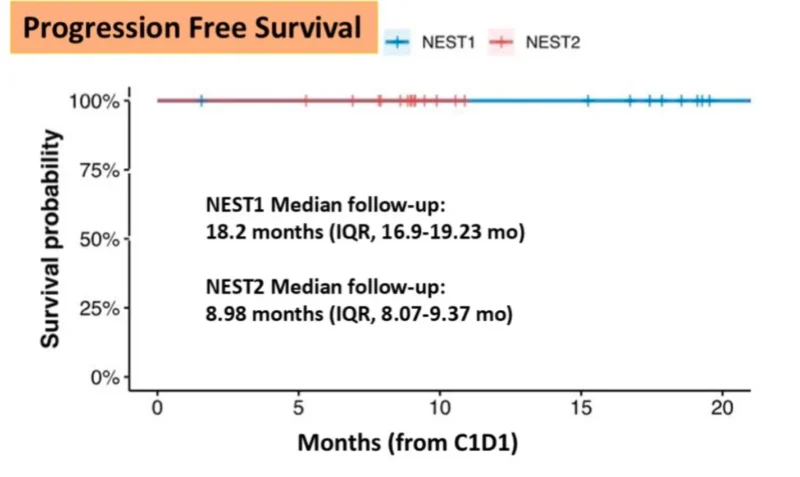
Across approximately 38 patients with MSS tumors treated with BOT+BAL in the NEST and UNICORN studies, no recurrences had been reported at the time of the webcast. However, follow-up remained limited, and the findings require confirmation in a larger randomized population.
“There have been no recurrences reported to date,” Kasi said. “Now again, this follow-up is a little early.”
Circulating tumor DNA also showed early molecular changes following treatment. In some patients, ctDNA clearance was observed by the second BAL dose, approximately two weeks after treatment began, and remained sustained during the available follow-up.
Kasi noted that prior ctDNA data associate ctDNA negativity with an approximately 90%–94% probability of remaining disease-free at two to three years, and he described the rapid clearance observed in these studies as an important early signal. Whether ctDNA clearance after neoadjuvant BOT+BAL reliably predicts durable long-term disease control requires prospective validation.
Safety Was the Gate
Preserving the timing and feasibility of curative-intent surgery was a central requirement of the early neoadjuvant studies. Any treatment-related toxicity in this setting must be weighed against the risk of compromising established surgical management.
Across more than 52 patients described during the webcast, immune-related adverse events were considered expected and manageable. Apart from one patient in UNICORN who developed hyperthyroidism and underwent surgery approximately 10 days later than planned, no surgical delays were reported.
Chalabi and Kasi also highlighted the potential to reduce chemotherapy-associated toxicity. Kasi noted that many patients for whom adjuvant chemotherapy represented standard care elected not to receive it. This was not part of the study design and does not establish that adjuvant chemotherapy can safely be omitted.
Could ROBBIN Change the Treatment Algorithm?
Neoadjuvant treatment is currently used in only a small proportion of patients with MSS colon cancer. Its use has increased since FOxTROT, particularly when tumor shrinkage may facilitate surgery or when postoperative chemotherapy is already expected based on baseline disease characteristics.
The evolving management of MSI-high colon cancer provides an example of how strong neoadjuvant immunotherapy results can begin to influence practice, even before an approach is adopted universally. For MSS disease, a broader shift would require evidence that neoadjuvant immunotherapy improves outcomes compared with the current strategy of surgery followed by guideline-directed postoperative management.
During the Q&A, Chalabi addressed whether positive results from ROBBIN could expand the use of neoadjuvant immunotherapy in this population.
“If you show that this is better with neoadjuvant immunotherapy than the standard of care adjuvant chemo, then it’s going to become much easier to treat a much larger population with neoadjuvant immunotherapy,” Chalabi said.
ROBBIN is intended to provide that randomized comparison. Pathologic response may offer an early indication of biological activity, but event-free survival will determine whether the strategy reduces recurrence and improves long-term outcomes.
NEST-3 Will Continue Alongside ROBBIN
The registrational ROBBIN trial and investigator-initiated studies such as NEST-3 are intended to address complementary objectives. ROBBIN will evaluate whether neoadjuvant BOT+BAL can improve outcomes in a large randomized population, while investigator-initiated studies can provide more detailed translational analyses that may not be feasible within a Phase 3 program.
During the Q&A, Kasi confirmed that NEST-3 was open and enrolling and that its first patient had been treated approximately two weeks before the webcast.
“While the registrational study will hopefully bring this to the larger patient population as standard of care, there is a deeper understanding that you can learn from translational studies, other aspects that go in tandem with some of these investigator-initiated trials that are not always possible in a phase three setting,” Kasi said.
NEST-3 and other investigator-initiated studies are therefore expected to continue alongside ROBBIN, supporting tissue-based research, biomarker assessment, and a more detailed understanding of treatment response.
Read about NEST Trial updates from ASCO GI 25 on OncoDaily.
A Phase 3 Test of an Early Clinical Signal
The rationale for ROBBIN is supported by several early observations: the potential immunologic advantages of treating patients while the primary tumor and draining lymph nodes remain intact, the pathologic responses observed in NICHE, and the early pathologic, ctDNA, and recurrence findings reported with BOT+BAL in NEST and UNICORN.
These findings, however, come from small, nonrandomized studies with limited follow-up and cannot establish whether neoadjuvant BOT+BAL reduces recurrence or improves survival.
“These signals are multiple across multiple studies and are hard to ignore,” Kasi said.
He described ROBBIN as the next step for evaluating the approach in a formal randomized trial, including its effects on pathologic response, ctDNA clearance, and recurrence-related outcomes.
The planned Phase 3 trial will determine whether the early pathologic and molecular findings can be reproduced in a substantially larger population and, most importantly, whether they translate into improved event-free survival for patients with high-risk localized MSS colon cancer.
Takeaway
For patients with high-risk localized MSS colon cancer, surgery followed, when indicated, by adjuvant chemotherapy has remained the principal curative-intent strategy for decades. Despite this approach, a substantial proportion of patients continue to experience recurrence.
Findings from NICHE, NEST, and UNICORN suggest that meaningful immune responses may be possible when immunotherapy is administered before surgery, even in tumors that have historically shown limited sensitivity to conventional checkpoint inhibition.
These early results remain preliminary and require randomized validation. ROBBIN is designed to determine whether the pathologic responses, rapid ctDNA clearance, and early disease-free outcomes observed in smaller studies translate into fewer recurrences and improved long-term disease control.
Read more about BOT/BAL in MSS Colon Cancer on OncoDaily.