On July 13, 2026, Agenus Inc. (Nasdaq: AGEN) announced an oversubscribed private placement expected to generate approximately $85 million in upfront gross proceeds, with up to an additional $255 million available through the full exercise of purchase warrants.
The transaction could therefore provide Agenus with up to $340 million to support the development of neoadjuvant botensilimab plus balstilimab, known as BOT+BAL, in microsatellite-stable colon cancer.
The financing is intended primarily to support ROBBIN, Agenus’s planned registrational Phase 3 trial evaluating neoadjuvant BOT+BAL in patients with previously untreated high-risk Stage II and Stage III MSS/pMMR colon cancer. Assuming the warrants are exercised in full, Agenus expects the proceeds to fund the completion of ROBBIN and support company operations through year-end 2031.
The announcement also reflects a broader prioritization of BOT+BAL in the neoadjuvant setting. To focus its resources on ROBBIN, Agenus plans to discontinue financial support for the ongoing BATTMAN Phase 3 trial in late-line metastatic MSS colorectal cancer.
A Financing Structured Around ROBBIN
The private placement was led by Commodore Capital, with participation from RA Capital Management, TCGX, Invus, and Ligand Pharmaceuticals. The transaction is expected to close on or around July 15, 2026, subject to customary closing conditions.
According to Agenus, both the upfront purchase price and the warrant exercise prices were set at a premium to the company’s closing share price on July 10, 2026.
The deal is structured in three layers. Agenus will issue 23,035,227 shares of common stock, or pre-funded warrants exercisable at $0.01 per share in their place. Investors also receive Series A warrants covering 21,144,277 shares at $4.02 per share and Series B warrants covering 33,797,214 shares at $5.03 per share. The combined effective price comes to $3.69 per share with accompanying warrants.
The warrant expiration dates are linked directly to ROBBIN progress. The Series A warrants expire at the earlier of five years from closing or 30 days after Agenus publicly reports that at least 60 patients have been dosed. The Series B warrants expire at the earliest of the five-year mark, 30 days after disclosure of pathologic response data from at least 50 ROBBIN patients, or one day after the Series A warrants expire — unless the holder has already fully exercised their Series A warrants.
The warrant expiration periods are linked to early ROBBIN milestones, while the additional proceeds depend on investors exercising the warrants.
As part of the agreement, Agenus will expand its board to nine directors, with two new Class III seats to be filled by designees of Commodore Capital Master LP.
Why Neoadjuvant — and Why MSS Colon Cancer
MSS tumors account for the majority of colon cancers but have historically resisted immune checkpoint inhibitors. Unlike their microsatellite instability-high (MSI-H) or mismatch repair-deficient (dMMR) counterparts — which tend to carry high mutational burdens and respond well to PD-1 blockade — MSS tumors are considered immunologically “cold,” meaning they harbor limited baseline antitumor immune activity.
High-risk Stage II and Stage III MSS colon cancer affects an estimated 38,000 patients per year in the United States and more than 200,000 worldwide. According to Agenus, no new curative-intent therapy has been approved for this population in over two decades, and the company estimates the US addressable market at more than $7 billion annually.
Agenus’s strategy centers on treating patients before surgery, while the primary tumor is still intact. The rationale is that an intact tumor may serve as a richer source of tumor antigens, giving BOT+BAL a better opportunity to prime a broad and lasting immune response.
Dr. Steven O’Day, Chief Medical Officer of Agenus, described the rationale for moving the combination into high-risk localized MSS colon cancer:
“We have seen neoadjuvant and perioperative immunotherapy improve outcomes in immunologically ‘hot’ or ‘warm’ tumors such as melanoma and lung cancer, but MSS colon cancer — a ‘cold’ tumor — has resisted standard checkpoint inhibitors. BOT was engineered to overcome that resistance and has produced deep pathologic responses with no recurrences reported in the NEST and UNICORN studies. With the ROBBIN trial, we are bringing this regimen to patients with high-risk Stage II and Stage III MSS colon cancer, where treating an intact tumor gives BOT+BAL its greatest opportunity to generate a durable immune response and improve long-term outcomes.”
The company’s decision to prioritize ROBBIN therefore reflects both the early clinical findings with BOT+BAL and its plan to evaluate the regimen in patients being treated with curative intent.
Understanding BOT/BAL
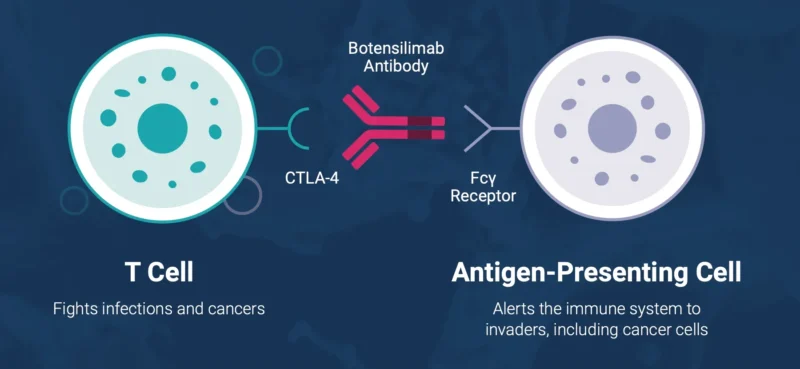
Botensilimab (BOT) is an Fc-enhanced anti-CTLA-4 antibody engineered to go beyond conventional CTLA-4 blockade. According to Agenus, the Fc-enhanced design enables BOT to prime and activate T cells, suppress regulatory T cells within the tumor microenvironment, engage myeloid cell populations, and promote durable immune memory. These combined mechanisms are intended to convert immunologically cold tumors into environments where an effective antitumor response can take hold.
Balstilimab (BAL) is a fully human IgG4 antibody targeting PD-1. By blocking PD-1’s interaction with its ligands PD-L1 and PD-L2, BAL is designed to release T cells from a key suppressive brake. It has been evaluated in more than 900 patients across several tumor types, where the company reports clinical activity and a favorable tolerability profile.
A Dual Checkpoint Strategy
Together, the two agents represent a dual-checkpoint strategy: BOT provides immune priming and activation through enhanced CTLA-4 inhibition, while BAL removes PD-1-mediated suppression. Approximately 1,300 patients have been treated with BOT, BAL, or the combination across Phase 1 and Phase 2 studies, with responses reported across nine late-line metastatic cancer types.
The Clinical Basis From NEST and UNICORN
The foundation for ROBBIN comes from two independent Phase 2 neoadjuvant studies — NEST and UNICORN — both evaluating BOT+BAL in MSS colorectal cancer.
Across the two trials, Agenus reported pathologic response rates of approximately 60% to 70%, major pathologic response (MPR) in roughly 35% to 40% of patients, and pathologic complete response (pCR) in approximately 30%. MPR indicates minimal residual viable tumor in surgically removed tissue, while pCR indicates no detectable viable cancer at all.
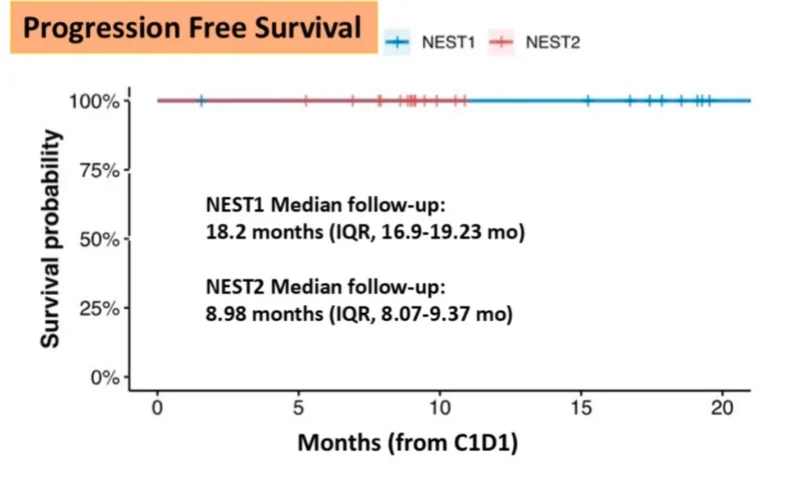
At a median follow-up ranging from approximately 9 to 18 months, all treated patients remained disease-free. The company also reported clearance of circulating tumor DNA (ctDNA) — tumor-derived DNA fragments detectable in the blood that are increasingly studied as markers of treatment response and residual disease.
Agenus noted that deep pathologic responses (MPR and pCR) in the neoadjuvant setting have been positively correlated with event-free survival across multiple tumor types, including MSS colon cancer. Updated data from NEST and UNICORN are expected later in 2026.
These results remain early, however, and the randomized ROBBIN trial will be needed to determine whether the observed pathologic and molecular responses translate into durable survival benefit.
Read more about NEST Trial updates from ASCOGI25 on OncoDaily.
ROBBIN Moves Into Phase 3
ROBBIN is a planned randomized, open-label, global Phase 3 study. It will enroll 850 patients with previously untreated high-risk Stage II or Stage III MSS/pMMR colon cancer, randomized 1:1.
Patients in the experimental arm will receive a short course of neoadjuvant BOT+BAL before surgery, followed by guideline-directed adjuvant chemotherapy or observation based on pathologic staging. Patients in the control arm will proceed directly to surgery and receive the same post-operative standard of care.
Endpoints and FDA Alignment
The primary endpoint is event-free survival (EFS), which measures the time patients remain free of disease recurrence, progression, or other protocol-defined events. Anticipated secondary and exploratory endpoints include overall survival, ctDNA negativity, quality of life, safety, and pathologic response.
Following interactions with the FDA, Agenus reported alignment with the agency on the study population, experimental regimen, control arm, primary endpoint, and interim analysis plan.
Anticipated Milestones
Agenus outlined four key milestones for ROBBIN:
- First patient dosed: Q1 2027
- Interim pathologic response data: second half of 2027
- Interim EFS analysis: second half of 2029
- Final EFS analysis: second half of 2030
Assuming full warrant exercise, Agenus expects the financing to fund ROBBIN through interim pathologic response data and the interim and final EFS analyses, with operational runway through year-end 2031.
Ending Financial Support for BATTMAN
As part of this strategic refocusing, Agenus plans to discontinue financial support for BATTMAN, an ongoing Phase 3 study evaluating BOT+BAL in late-line metastatic MSS colorectal cancer.
The company said it will honor its obligations to patients currently receiving treatment and work closely with the Canadian Cancer Trials Group (CCTG) and participating investigators to manage the transition responsibly. Agenus also acknowledged the contributions of clinicians, site teams, CCTG, and patients to the development of BOT+BAL in late-stage disease.
The decision establishes neoadjuvant BOT+BAL in high-risk localized MSS colon cancer as the company’s principal late-stage development priority.
Read more about BATTMAN Trial on OncoDaily.
Agenus’s Focus on Curative-Intent Development
Garo H. Armen, Ph.D., Founder, Chairman and Chief Executive Officer of Agenus, described the ROBBIN strategy within the company’s broader mission:
“Since Agenus was founded 32 years ago, our mission has been to harness the immune system to improve outcomes and, where possible, cure cancer. Our plan to prioritize neoadjuvant BOT+BAL in MSS colon cancer reflects both the strength of the emerging clinical evidence and the opportunity to bring this important combination regimen to patients where it may have the greatest impact. With ROBBIN, we are advancing a randomized global trial designed to confirm the rapid and deep activity observed across the NEST and UNICORN trials.”
The announcement brings together a planned registrational Phase 3 program, Phase 2 findings from NEST and UNICORN, and a financing structure designed to support the company through ROBBIN’s principal clinical milestones.
Conference Call and Independent Clinical Perspectives
The company scheduled a conference call and webcast for 8:30 a.m. ET on July 13, 2026. The call was expected to feature Myriam Chalabi, M.D., Ph.D., of the Netherlands Cancer Institute, and Pashtoon Kasi, M.D., M.S., of City of Hope Hospital, who would provide independent clinical perspectives on the program.
What Comes Next for ROBBIN
ROBBIN will test whether the pathologic and molecular responses seen in NEST and UNICORN hold up in a larger randomized population and, critically, whether they translate into improved event-free survival. The first tangible milestone — dosing of the first patient — is expected in early 2027, with interim pathologic response data anticipated later that year.
For Agenus, the July 13 announcement consolidates the company’s late-stage strategy around ROBBIN in a disease setting where, according to the company, no new curative-intent therapies have been approved in more than 20 years. The clinical significance of this strategy will depend on the results generated by ROBBIN over the coming years.
The full announcement is available from Agenus Inc.