Esophageal adenocarcinoma is increasingly being approached as a molecularly diverse disease rather than a single tumor type. As treatment options expand, biomarker testing has become an important part of understanding tumor biology and identifying which therapies may be most appropriate for individual patients.
At the same time, newer molecular and blood-based approaches are adding another layer to how esophageal adenocarcinoma is classified, monitored, and studied. While some biomarkers already influence routine treatment decisions, others are still being evaluated and may shape the next generation of precision therapy.
What Are the Key Biomarkers in Esophageal Adenocarcinoma?
Esophageal adenocarcinoma (EAC) has a more established biomarker landscape than esophageal squamous cell carcinoma, and molecular testing now plays an important role in treatment planning for advanced disease.
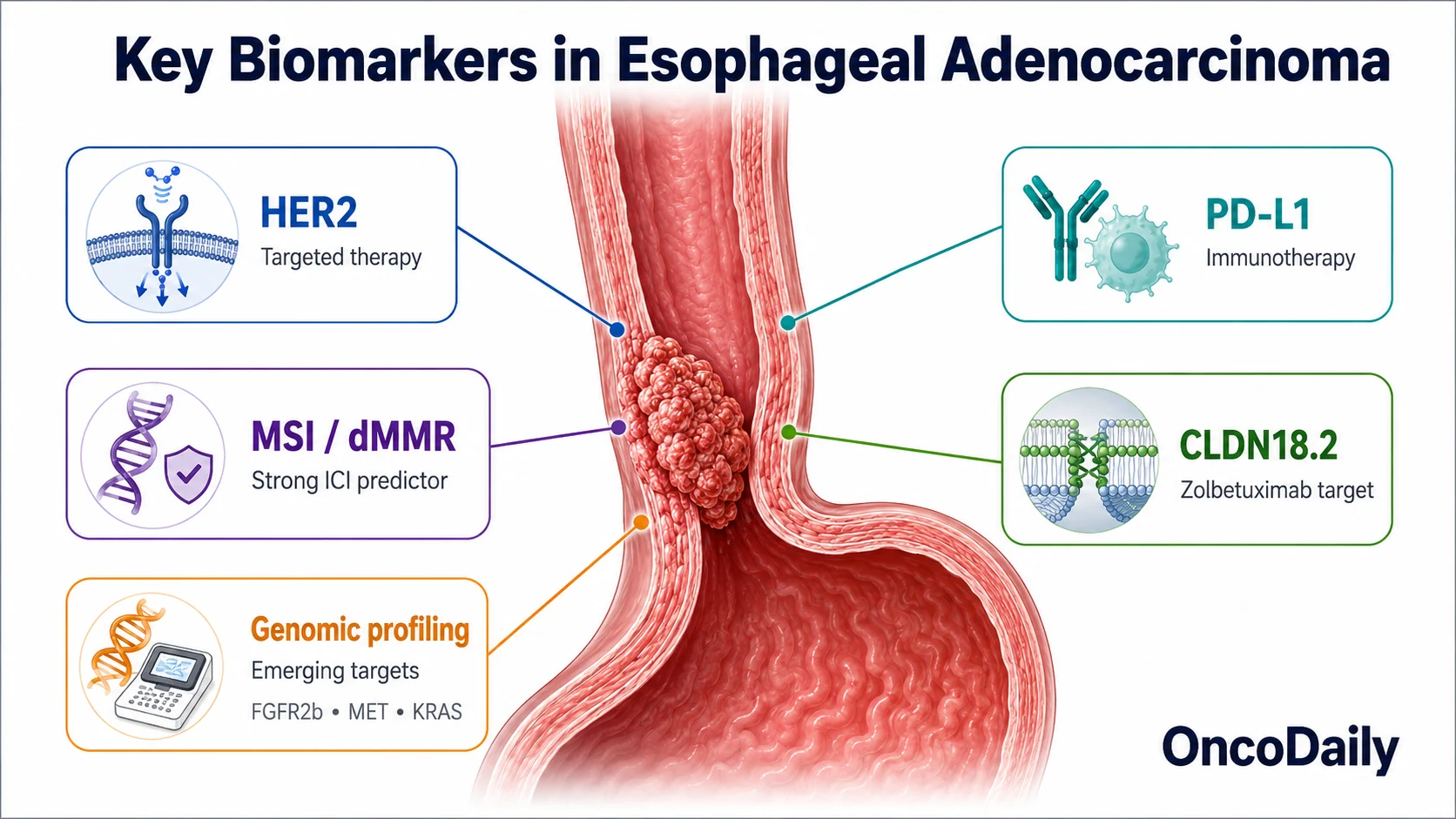
The main clinically relevant biomarkers are HER2, PD-L1, mismatch repair deficiency/microsatellite instability (dMMR/MSI-H), and CLDN18.2. These are commonly assessed as part of the broader gastroesophageal adenocarcinoma biomarker workup because they can influence the use of targeted therapy or immunotherapy. The clinical relevance of CLDN18.2 is currently better established in gastric and gastroesophageal junction (GEJ) adenocarcinoma than in tumors arising entirely within the esophagus (Shah et al., 2026).
Beyond these established biomarkers, genomic profiling is identifying additional molecular subgroups and less common actionable alterations. Some may eventually provide new treatment options, while others are currently most useful for identifying patients who may be eligible for clinical trials.
As the molecular classification of EAC becomes more detailed, biomarker testing is moving beyond a single-marker approach toward a broader assessment of tumor biology and potential treatment vulnerabilities (Pinto et al., 2026).
HER2 Testing and HER2-Targeted Therapy
HER2 is one of the best-established actionable biomarkers in gastroesophageal adenocarcinoma. Testing is recommended in advanced disease because HER2 positivity can directly change systemic treatment options.
Testing usually begins with immunohistochemistry (IHC). Tumors with IHC 3+ staining are considered HER2-positive, while IHC 2+ tumors require confirmation of HER2 amplification by in situ hybridization (ISH). IHC 0 or 1+ tumors are considered HER2-negative by conventional criteria. Because HER2 expression can vary within the same tumor, adequate sampling and careful interpretation are important (Bartley et al., 2017).
In advanced HER2-positive gastroesophageal adenocarcinoma, trastuzumab combined with fluoropyrimidine- and platinum-based chemotherapy remains the HER2-directed treatment backbone. For pMMR/MSS HER2-positive gastric or GEJ adenocarcinoma with PD-L1 CPS ≥1, current ASCO guidance recommends adding pembrolizumab to trastuzumab and chemotherapy, based on KEYNOTE-811 (Shah et al., 2026).
HER2 expression can also change during the course of treatment. This is particularly relevant after exposure to trastuzumab, when loss or reduced expression of HER2 may occur. Reassessment can therefore be useful before choosing another HER2-directed therapy later in the disease course.

PD-L1, MSI and dMMR as Immunotherapy Biomarkers
PD-L1 expression and MSI-H/dMMR are the main biomarkers used to help guide immunotherapy in esophageal adenocarcinoma, but they measure different aspects of tumor biology and should not be interpreted in the same way.
PD-L1 is usually measured by immunohistochemistry and reported as a combined positive score (CPS), which includes staining in both tumor cells and associated immune cells. Higher PD-L1 expression is generally associated with a greater likelihood of benefit from adding immune checkpoint inhibition to chemotherapy, but PD-L1 is an enrichment marker rather than a reliable yes-or-no predictor of response (Gambella et al., 2025; Shah et al., 2026).
MSI-H and dMMR identify tumors with defective DNA mismatch repair and increased genomic instability. These tumors can generate a larger number of neoantigens and are often particularly sensitive to immune checkpoint inhibition. Unlike PD-L1, the predictive value of MSI-H/dMMR can remain important even when PD-L1 expression is low.
Current ASCO guidance recommends testing advanced gastroesophageal adenocarcinoma for PD-L1 and dMMR/MSI-H, together with other relevant biomarkers. In pMMR/MSS disease, PD-L1 helps estimate the expected benefit from chemo-immunotherapy. When MSI-H/dMMR is present, immunotherapy becomes a particularly important treatment consideration, and immunotherapy alone may also be considered in selected patients (Shah et al., 2026).
The two biomarkers therefore complement each other: PD-L1 helps refine immunotherapy selection across a broad group of patients, while MSI-H/dMMR identifies a smaller but biologically distinct subgroup with strong sensitivity to checkpoint inhibition.
CLDN18.2 Testing and Targeted Treatment
CLDN18.2 is now part of the biomarker workup for gastroesophageal adenocarcinoma, although its established treatment role is currently strongest in gastric and GEJ adenocarcinoma rather than pure esophageal adenocarcinoma.
CLDN18.2 expression is assessed by immunohistochemistry. For zolbetuximab-based treatment, positivity is defined as moderate-to-strong membranous staining in at least 75% of tumor cells, the cutoff used in the phase III SPOTLIGHT and GLOW trials (Dundr and Matěj, 2026).
Testing matters because CLDN18.2 positivity can identify patients who may benefit from zolbetuximab, a monoclonal antibody directed against CLDN18.2. In HER2-negative, CLDN18.2-positive gastric or GEJ adenocarcinoma, zolbetuximab combined with fluoropyrimidine- and platinum-based chemotherapy improved progression-free and overall survival compared with chemotherapy alone.
Current ASCO guidance places CLDN18.2 within the broader first-line biomarker algorithm. For pMMR/MSS, HER2-negative gastric or GEJ adenocarcinoma with CLDN18.2 positivity and PD-L1 expression <1, zolbetuximab plus chemotherapy should be offered. When both CLDN18.2 and PD-L1 are positive, either immunotherapy- or zolbetuximab-based treatment may be considered depending on the individual clinical situation (Shah et al., 2026).
For adenocarcinomas arising entirely within the esophagus, however, direct clinical evidence for zolbetuximab is much more limited. CLDN18.2 remains relevant to EAC research, particularly as new antibodies, antibody-drug conjugates, bispecifics, and cellular therapies directed against the target move through clinical development.
FGFR2b and Other Emerging Molecular Targets
FGFR2b is one of the better-studied emerging biomarkers in gastroesophageal adenocarcinoma, although most of the clinical evidence again comes from gastric and GEJ cancers rather than pure EAC.
FGFR2b overexpression is generally assessed by immunohistochemistry. The FORTITUDE program used 2+ or 3+ FGFR2b staining in at least 10% of tumor cells to define the biomarker-positive population (Rha et al., 2025).
The FGFR2b-targeted antibody bemarituzumab was evaluated with mFOLFOX6 in the phase III FORTITUDE-101 trial. An early analysis showed an overall survival advantage, but the treatment effect became smaller with longer follow-up. At the later analysis, median overall survival was 14.5 months with bemarituzumab and 13.2 months with placebo, with an HR of 0.82. In February 2026, Amgen announced that it did not plan to pursue regulatory approval for bemarituzumab in first-line gastric cancer based on results from FORTITUDE-101 and FORTITUDE-102 (Rha et al., 2025; Amgen, 2026).
FGFR2b therefore remains biologically interesting, but bemarituzumab is not an approved standard treatment. Other approaches targeting FGFR2 or FGFR2b, including ADCs, bispecific antibodies, and newer targeted agents, continue to be investigated.
Broad genomic profiling can also uncover rarer abnormalities. NTRK and RET fusions and BRAF V600E mutationsare uncommon but may provide access to tumor-agnostic targeted therapies when identified. Other alterations, including MET amplification and KRAS G12C, are being studied as treatment targets but remain more relevant to clinical trials than routine EAC treatment at present (Zhang et al., 2026).
These findings are uncommon individually, but they provide a reason to consider broad next-generation sequencing in advanced disease, particularly when standard biomarker-directed options have been exhausted.

Antibody-Drug Conjugates, Liquid Biopsy and Future Biomarkers
Antibody-drug conjugates (ADCs) are adding another layer to biomarker-driven treatment in gastroesophageal adenocarcinoma. The most established example is trastuzumab deruxtecan (T-DXd), a HER2-targeted ADC carrying a topoisomerase I inhibitor payload.
In the phase III DESTINY-Gastric04 trial, T-DXd improved overall survival compared with ramucirumab plus paclitaxel in patients with previously treated HER2-positive gastric or GEJ adenocarcinoma. Median overall survival was 14.7 months with T-DXd and 11.4 months with ramucirumab plus paclitaxel (Shitara et al., 2025).
As with zolbetuximab, the strongest evidence for T-DXd comes from gastric and GEJ rather than pure esophageal adenocarcinoma. Its use in HER2-low disease, earlier treatment settings, and esophagogastric adenocarcinoma more broadly is being explored in ongoing studies. Other ADCs directed against HER2 and additional surface targets are also entering clinical development.

Circulating tumor DNA (ctDNA) is developing along a different path. Rather than directly identifying a drug target, ctDNA can provide information about the amount and molecular composition of tumor DNA circulating in the blood. In gastroesophageal adenocarcinoma, postoperative ctDNA positivity has consistently been associated with a higher risk of recurrence, while changes in ctDNA during treatment may reflect response or emerging resistance (Sahwan et al., 2025).
Serial liquid biopsy can also detect changes in genomic alterations such as ERBB2, FGFR2, MET, and RAS-pathway alterations, potentially providing a view of how the tumor evolves under treatment without requiring repeated tissue biopsies. This may become particularly useful when resistance develops to targeted therapies.
For now, however, the prognostic value of ctDNA is ahead of its clinical utility. There is still not enough prospective randomized evidence to routinely escalate, stop, or switch treatment solely on the basis of a ctDNA result (Sahwan et al., 2025).
Other biomarkers being studied include HER2-low expression, tumor mutational burden, DNA methylation signatures, multi-omic blood assays, and AI-assisted digital pathology. These approaches may eventually improve treatment selection, detect molecular residual disease earlier, or help identify EAC before it becomes clinically apparent.
The field is therefore moving toward a broader model of precision oncology in which tissue biomarkers, genomic profiling, and blood-based monitoring are used together. Most of these newer approaches are not ready for routine treatment decisions yet, but they are likely to shape how esophageal adenocarcinoma is classified and managed in the future.
FAQ
What are the main biomarkers in esophageal adenocarcinoma?
The main biomarkers include HER2, PD-L1, MSI/dMMR, and CLDN18.2.
Why is HER2 testing important in esophageal adenocarcinoma?
HER2 positivity can identify patients who may benefit from HER2-targeted therapy.
How does PD-L1 affect immunotherapy decisions?
Higher PD-L1 CPS is generally associated with a greater likelihood of benefit from immune checkpoint inhibitors.
What does MSI-H or dMMR mean?
MSI-H/dMMR indicates defective DNA repair and may predict a strong response to immunotherapy.
What is the role of CLDN18.2?
CLDN18.2 is an actionable biomarker in gastroesophageal adenocarcinoma and is the target of therapies such as zolbetuximab.