
Esophageal squamous cell carcinoma (ESCC) is biologically distinct from esophageal adenocarcinoma and has a different biomarker landscape. While PD-L1 is the main biomarker currently used to help guide immunotherapy, advances in genomic profiling are identifying additional alterations that may improve treatment selection in the future.
Research is also expanding into tumor mutational burden, TP53 and cell-cycle alterations, growth-factor pathways, antibody-drug conjugates, and circulating tumor DNA. Together, these biomarkers are helping define a more precise approach to ESCC, although many remain investigational and are not yet part of routine clinical care.
What Are the Key Biomarkers in Esophageal Squamous Cell Carcinoma?
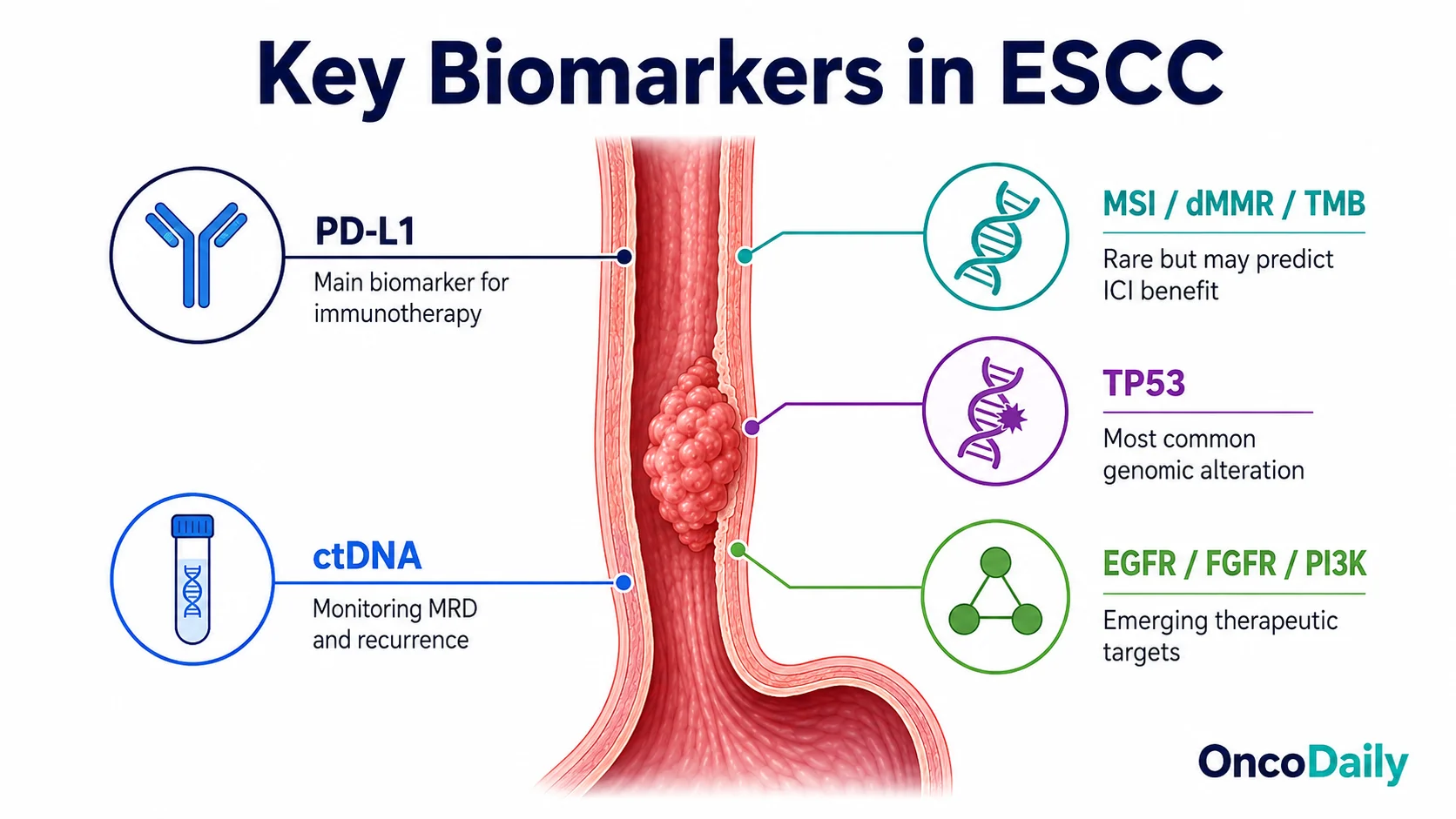
Esophageal squamous cell carcinoma (ESCC) still has relatively few biomarkers that are routinely used to guide treatment. PD-L1 expression is the most established predictive biomarker and can help guide the use of immune checkpoint inhibitors in advanced disease, although it does not reliably predict response in every patient (Ma et al., 2025).
Other immune biomarkers are being studied, including PD-1-positive CD8-positive T-cell infiltration and CD39-positive tumor-infiltrating T cells. These may provide additional information about response to immunotherapy, but they are not yet used in routine practice (Zhao et al., 2026; Chen et al., 2025).
MSI, dMMR, and tumor mutational burden (TMB) may also help identify more immunogenic tumors, although MSI-high and dMMR disease is rare in ESCC (Ma et al., 2025).
Common genomic alterations include TP53, cell-cycle regulators, EGFR, FGFR, and the PI3K–AKT–mTOR pathway. Many of these are being explored as treatment targets, but most have not yet led to standard targeted therapies (Zhang et al., 2026; Zhao et al., 2026).
Circulating tumor DNA (ctDNA) is another area of interest, particularly for detecting molecular residual disease, monitoring treatment response, and identifying recurrence (Dadgar et al., 2025).
PD-L1 Testing and Immunotherapy Biomarkers
PD-L1 testing plays an important role in treatment planning for advanced or metastatic ESCC, especially when considering first-line immune checkpoint inhibitor therapy (Fernández-Montes et al., 2026).
PD-L1 can be measured using different scoring systems. The combined positive score (CPS) includes PD-L1-positive tumor and immune cells, while the tumor proportion score (TPS) measures staining in tumor cells only. The scoring system used depends on the drug, assay, and regulatory setting (Gambella et al., 2025).
For pembrolizumab-based treatment, benefit is generally greater in tumors with higher PD-L1 expression, particularly CPS ≥10. CheckMate 648 used tumor-cell PD-L1 expression with a ≥1% cutoff for its primary nivolumab analyses. However, PD-L1 requirements differ between treatments and regions, and some regimens can be used regardless of PD-L1 status (Fernández-Montes et al., 2026).
PD-L1 is not a perfect biomarker. Expression can vary between different areas of the tumor, metastatic sites, and biopsy samples. For this reason, the result needs to be considered together with the treatment being used and the overall clinical picture (Gambella et al., 2025).

MSI, dMMR and Tumor Mutational Burden
Microsatellite instability (MSI), mismatch repair deficiency (dMMR), and tumor mutational burden (TMB) are being studied as tumor-intrinsic biomarkers of immunogenicity in ESCC. MSI-H/dMMR is uncommon in this histology and is not routinely used as an ESCC-specific biomarker, although its presence may have therapeutic relevance because of its association with sensitivity to immune checkpoint inhibition (Ma et al., 2025).
TMB measures the number of somatic mutations within a tumor. Its role in ESCC is still being defined. In the final JUPITER-06 biomarker analysis, copy-number alteration-corrected TMB was associated with durable benefit from toripalimab plus chemotherapy, supporting further study of genomic markers of immunotherapy response (Chen et al., 2026).
Blood-based TMB appears less useful. In the SCRUM-MONSTAR GOZILA substudy, bTMB did not predict response or progression-free survival with PD-1 inhibitors across several tested cutoffs (Duan et al., 2026).
Overall, MSI-H/dMMR is a rare but potentially important finding, while TMB is not yet a routine standalone biomarker for treatment selection.

TP53 and Common Genomic Alterations
TP53 is the most frequently altered gene in ESCC, with mutations found in the majority of tumors. Loss of normal p53 function promotes genomic instability and contributes to tumor development and progression (Zhang et al., 2026).
Other common abnormalities involve CDKN2A, CCND1, NOTCH1, KMT2D, NFE2L2, TP63, and SOX2. These alterations affect cell-cycle control, squamous differentiation, chromatin regulation, and oxidative-stress pathways (Zhang et al., 2026; Zhao et al., 2026).
For now, most of these genomic changes are more useful for understanding tumor biology and identifying patients for clinical trials than for choosing standard treatment.
EGFR, FGFR and PI3K as Emerging Therapeutic Targets
The EGFR, FGFR, and PI3K pathways are frequently altered in ESCC and are involved in tumor growth, survival, and treatment resistance (Zhao et al., 2026).
EGFR overexpression and amplification occur in a subset of tumors and have made EGFR an attractive treatment target. However, conventional EGFR-targeted therapies have not yet become part of standard ESCC treatment (Zhang et al., 2026).
FGFR1 amplification is found in another molecular subgroup. Alterations in PIK3CA and the PI3K–AKT–mTOR pathway are also seen in ESCC and are being studied as possible targets for new therapies and combination approaches (Zhao et al., 2026).
These pathways remain important areas of research, but none currently defines a standard targeted treatment.
You can also read Success Rate of Immunotherapy for Esophageal Cancer: What Patients Should Know in 2025 on OncoDaily.
Antibody-Drug Conjugates, Liquid Biopsy and Future Biomarkers
Antibody-drug conjugates (ADCs) are becoming an important area of research in ESCC. One of the more advanced agents is BL-B01D1, a bispecific EGFR–HER3 ADC carrying a topoisomerase I inhibitor payload. In a phase 1b study in previously treated metastatic ESCC, the confirmed response rate reached 39.6% at the recommended phase 2 dose, supporting further clinical development (Liu et al., 2025).
Circulating tumor DNA (ctDNA) is also gaining attention as a liquid-biopsy biomarker. Postoperative ctDNA positivity has been linked to molecular residual disease and a higher risk of recurrence after curative-intent surgery (Fang et al., 2025).
Serial ctDNA testing may eventually help monitor response, detect recurrence earlier, and track new genomic changes during treatment. However, using ctDNA results to make treatment decisions still needs prospective clinical validation (Dadgar et al., 2025).
FAQ
What is the main biomarker used in ESCC?
PD-L1 is the most established biomarker and can help guide immunotherapy selection.
Is MSI-high common in esophageal squamous cell carcinoma?
No. MSI-high and dMMR are rare in ESCC, but they may indicate greater sensitivity to immunotherapy.
What is the most common genomic alteration in ESCC?
TP53 mutations are the most frequent genomic alterations in ESCC.
Are there targeted therapies for EGFR, FGFR, or PI3K alterations in ESCC?
Not routinely. These pathways are being studied, but targeted treatments remain largely investigational.
What is the role of ctDNA in ESCC?
Circulating tumor DNA (ctDNA) may help detect minimal residual disease, monitor treatment response, and identify recurrence earlier.