Biomarker testing has become central to treatment selection in advanced gastric and gastroesophageal junction adenocarcinoma. In addition to HER2, PD-L1 and MSI/dMMR, two further targets have gained attention: claudin 18.2 (CLDN18.2) and fibroblast growth factor receptor 2 isoform IIIb (FGFR2b).
The FDA approval of zolbetuximab in October 2024 established CLDN18.2 as an actionable biomarker in HER2-negative disease. FGFR2b remains investigational following the phase 3 bemarituzumab programme. Although both are assessed by immunohistochemistry (IHC), they differ in testing thresholds, clinical evidence and their relationship with established biomarkers.
How these biomarkers sit alongside HER2, PD-L1 and MSI/dMMR, and how to sequence testing on limited biopsy tissue, will be among the topics discussed at the Community Oncology Global Congress 2026, an international virtual congress taking place 28-30 August 2026 dedicated to advancing cancer care in community settings worldwide.
How CLDN18.2 and FGFR2b Are Tested
Both biomarkers are assessed by immunohistochemistry. CLDN18.2 testing uses the VENTANA CLDN18 (43-14A) RxDx Assay, an FDA-approved companion diagnostic (FDA, October 2024). Positivity for zolbetuximab eligibility requires moderate-to-strong (2+/3+) membranous staining in at least 75% of tumour cells, a threshold substantially higher than any other IHC biomarker in gastrointestinal oncology (Shitara et al., The Lancet, 2023).
FGFR2b testing uses the VENTANA FGFR2b (FPR2-D) RxDx Assay (currently for investigational use only), also IHC-based. Eligibility for bemarituzumab requires 2+/3+ membranous staining in at least 10% of tumour cells (refined from >0% in the phase 2 FIGHT trial), a notably lower threshold. The FIGHT trial also accepted circulating tumour DNA-based FGFR2 gene amplification as an alternative route to eligibility, though it captures a narrower population (approximately 4% versus 16.6% by IHC) (Wainberg et al., Lancet Oncology, 2022; Maron et al., ESMO Open, 2026).
Find more videos on OncoDaily YouTube TV.
Claudin 18.2: From Approval to New Questions
CLDN18.2 is a tight-junction protein normally buried within the gastric mucosa. Malignant transformation disrupts epithelial polarity and exposes CLDN18.2 on the tumour cell surface. In normal tissue, the protein is inaccessible because it sits within intact tight junctions, but once mucosal architecture breaks down, CLDN18.2 becomes a surface antigen that monoclonal antibodies can bind. Zolbetuximab (Vyloy), a chimeric IgG1 monoclonal antibody targeting CLDN18.2, was approved by the FDA on October 18, 2024 in combination with fluoropyrimidine- and platinum-containing chemotherapy for adults with HER2-negative, CLDN18.2-positive advanced G/GEJ adenocarcinoma (FDA, October 2024).
The pooled final analysis of the phase 3 SPOTLIGHT and GLOW trials reported median overall survival of 16.4 months with zolbetuximab plus chemotherapy against 13.7 months with chemotherapy alone (HR 0.77; 95% CI, 0.67-0.89), and median progression-free survival of 9.2 versus 8.2 months (HR 0.71; 95% CI, 0.61-0.83) (Shitara et al., 2024).
In 2026, new data sharpened the clinical picture. An ambispective European study of 563 patients found CLDN18.2-high expression (at the 75% threshold) in 48.3% of G/GEJ adenocarcinomas, roughly 10% higher than reported in pivotal trials. When the threshold was lowered to 25% or more of tumour cells, 62.9% of patients qualified (Terán et al., ESMO Open, 2026).
The same study revealed that CLDN18.2-high tumours treated with immunotherapy-based regimens showed a trend toward worse outcomes (median OS 16.0 versus 43.0 months; HR 2.04; P = 0.052), while CLDN18.2-high patients receiving HER2-targeted therapy had significantly longer progression-free survival (17.0 versus 8.9 months; HR 0.42; P = 0.03) (Terán et al., ESMO Open, 2026). These findings, while retrospective, suggest that CLDN18.2 status may influence the benefit derived from immunotherapy.
FGFR2b: Trial Evidence and Global Prevalence
FGFR2b is a splice variant of fibroblast growth factor receptor 2 whose overexpression drives aberrant signalling and tumour cell proliferation. Unlike CLDN18.2, which serves as a passive surface target, FGFR2b is an active oncogenic driver that promotes tumour growth through downstream pathways. Both CLDN18.2 and FGFR2b overexpression are enriched in diffuse-type gastric cancer, a histology historically associated with limited treatment options.
Bemarituzumab is a first-in-class humanised IgG1 monoclonal antibody that blocks FGFR2b signalling and engages antibody-dependent cellular cytotoxicity. On June 30, 2025, the phase 3 FORTITUDE-101 trial met its primary endpoint of overall survival at a pre-specified interim analysis (Amgen, 2025). A subsequent final analysis indicated that the survival benefit had attenuated at longer follow-up ( S.Y. Rha et al., ESMO Annals of Oncology, 2025, LBA10).
The largest global prevalence analysis to date pooled 7,910 tumour samples from FORTITUDE-101 and FORTITUDE-102 prescreening. FGFR2b overexpression at any 2+/3+ level was found in 36.5% (95% CI 35.4-37.6) and at the trial-eligible threshold of 10% or more in 16.6% (95% CI 15.7-17.4). Prevalence was consistent across geographic regions, age, sex, biopsy methods and collection sites (Maron et al., ESMO Open, 2026).

Testing Order on Limited Tissue
Endoscopic biopsies from the upper gastrointestinal tract are inherently limited in volume, and each additional assay consumes tissue. NCCN Guidelines recommend obtaining six to eight biopsies at endoscopy to provide sufficient material for histologic and molecular interpretation (NCCN Esophageal and EGJ Cancers, Version 3.2026). The consensus approach is to perform IHC-based assays first, including HER2, PD-L1, MMR and CLDN18.2, before committing tissue to broader NGS panels (Maria Alsina Maqueda et al., 2025).
Each IHC stain requires a single unstained section of 4-5 µm. CLDN18.2 IHC should be ordered at the same time as HER2 and other biomarkers, rather than reflexively after HER2-negative results are returned. IHC turnaround is typically two to five days; NGS may take two to three weeks. When FGFR2b testing enters routine practice, the same IHC-first strategy should apply.
Biomarker Overlap
CLDN18.2-high expression was found across all molecular subtypes: 33.9% in dMMR, 62.5% in EBV-positive, and 41.9% in HER2-positive tumours. Among patients with PD-L1 CPS of 5 or more, 47.2% were also CLDN18.2-high (Terán et al., ESMO Open, 2026). The approximately 40% coexpression of CLDN18.2 and PD-L1 defines the subgroup in which the first-line therapeutic dilemma, chemoimmunotherapy versus CLDN18.2-targeted therapy, is most clinically pressing.
For FGFR2b, 45% of patients with overexpression at 10% or more also met the CLDN18.2 positivity threshold, while approximately 50% of FGFR2b-positive tumours were negative for all other actionable biomarkers (S. Sato et al., ESMO Open, 2025). A tissue microarray study of 1,538 gastric carcinomas confirmed that both biomarkers are enriched in diffuse-type tumours but that their co-expression is not absolute (Soomin Ahn et al., JGC, 2025). Testing for both markers expands the proportion of patients eligible for targeted therapy.
Beyond First Line: CLDN18.2-Directed ADCs and Emerging Data
On July 27, 2026, AstraZeneca announced that the phase 3 CLARITY-Gastric01 trial met its primary endpoint: sonesitatug vedotin (Sone-Ve), a CLDN18.2-targeting antibody-drug conjugate with an MMAE payload, demonstrated a statistically significant and clinically meaningful improvement in overall survival in patients with CLDN18.2-positive advanced gastric cancer, gastroesophageal junction cancer, or oesophageal adenocarcinoma treated in the second line and beyond.
The trial used a broader positivity threshold than zolbetuximab, requiring CLDN18.2 expression in 25% or more of tumour cells at any staining intensity, assessed using the Ventana SP455 assay. This threshold captures approximately 60% of advanced gastric and GEJ cancers.
CLARITY-Gastric01 is the first phase 3 trial to show an OS benefit with a CLDN18.2-directed ADC in this setting, and it introduces the possibility that CLDN18.2 testing thresholds may differ by drug class and line of therapy.
The phase 2 GLEAM study (abstract 342O) tested zolbetuximab plus gemcitabine and nab-paclitaxel in patients with CLDN18.2-positive metastatic pancreatic adenocarcinoma using the same 75% staining threshold. Median OS was 13.7 months in the zolbetuximab arm and 13.6 months in the control arm, with no survival advantage for the addition of zolbetuximab. This negative result narrows the current clinical utility of CLDN18.2 targeting to gastric and GEJ cancers, though further pancreatic cancer studies remain ongoing (Park et al., Abstract 342O).
What NCCN Guidelines 2026 Recommend
The current NCCN Guidelines (Version 3.2026) for both Gastric Cancer and Esophageal/EGJ Cancers now include CLDN18.2 in the initial IHC biomarker panel, using the same 75% positivity threshold described above. This assessment applies to patients with untreated inoperable locally advanced, recurrent, or metastatic adenocarcinoma for whom zolbetuximab therapy is being considered (NCCN Gastric Cancer, Version 3.2026; NCCN Esophageal and EGJ Cancers, Version 3.2026).
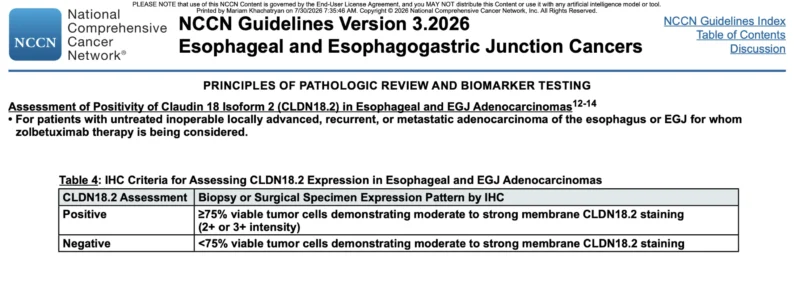
Alongside CLDN18.2, the guidelines recommend IHC testing for HER2 overexpression, PD-L1 expression, MMR protein expression, BRAF V600E and TRK A/B/C (NTRK 1/2/3), with ISH and molecular testing (PCR, NGS) for additional targets including HER2 amplification, MSI, RET gene fusion and TMB assessment. The guidelines note that ctDNA-based multigene panel testing may be considered when limited tissue is available, though negative results should be interpreted with caution (NCCN Gastric Cancer, Version 3.2026; NCCN Esophageal and EGJ Cancers, Version 3.2026).
Looking Forward
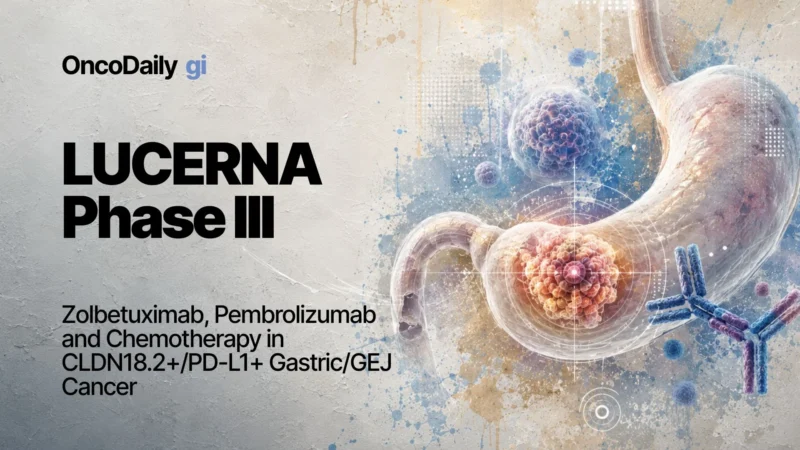
Several phase 3 trials will generate data in populations where biomarker overlap is the rule. The LUCERNA trial (NCT06901531) is evaluating zolbetuximab in combination with pembrolizumab and chemotherapy (CAPOX or mFOLFOX6) as first-line treatment for patients with HER2-negative, CLDN18.2-positive and PD-L1-positive advanced G/GEJ adenocarcinoma. This trial directly addresses the unanswered question of whether combining CLDN18.2-targeted therapy with immunotherapy improves outcomes over either strategy alone (K. Shitara et al., ESMO Gastrointestinal Oncology, 2026).
FORTITUDE-102 is testing bemarituzumab with chemotherapy and nivolumab in FGFR2b-positive disease. CLARITY-Gastric02 is assessing sonesitatug vedotin in combination with capecitabine, with or without rilvegostomig, in the first-line setting. Together, these trials will clarify how to sequence and combine the new targeted agents with immunotherapy across biomarker-defined subgroups.
The Questions Every Oncologist Will Face
The biomarker panel in gastric and GEJ cancer has doubled in three years, but the evidence to guide decision-making has not kept pace. A patient walks in with a CLDN18.2-positive, PD-L1 CPS 8 tumour. Do you reach for zolbetuximab or nivolumab? No randomised trial answers that question today. Another patient’s biopsy yields two small cores and the pathologist needs to run HER2, PD-L1, MMR, CLDN18.2 and potentially FGFR2b before any tissue goes to NGS. Which marker gets cut if the tissue runs out?
These are not hypothetical scenarios; they are Monday morning decisions, and the number of clinicians facing them is growing. Several remain genuinely unresolved. When both CLDN18.2 and PD-L1 CPS of 5 or more are present in the same tumour, it is unclear whether CLDN18.2 status should steer the choice between chemoimmunotherapy and zolbetuximab.
The CLDN18.2 positivity threshold itself may need to differ between monoclonal antibodies (75%) and antibody-drug conjugates (25%), raising the practical problem of how two cut-offs coexist in a single testing workflow.
FGFR2b poses a different question: it identifies roughly 16.6% of advanced G/GEJ cancers, yet bemarituzumab remains investigational with a survival signal that attenuated at longer follow-up, leaving open when, if at all, it should enter the routine panel — and how to identify the FGFR2b-positive patients who are negative for every other actionable biomarker.
Finally, because CLDN18.2 and FGFR2b expression can shift over time and between tumour sites, it is unsettled whether re-biopsy at progression should be standard before later-line therapy, and how to allocate limited biopsy tissue when five or more IHC markers plus NGS are all indicated but only one or two cores are available.
Until prospective data answer these questions, the immediate imperative is practical: order comprehensive IHC testing at diagnosis, secure adequate tissue, and integrate CLDN18.2 into the reflex panel now, with FGFR2b testing poised to follow.
How to navigate these decisions in real-world community practice will be a focus of the Community Oncology Global Congress 2026, taking place virtually 28-30 August 2026. Register now.