Cancer care does not begin and end inside major academic hospitals.
For millions of patients, the most important conversations happen in community clinics: the first discussion about a suspicious scan, the explanation of a diagnosis, the choice of treatment, the management of side effects, and the long months or years of follow-up that come afterward.
These are the settings where patients often know their care teams by name. They are also the settings where shortages, delayed referrals, financial barriers, limited access to specialists, and gaps in supportive services are felt most directly.
From August 28 to 30, 2026, the Community Oncology Global Congress will bring these realities into an international forum. The virtual congress will unite community oncologists, multidisciplinary cancer professionals, researchers, healthcare leaders, patient advocates, and policymakers to examine how cancer care can be strengthened beyond major academic centers.
The discussion will not be limited to one country, one healthcare model, or one area of oncology. It will reflect the experiences of professionals working across highly resourced systems, rural communities, rapidly developing cancer programs, and regions where access to basic oncology services remains difficult.
Community Oncology Global Congress 2026
Where Most Cancer Care Actually Happens
Major cancer centers play an essential role in research, training, and the development of new treatments. Yet much of everyday oncology happens elsewhere.
Community practices are often responsible for turning scientific progress into routine patient care. They deliver chemotherapy, immunotherapy, radiotherapy, supportive treatment, survivorship care, and palliative services. They coordinate referrals, monitor complications, explain difficult decisions, and help patients navigate systems that can be confusing even under the best circumstances.
Their role becomes even more important when patients live far from academic institutions or cannot repeatedly travel for treatment.
In many regions, the community oncologist is not simply one part of the cancer pathway. That physician may be the main specialist available to the patient, the coordinator of multidisciplinary care, and the person responsible for adapting international recommendations to local resources.
The Community Oncology Global Congress 2026 is designed around this reality.
Rather than treating community oncology as a secondary branch of cancer care, the congress will place it at the center of discussions about access, quality, equity, continuity, and outcomes.
Different Countries, Familiar Challenges
The structure of community oncology varies widely around the world, but many of its challenges are shared.
A practice in rural North America may have access to modern therapies but struggle to recruit specialists, open clinical trials, or maintain financially sustainable services. An oncology team in a resource-constrained setting may face shortages of diagnostic equipment, pathology services, medicines, radiotherapy facilities, or trained personnel.
In other regions, cancer centers may be expanding rapidly while still working to develop referral pathways, survivorship programs, patient-navigation services, and multidisciplinary models of care.
Even well-established systems continue to face problems involving treatment affordability, administrative burden, fragmented care, limited health literacy, workforce pressure, and unequal access to innovation.
The congress will create space for these experiences to be discussed openly. Experts from different healthcare systems will share what has worked, where progress has stalled, and which solutions may be adapted for other communities.
The purpose is not to present a single model as the answer. Cancer care must respond to local needs, available resources, cultural expectations, geography, and national health priorities. What succeeds in one setting may require significant modification in another.
That is precisely why an international community oncology meeting matters.
Scientific Leadership with Frontline Experience
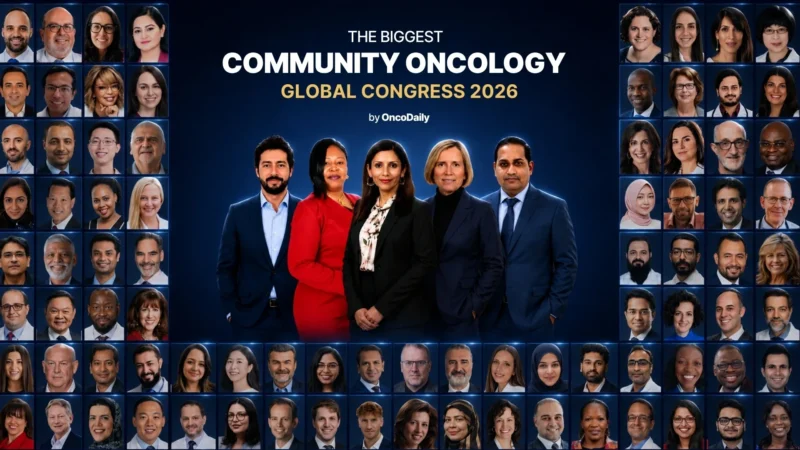
The congress is led by professionals whose work reflects the breadth of community cancer care.
Jasmine Kamboj is a community oncologist and hematologist at Mayo Clinic, a board member of the Minnesota Society of Clinical Oncology, and Co-lead of CoP Policy at the American Society of Clinical Oncology.
Foluke Sarimiye is a radiation and clinical oncologist, community oncologist, and psycho-oncologist at the University of Ibadan and University College Hospital in Ibadan, Nigeria. She is also Co-founder and Executive Director of the Patela Care Foundation.
Felipe Roitberg is a medical oncologist from Brazil and Founder and Director of Grupo SOnHe – Oncology and Hematology Services. His work focuses on community oncology, cancer care delivery, and multidisciplinary practice in Latin America.
Joanna Metzner-Sadurski is a community medical oncologist and hematologist at Self Regional Healthcare in South Carolina. She is also Founder and Executive Director of Oncology101.org and an advocate for community oncology, clinical research, and patient education.
Amol Akhade is a medical and hemato-oncologist from India with more than 18 years of experience in cancer care. Trained at Tata Memorial Hospital in Mumbai, he focuses on personalized treatment approaches and innovative therapies.
Debra Patt is Executive Vice President at Texas Oncology and a practicing oncologist and breast cancer specialist in Austin. She also serves as Medical Director for Public Policy at The US Oncology Network, President of the Community Oncology Alliance, and a board member of the American Society of Clinical Oncology. Her work spans cancer care access, healthcare policy, and digital innovation.
Their combined experience reflects the congress’s wider ambition: to connect policy, clinical practice, research, patient advocacy, and healthcare leadership without losing sight of what happens in the consultation room.
A Faculty Built Around the Full Cancer Journey
Cancer care is never delivered by one profession alone, and the congress faculty reflects that.
The speaker group includes medical oncologists, hematologists, radiation oncologists, surgical oncologists, nurses, advanced practice providers, pharmacists, pathologists, psychologists, genetic specialists, researchers, healthcare executives, patient advocates, and cancer survivors.
The program will draw on expertise in community and rural oncology, supportive and palliative care, survivorship, childhood cancer, clinical trials, molecular diagnostics, precision oncology, healthcare policy, value-based care, pharmacy services, psycho-oncology, and patient education.
Janet L. Abrahm, Professor of Medicine at Harvard Medical School and Founder of the Palliative Care Service at Dana-Farber Cancer Institute and Brigham and Women’s Hospital, will bring decades of experience in supportive and palliative oncology.
Ruiling Yuan, a board-certified medical oncologist and hematologist at Self Regional Healthcare, will contribute her work in community and rural cancer care, survivorship, health policy, patient access, and health literacy.
Kashyap Patel, Chief Executive Officer of Carolina Blood and Cancer Care Associates, will offer perspectives on community oncology leadership, value-based care, cancer disparities, precision medicine, and healthcare policy.
Anjali Sibley, Director of Stanford Medicine Cancer Center in Emeryville, brings experience in community-based oncology, survivorship, clinical trial access, health equity, and patient-centered care.
The faculty also includes leaders from major community oncology networks and practices, including Manojkumar Bupathi, President of Rocky Mountain Cancer Centers; Gustavo Fonseca, Director of Research and Clinical Trials at Florida Cancer Specialists & Research Institute; Simon Blanc, Cancer Center Director at Broward Health; and Jonathan Ticku, Assistant Professor of Oncology and GU Oncology Lead at Mayo Clinic Health System.
Their participation places operational realities alongside clinical science. Discussions about better care must also address staffing, infrastructure, payment systems, pharmacy services, referral pathways, and the long-term sustainability of oncology practices.
The Patient Voice Is Not an Additional Session
The congress will also include patients, survivors, and advocates whose experience can expose gaps that are not always visible in clinical data.
Jenny Ahlstrom, Founder and Chief Executive Officer of the HealthTree Foundation, will bring experience in multiple myeloma advocacy, patient-owned health data, personalized education, research acceleration, and community support.
Terri Conneran, a lung cancer survivor and advocate with KRAS Kickers, will contribute her work in awareness, education, research advocacy, and support for people affected by KRAS-driven lung cancer.
Astriani Dwi Aryaningtyas, Founder of Inspirasien, will share her experience in health advocacy, psycho-oncology support, and mentorship for patients and caregivers facing chronic and serious illnesses.
Christine Verini, Chief Executive Officer of CancerCare, will offer perspectives on psychosocial oncology, nonprofit leadership, patient support, health equity, and access to services.
Angelina Lorello, a patient experience and community oncology advocate at New York Cancer & Blood Specialists, will bring a personal and professional perspective focused on storytelling and the experiences of patients and caregivers.
Their presence is not symbolic. Decisions about navigation, communication, survivorship, access, and care quality are incomplete when the people receiving that care are absent from the discussion.
The Questions That Shape Everyday Oncology
The congress will focus on practical issues that influence patient care every day.
How can cancer be diagnosed earlier when referral systems are slow or specialist services are limited? How can patients receive modern treatments without travelling long distances? What allows a community practice to open clinical trials? How should survivorship and palliative care be integrated into routine oncology? What support do nurses, pharmacists, advanced practice providers, and navigators need to work effectively?
The program will examine timely diagnosis, treatment delivery, multidisciplinary collaboration, patient navigation, workforce development, survivorship, palliative care, cancer prevention, clinical research, health literacy, and digital tools.
It will also address the wider systems surrounding clinical care, including healthcare policy, payment reform, practice operations, workforce capacity, and access to advanced diagnostics and personalized treatment.
These are not abstract policy questions. They determine whether a patient receives the right diagnosis, reaches the right specialist, begins treatment on time, understands the plan, and remains supported throughout care.
Research Must Reach the Community
Clinical research has transformed oncology, but participation in research remains concentrated in a limited number of institutions.
That leaves many patients outside the clinical trial system, particularly those living in rural areas, underserved communities, or regions without established research infrastructure.
Community practices care for large and diverse patient populations. Expanding research into these settings can improve access to investigational therapies while making study populations more representative of the patients seen in routine practice.
The congress faculty includes investigators working in early- and late-phase clinical trials, real-world evidence, translational research, liquid biopsy, biomarker-driven studies, molecular diagnostics, and multi-center collaboration.
Their discussions will consider not only the scientific value of community research, but also the barriers that practices face when attempting to participate. These may include staffing, regulatory requirements, funding, data systems, patient recruitment, and the time required to maintain research programs alongside busy clinical services.
Making research more inclusive will require more than asking community centers to refer patients elsewhere. It will require investment in the places where those patients already receive care.
The Teams Behind Community Cancer Care
A strong community oncology service depends on far more than the availability of a physician.
Advanced practice providers, nurses, pharmacists, psychologists, administrators, researchers, navigators, and practice leaders all shape the patient experience.
Katie Alexander, an Adult-Gerontology Acute Care Nurse Practitioner and Advanced Practice Provider Coordinator at the American Oncology Network, will bring expertise in oncology care, professional education, onboarding, and workforce development.
Jeanine Frances Ewing, a board-certified oncology pharmacist at Florida Cancer Specialists, will contribute experience in formulary management, evidence-based pharmacy practice, multidisciplinary care, and clinical decision support.
Christine Pfaff, Director of Clinical Initiatives at the Community Oncology Alliance, and Brooke Peters, a clinical pharmacist at the American Oncology Network, will provide further perspectives on clinical operations, pharmacy services, medication management, and access to treatment.
Practice executives will also be part of the conversation. Kathy Oubre, Chief Executive Officer of Pontchartrain Cancer Center, and Glenn Balasky, Executive Director of Rocky Mountain Cancer Centers, work at the intersection of practice leadership, policy, payment reform, value-based care, and patient access.
These areas may receive less attention than new drugs or major trial results, but they determine whether oncology services can continue functioning and whether patients can receive those advances in practice.
A Congress for Everyone Involved in Cancer Care Delivery
The Community Oncology Global Congress 2026 is intended for community oncologists, medical oncologists, hematologists, radiation oncologists, surgical oncologists, oncology nurses, pharmacists, palliative care professionals, researchers, healthcare administrators, patient advocates, policymakers, cancer organizations, and professionals working to improve care in community settings.
Participants will hear perspectives from the United States, Nigeria, Brazil, India, Italy, Mexico, Indonesia, Romania, Kenya, Saudi Arabia, Peru, Jordan, Ghana, Malawi, Algeria, Egypt, Vietnam, Nepal, Pakistan, Russia, Türkiye, and other countries.
That geographic range is one of the congress’s greatest strengths. It allows community oncology to be discussed not as a fixed system, but as a field shaped by different resources, populations, and healthcare realities.
Moving Oncology Beyond Institutional Walls
The progress made in oncology over recent decades is undeniable. New treatments, diagnostic tools, supportive strategies, and research methods have changed what is possible for many patients.
The next challenge is ensuring that progress is not defined by where a patient lives or which institution they can reach.
Community oncology is where scientific advances meet daily life. It is where treatment plans must account for transportation, family responsibilities, financial pressure, workforce limitations, and the availability of local services. It is also where continuity, trust, and long-term relationships can become some of the strongest parts of cancer care.
The Community Oncology Global Congress 2026 will bring these experiences together over three days of international discussion.
Its message is clear: high-quality cancer care should not depend on proximity to a major academic center. It should be available in the communities where patients live, work, recover, and continue their lives.
The Community Oncology Global Congress 2026 will take place virtually from August 28 to 30, 2026.
Written by Nare Hovhannisyan, MD