
The first week of March brings a wide range of updates across GI Oncology, spanning colorectal, pancreatic, gastroesophageal, biliary tract cancers, and GIST.
This week’s selected posts highlight EGFR inhibitor rechallenge in metastatic colorectal cancer, the real-world adoption of total neoadjuvant therapy (TNT) in locally advanced rectal cancer, and new international evidence supporting adjuvant imatinib in KIT exon 9 GIST. Additional insights include the prognostic role of nutritional status in advanced pancreatic cancer, updated guidance on neoadjuvant therapy for cT2N0 esophageal cancer, and a randomized NEJM trial evaluating neoadjuvant GOLP versus upfront surgery in intrahepatic cholangiocarcinoma.
Further highlights include new results from the MOONLIGHT trial in advanced gastroesophageal adenocarcinoma, a patient story illustrating durable immunotherapy response in microsatellite-stable colorectal cancer, a review of perioperative strategies for biliary tract cancer, and prospective registry data on pancreatic IPMN surveillance from the PANCY registry.
Together, these posts reflect how clinical trials, translational research, and real-world data continue to shape modern GI oncology practice.
Suneel Kamath – GI Oncologist, Cleveland Clinic
“My editorial on EGFR inhibitor rechallenge in metastatic colorectal cancer is out in JCO Oncology Practice! Indeed, it is ‘A Worthy Option in the Crowded Refractory Advanced Colorectal Cancer Space.’”
Felipe Couñago, MD, PhD – Medical Director, GenesisCare Spain | Radiation Oncologist | Clinical Researcher | Professor | Passionate about innovation and value-based cancer care
“New publication
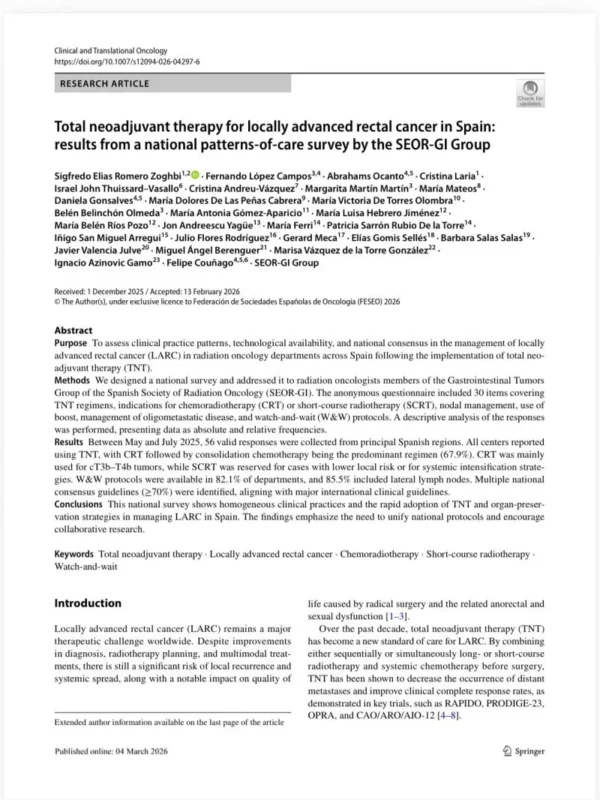
I’m pleased to share that our article ‘Total neoadjuvant therapy for locally advanced rectal cancer in Spain: results from a national patterns-of-care survey by the SEOR-GI Group’ has been published in Clinical and Translational Oncology.
This national survey explores how Total Neoadjuvant Therapy (TNT) is currently implemented across radiation oncology departments in Spain.
Key findings highlight:
- Rapid adoption of TNT in routine clinical practice
- Widespread use of modern radiotherapy techniques such as VMAT
- Increasing implementation of organ preservation strategies and watch-and-wait protocols
These results reflect how evidence from major clinical trials is being translated into real-world management of locally advanced rectal cancer.
Special congratulations to Sigfredo Romero, MD, coordinator of the SEOR Gastrointestinal Tumors Group, for leading this important work, and thanks to all colleagues who contributed to this collaborative national effort.”
Alessandro Gronchi, MD, FSSO – Director, Department of Surgical Oncology, Fondazione IRCCS National Cancer Institute of Milan
“Adjuvant Imatinib in KIT Exon 9 GIST – Strongest Evidence to Date
Proud to share this international multicenter study just published in JAMA Oncology: ‘Adjuvant Imatinib or Observation in Patients With Gastrointestinal Stromal Tumors With KIT Exon 9 Mutations’
KIT exon 9–mutated GISTs represent a biologically distinct and relatively understudied subgroup, historically considered less sensitive to standard-dose imatinib in the advanced setting. Evidence in the adjuvant context has been limited.
What we did
• 367 patients
• 35 referral centers across Europe, US, and Japan
• Propensity score overlap weighting to address confounding
• Focus on both the full cohort and mNIH high-risk subgroupKey findings
• Adjuvant imatinib significantly reduced early risk of recurrence (HR 0.19)
• Associated with improved overall survival (HR 0.37)
• Consistent results in mNIH high-risk patients
• No clear advantage of 800 mg vs 400 mg in the adjuvant settingDespite the known relative dose insensitivity of exon 9 disease in the metastatic context, in the micrometastatic/adjuvant setting we observe a meaningful clinical benefit.
Recurrence remains frequent (~75% in high-risk patients), underscoring the need for better strategies and prospective studies to define optimal dose and duration.
This work reflects a truly global collaboration and represents, to our knowledge, the most robust evidence currently available for adjuvant therapy in this molecular subgroup.
Grateful to all co-authors and participating centers for this effort.”
Catia Carconi – MD | Resident in Oncology | Research Scholar in Molecular Oncology and Immunology
“Alterations in nutritional status are common in advanced pancreatic cancer, yet their prognostic relevance in patients receiving chemotherapy remains poorly defined.
In our recent study, we evaluated the prognostic role of clinical-nutritional status and radiological body composition in patients with advanced PDAC receiving chemotherapy.
These parameters may help identify high-risk patients earlier in the continuum of care and support a multidisciplinary nutritional approach to patient management.
If interested, have a look at the paper.
For colleagues treating PDAC: do you routinely assess the parameters included in the PANCIN index?”
Sarbajit Mukherjee, MD, MS – Chief of GI Medical Oncology
“Clinical question:
For cT2N0 esophageal cancer, should we proceed with primary surgery, or start with neoadjuvant therapy?Our collective effort through the International Society for Diseases of the Esophagus (ISDE) to address this long-standing clinical dilemma has now been published.
Key takeaways from the guideline:
• Neoadjuvant therapy followed by surgery is suggested for most patients
• Clinical staging is often inaccurate, with nodal upstaging reported in up to ~48% of patients
• Selected low-risk patients (small, well-differentiated tumors without LVI) may still be candidates for primary surgeryHow does this compare with the National Comprehensive Cancer Network® (NCCN®) guidelines?
These recommendations broadly align with NCCN guidance, which already favors multimodality therapy for many cT2N0 tumors.The key insight:
Even when survival curves appear similar, the risk of understaging pushes the field toward neoadjuvant therapy in most patients.Future work will likely refine selection through biomarkers, ctDNA, and improved staging tools.”
Nicholas Hornstein – Assistant Professor of Medical Oncology
“New NEJM RCT: neoadjuvant ‘GOLP’ (gem-ox + lenvatinib + toripalimab) vs upfront surgery in resectable high-risk intrahepatic CCA. n=178.
I seriously can’t believe that is the regimen name.
- EFS: 18.0 vs 8.7 mo (p<0.001) crossed boundary
- OS: HR 0.43, p=0.005 — sounds great, doesn’t meet significance (α=0.0019). Correct read: no OS benefit demonstrated.
- Toxicity: AEs in 97% of pts in neo arm vs 70% control. Gr3+ in 28%.
Three takes:
‘GOLP’… One of the worst regimen names in recent memory.
The trial allocated almost no alpha to OS. Don’t let the HR fool you.
Near-universal AEs in the neoadjuvant arm for a disease where we don’t yet know if this translates to survival.
EFS benefit is important and biologically plausible, but before this changes practice, we need OS data and international validation (this was China high-volume centers only).”
Salah-Eddin Al-Batran – Professor of Oncology, Chief Executive, Frankfurt Institute of Clinical Cancer Research (IKF)
“Excited to share the publication of the IKF-s628/MOONLIGHT trial in Nature Communications.
Our multi-cohort phase II study evaluated first-line immunotherapy strategies in advanced HER2-negative gastroesophageal adenocarcinoma (GEA), including dual checkpoint inhibition and triplet chemotherapy combinations.
Key findings:
Dual checkpoint blockade (nivolumab + ipilimumab) added to mFOLFOX
Did not improve outcomes compared to chemotherapy alone.
- Median PFS: 5.8 vs 6.6 months
- Median OS: 10.1 vs 12.5 months
- Higher grade ≥3 toxicities (74% vs 45%)
Short induction FOLFOX followed by immunotherapy (sequential strategy)
Inferior to continuous chemoimmunotherapy.
- Median PFS: 4.0 months
- Median OS: 7.6 months
FLOT + nivolumab (triplet chemotherapy + IO)
Encouraging activity and feasibility:
- Median PFS: 7.0 months
- Median OS: 14.6 months
- ORR: 56%
Particularly promising in PD-L1 positive tumors.
Grateful to the leading author Sylvie Lorenzen, all investigators, study teams, and especially our patients and their families for their trust and contribution.”
Read about MOONLIGHT Trial: Testing Dual Checkpoint Blockade and Triplet Chemoimmunotherapy in 1L Advanced Gastroesophageal Adenocarcinoma on OncoDaily.
Nicholas DeVito, MD – Assistant Professor of Medicine, Duke University, Division of Medical Oncology
“Kicking off Colorectal cancer awareness month by celebrating my young patient, Bianca Harvey, who has only been treated on clinical trials and is living her life again after overcoming a stage IV diagnosis. Now in a long term response to immunotherapy (with microsatellite stable CRC!), her story will help others with this disease as we further our research in how the immune system interacts with colorectal cancer. Not only that – Bianca’s persistent optimism and incredibly supportive family and community have been an uplifting inspiration to our clinic and research team!
Thank you to Duke University Health System for featuring her on Faces of Research:”
Christian T. J. Magyar – MD | Surgeon-Scientist | HPB Surgery and Abdominal Transplant
“Thrilled!
I’m excited to have contributed to the recently published Review article ‘Perioperative approaches for patients with biliary tract cancer’ in Nature Reviews Clinical Oncology (Nature Portfolio). It has been a pleasure collaborating with an outstanding team of researchers (Anudari Zorigtbaatar MD, CM, Zhihao Li, Laia A., Anna Saborowski, Prof. Dr. Arndt Vogel, Robert Grant, Grainne O’Kane MB, BCH, BAO, MRCPI, MD, Dr. Gonzalo Sapisochin) to highlight current and evolving strategies in a highly challenging area of oncology.Key Messages:
- Multidisciplinary perioperative care: Surgical resection remains the cornerstone of curative treatment for biliary tract cancers, but neoadjuvant and adjuvant approaches are crucial to improve patient outcomes in the face of high recurrence risk.
- Personalized strategies and innovation: Advancing (molecular) profiling and exploring expanded roles for liver transplantation, targeted agents, and immunotherapies promise to refine patient selection and inform future clinical trial designs.
Thank you to everyone involved in this important work — looking forward to continued progress in improving care for patients with biliary tract cancers!”
Stefano Crippa – Associate Professor of Surgery, Università Vita-Salute San Raffaele
“Real life management of intraductal papillary mucinous neoplasms of the pancreas: Final data from the prospective Italian pancreatic cysts (PANCY) registry
- 647 IPMNs diagnosed between 2015 and 2017, of which 547 were BD-IPMNs and 590 underwent surveillance
- Malignancy rates for BD- and mixed-IPMNs under surveillance were 2.7% and 12.5%
- Smoking (OR 2.2) and cyst size >15 mm at diagnosis (OR 7.1) were risk factors for relevant changes during surveillance
- BD-IPMN progression risk is very low for lesions <15 mm, mainly in non-smokers aged > 65 years
Aigo – Associazione Italiana Gastroenterologi ed Endoscopisti Digestivi Ospedalieri AISP Pancreas & all centers involved and co-authors”

Find out 10 Must-Read Posts in GI Oncology from the last week of February on OncoDaily.