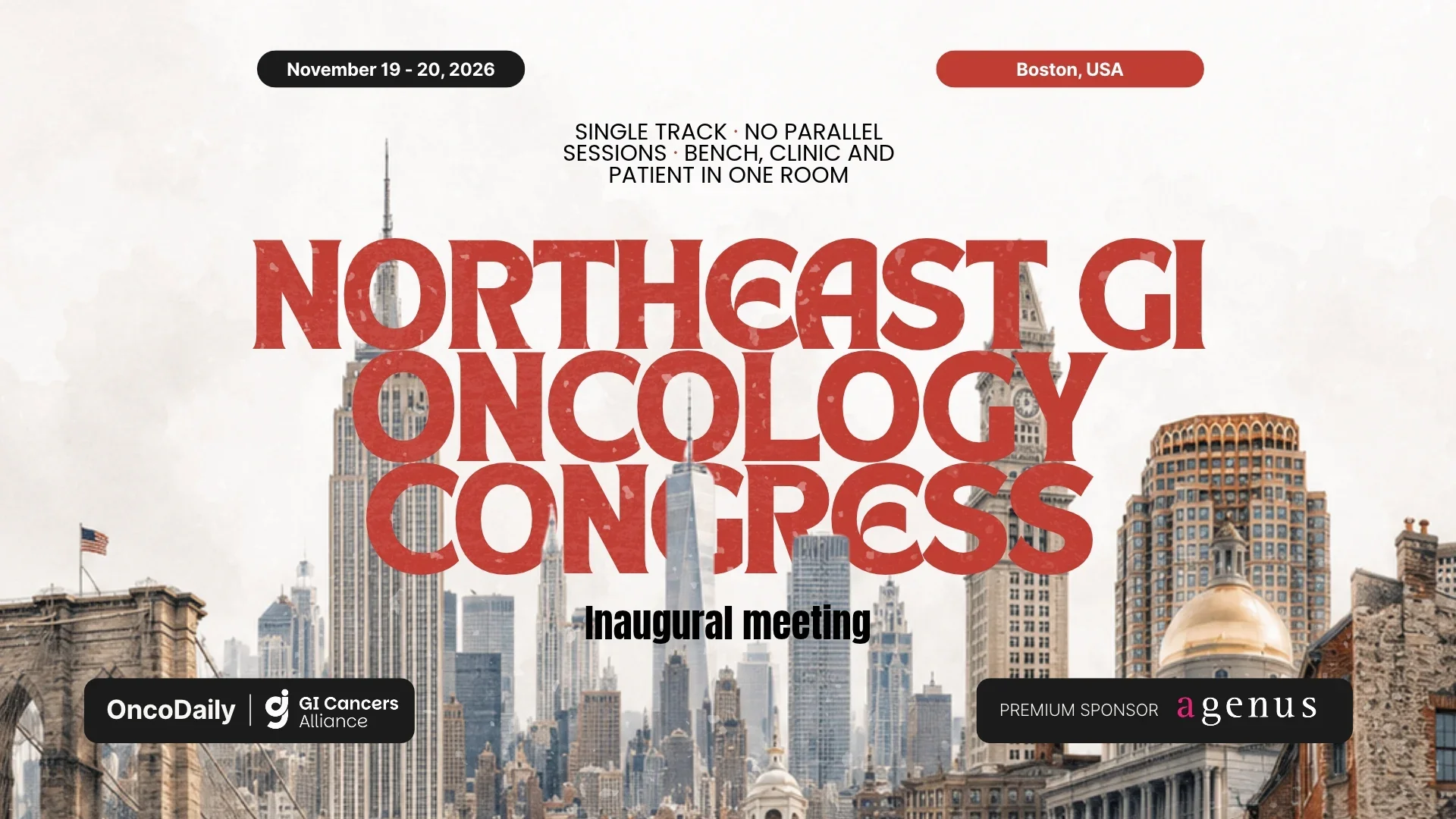
OncoDaily’s Northeast GI Oncology Congress 2026 will take place November 19–20 in Boston, Massachusetts, bringing clinicians, researchers, early-career investigators, and patient advocates together to discuss the future of gastrointestinal cancer care.
Under the theme “The whole field, in one conversation,” NEGI 2026 will follow a single track with no parallel sessions. Across two days, the program will connect advances in GI cancer research with the decisions facing clinical teams and the priorities of people living with cancer.
Most sessions will open with brief presentations and leave time for live panels, case discussions, and audience questions. Attendees will be able to vote on selected clinical decisions and compare their reasoning with that of faculty and patient advocates.
From Emerging Science to Clinical Decisions
From liquid biopsy to new treatment modalities, the congress will examine how advances in science might inform care across gastroesophageal, pancreatic, biliary, and colorectal cancers. Discussions will cover biomarker-guided treatment and the role of circulating tumor DNA (ctDNA) in assessing molecular residual disease. The gastroesophageal session will consider how to weigh CLDN18.2, HER2, FGFR2b, and PD-L1 when more than one biomarker may inform treatment. Other discussions will address RAS-directed research in pancreatic cancer and the role of immunotherapy and organ preservation in colorectal cancer.
One question cuts across these topics: when is the evidence strong enough to change a treatment decision? A biomarker may reveal something about a tumor or a patient’s risk, but its clinical value depends on what teams can do with that information. The shared program gives attendees a chance to compare where the evidence stands across different GI cancers.
The program will also bring together insights from different tumor types. An approach to treatment resistance or patient selection in one cancer can suggest a new direction in another, even when the underlying biology and available treatments differ.
Read more: From Liquid Biopsy to New Treatment Modalities
One Room, Many Perspectives
The upper GI case-based tumor board will put multidisciplinary collaboration into practice. A single case can raise questions about staging, pathology, treatment sequence, and what the patient can realistically manage. Hearing how specialists weigh those considerations shows how a recommendation takes shape and where uncertainties remain.
Patient advocacy is part of that same conversation. Martha Raymond of GI Cancers Alliance will moderate the patient advocacy plenary, which will explore how patient experience and patient-reported outcomes can shape research questions, trial endpoints, and the practical demands of taking part in a study. The program will also address quality of life and treatment burden. Those discussions bring a practical question to both trial design and clinical care: alongside disease control, what should a treatment make possible for the person receiving it?
The discussion of treatment burden makes that question concrete. Time spent receiving care, side effects, and the ability to keep up with everyday activities can all shape how a patient weighs the potential benefits of treatment. Bringing those concerns into the discussion early can help researchers choose outcomes that reflect what patients value.
Read more: Why Multidisciplinary Collaboration Matters in GI Oncology
A Platform for Young Investigators
Rapid-fire presentations, mentorship tables, and a session on designing GI cancer trials will give early-career investigators opportunities to present their work and discuss it with colleagues. These exchanges can help turn an interesting observation into a question a study can answer, or connect an investigator with a collaborator who brings a different kind of expertise.
For attendees at any career stage, these sessions offer a chance to hear which questions the next generation of GI oncology researchers is asking and what it would take to investigate them.
The formats serve different purposes. A short presentation gives researchers practice explaining why their findings matter; a conversation at a mentorship table gives them time to ask what to do next, whether that means refining the study design or finding the right team to carry it out.
Read more: Young Investigators and New Ideas at NEGI 2026
See You in Boston
Yelena Y. Janjigian of Memorial Sloan Kettering Cancer Center and Samuel J. Klempner of Massachusetts General Hospital chair the congress. Aparna R. Parikh of Massachusetts General Hospital and Eileen M. O’Reilly of Memorial Sloan Kettering Cancer Center serve as co-chairs. GI Cancers Alliance is the congress partner, and Agenus is the premium sponsor.
A conversation that starts with a biomarker can lead to a question about trial design, treatment burden, or a decision a patient and their care team need to make. NEGI 2026 brings those discussions into the same room so each can inform the others.
Save the date: November 19–20, 2026 | The Royal Sonesta Boston, Cambridge, Massachusetts.
Visit the official Northeast GI Oncology Congress 2026 event page for the full program and event details.