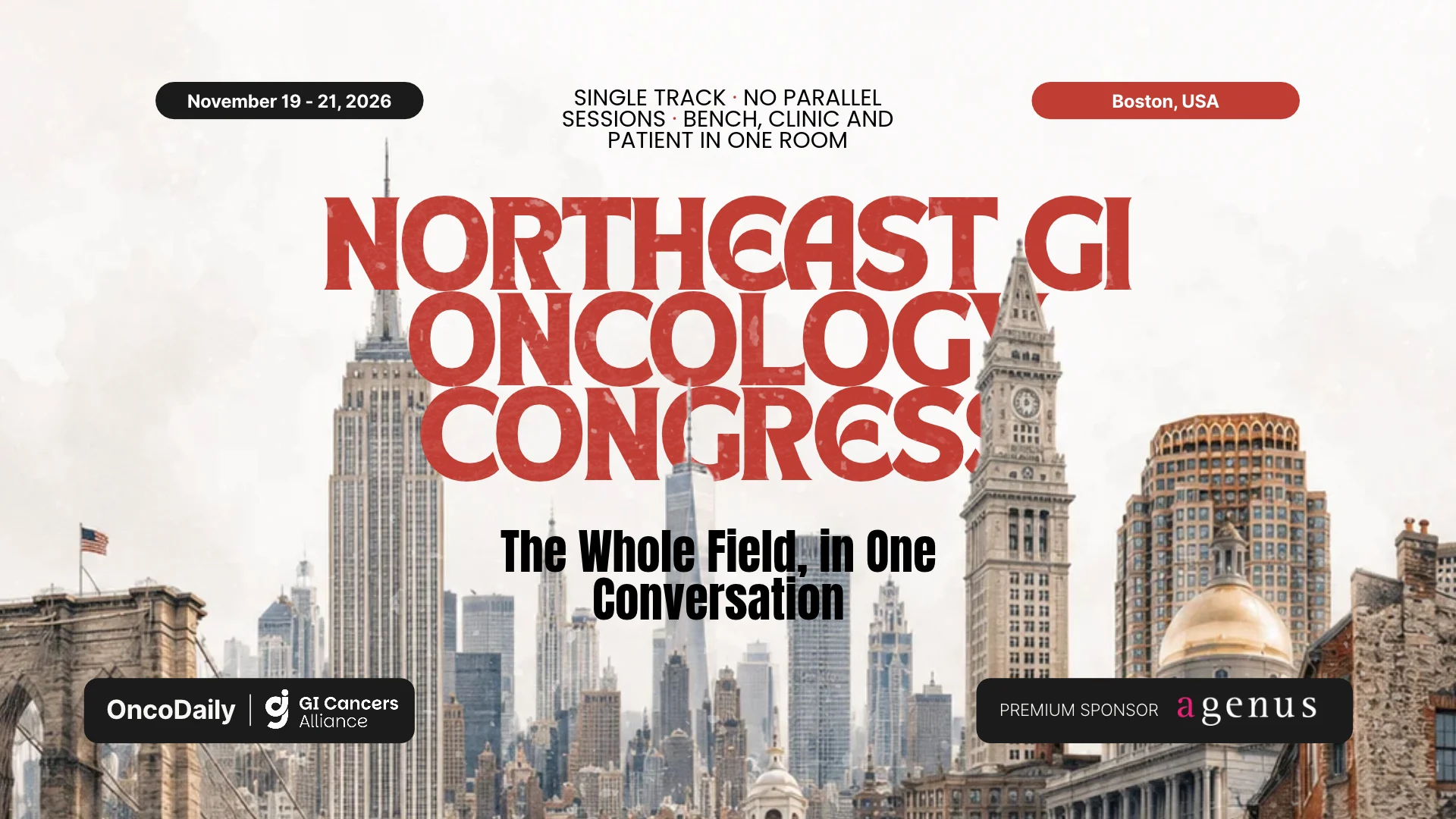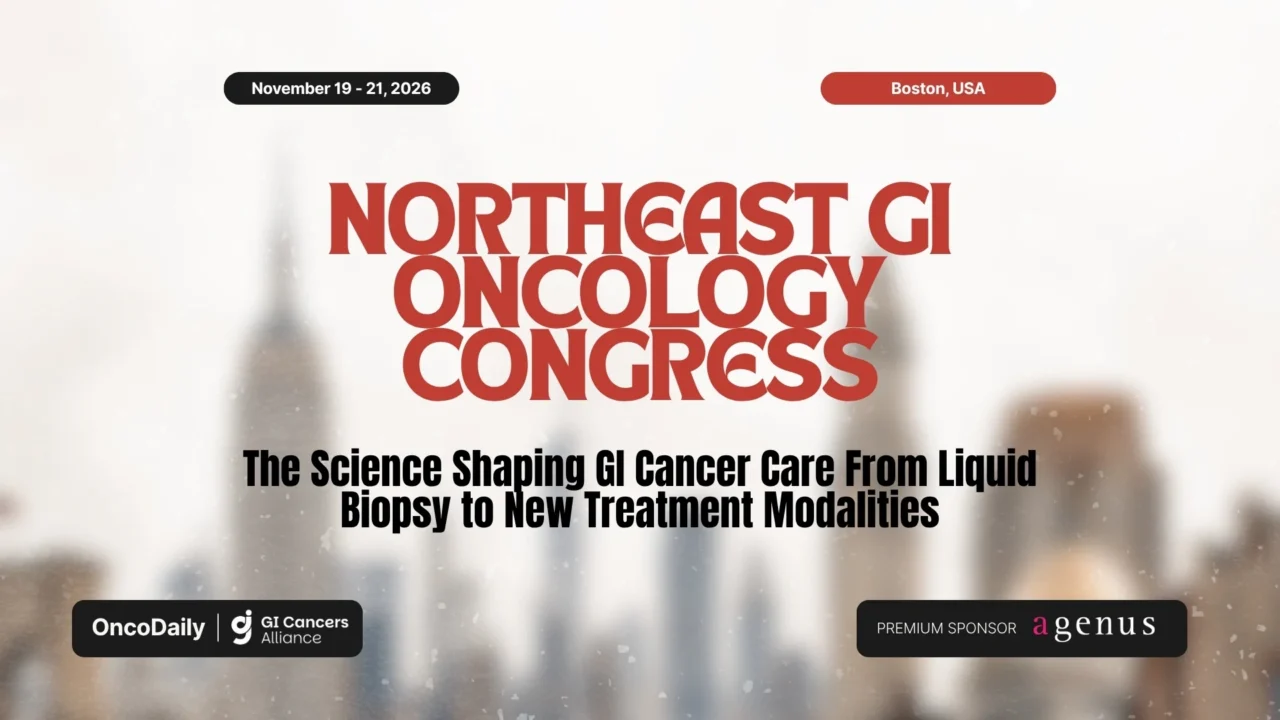
OncoDaily’s Northeast GI Oncology Congress 2026 will take place November 19–21 in Boston, Massachusetts, bringing clinicians, researchers, and emerging investigators together to examine the science shaping the next era of gastrointestinal cancer care. Over three days, the congress will explore liquid biopsy, biomarker-directed treatment, immunotherapy, and new therapeutic modalities, connecting the biological rationale behind these approaches with the evidence needed to guide clinical decisions.
With its guiding theme, “The whole field, in one conversation,” the congress will follow a single track, with no parallel sessions, allowing participants to examine advances across gastroesophageal, pancreatic, biliary, and colorectal cancers. From the role of circulating tumor DNA in adjuvant treatment decisions to emerging cellular therapies, personalized vaccines, and antibody–drug conjugates, the program will address both the opportunities ahead and the questions that remain about patient selection, treatment sequencing, and resistance.
Explore the program and register: Northeast GI Oncology Congress 2026
Liquid Biopsy: From Detecting Risk to Guiding Action
The program includes a debate on whether circulating tumor DNA (ctDNA) should guide adjuvant decisions, examining evidence across colorectal, gastroesophageal, and pancreatic cancers.
Tumors can release DNA into the bloodstream, providing material that researchers can analyze through a blood sample. After surgery, ctDNA testing offers a way to investigate whether molecular evidence of cancer remains and whether it can help predict recurrence.
The clinical question extends beyond detecting a signal. If a result is positive, which intervention should follow? If it is negative, what evidence is needed before reducing treatment? A test that identifies higher risk must also be evaluated for whether acting on its findings improves outcomes.
This makes liquid biopsy a useful starting point for the congress’s scientific conversation: how does additional information become a better decision for a patient?
Choosing Between Targets in Gastroesophageal Cancer
Upper GI discussions will examine CLDN18.2, HER2, FGFR2b, and PD-L1, including treatment sequencing and combinations, alongside a debate on perioperative immunotherapy.
For clinicians, the useful question is how to weigh competing options when more than one strategy appears relevant. What evidence should determine the first choice? What should be preserved for later treatment? And how should the strength of the evidence be communicated to patients?
These questions invite careful attention to the population studied, the treatment setting, and the outcomes measured. A promising result in advanced disease does not, by itself, resolve a treatment decision around surgery.
Pancreatic and Biliary Cancers: Testing Precision Strategies
The pancreatic and biliary sessions will address RAS(ON) inhibitors, KRAS G12D, combinations, resistance, and approaches targeting FGFR2, IDH1, and HER2.
A central question for precision treatment is what happens after the initial response. How should a study investigate resistance? Which combinations have a clear biological rationale? What evidence would justify moving an approach into an earlier line of treatment?
The congress provides an opportunity to examine these questions together while retaining the distinctions between diseases, molecular subgroups, and treatment settings.
Colorectal Cancer: Treatment and Organ Preservation
Colorectal topics include organ preservation in mismatch repair-deficient disease, immunotherapy in microsatellite-stable cancers, KRAS/BRAF/HER2-directed treatment, and early-onset cancer biology.
Organ preservation introduces a particularly meaningful question: can treatment control cancer while reducing the need for an intervention that changes a patient’s daily life? Assessing that possibility requires attention to durable control, follow-up, and patient priorities.
It also broadens the discussion of what a successful treatment should achieve. Tumor response is one measure; the consequences of that response for subsequent care deserve equal scrutiny.
New Modalities: Understanding the Mechanism
CAR-T therapies, T-cell engagers, personalized mRNA vaccines, and antibody–drug conjugates are also on the agenda.
These approaches use different routes to attack cancer. CAR-T therapy engineers T cells to recognize selected proteins on cancer cells. Cancer treatment vaccines aim to generate immune recognition of tumor antigens. Antibody–drug conjugates link an antibody to a drug, using antigen binding to help deliver treatment to selected cells.
Understanding the mechanism provides a framework for evaluating the clinical evidence. Which patients should be enrolled? How should target expression be assessed? What would demonstrate that an immune response or drug-delivery strategy translates into meaningful benefit?
The next era of GI cancer care will depend on answering those questions through well-designed research and thoughtful clinical interpretation.
A Shared Scientific Conversation across GI Oncology
Co-chaired by Yelena Janjigian, Aparna R. Parikh, Samuel Klempner, and Eileen O’Reilly, NEGI 2026 will use a single track without parallel sessions.
The scientific opportunity lies in examining what connects these approaches: better patient selection, clearer treatment decisions, and evidence that matters in practice.
The Northeast GI Oncology Congress 2026 is supported by GI Cancers Alliance, a congress partner, and Agenus, a premium sponsor. Together, they bring patient advocacy and biotechnology perspectives to the meeting.
Read further about the congress on OncoDaily: Northeast GI Oncology Congress 2026: Bringing the GI Oncology Community Together