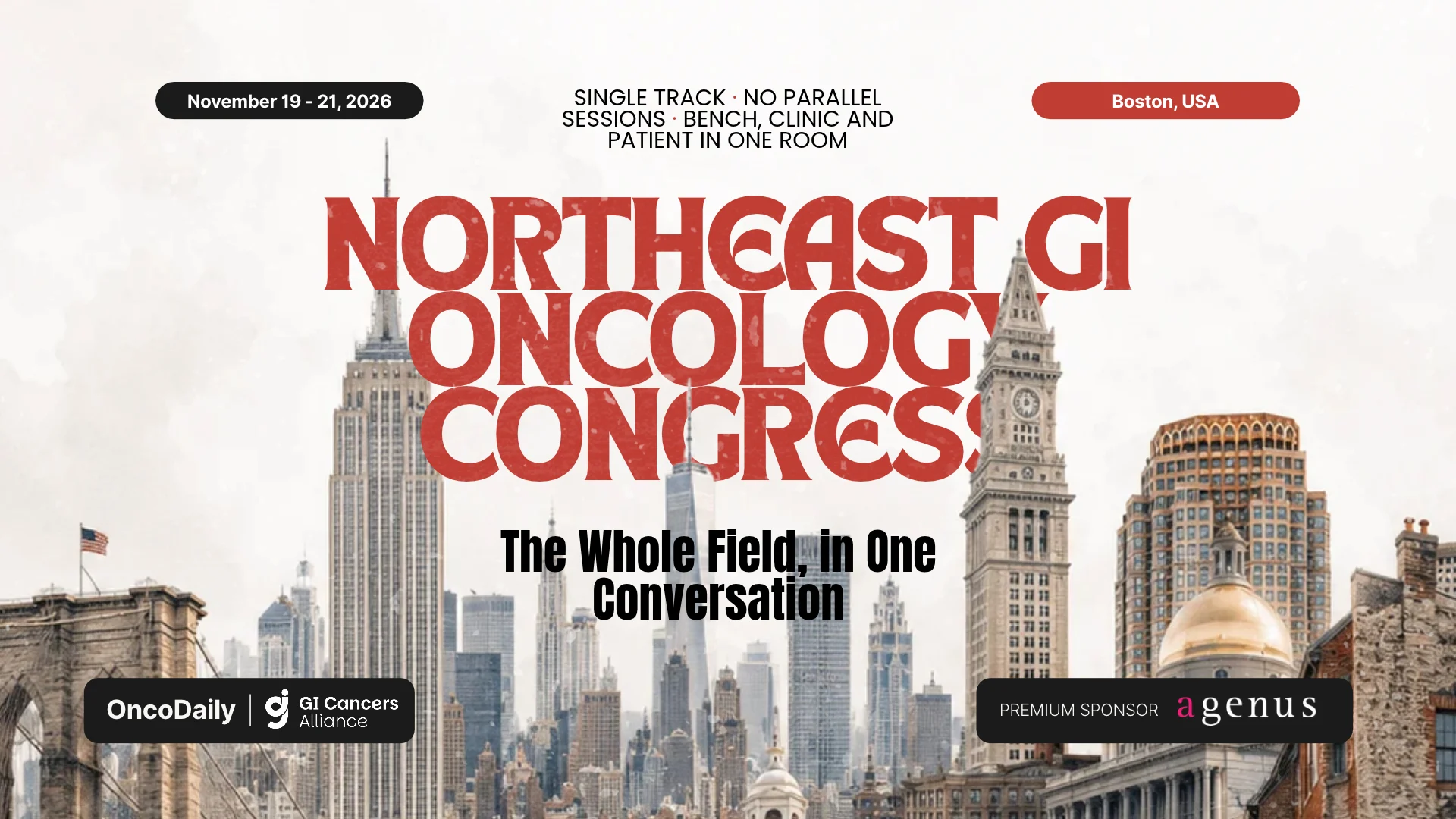
OncoDaily’s Northeast GI Oncology Congress 2026 will take place November 19–21 in Boston, Massachusetts, bringing clinicians, researchers, early-career investigators, and patient advocates together to discuss the future of gastrointestinal cancer care. Alongside emerging science, the meeting will explore how different perspectives can inform the decisions that follow a diagnosis.
With its guiding theme, “The whole field, in one conversation,” the congress will follow a single track, with no parallel sessions. Case-based discussions, debates, and cross-disease panels will give participants a shared setting to examine evidence and consider its implications across specialties.
Explore the program and register: Northeast GI Oncology Congress 2026
Different Perspectives, One Treatment Plan
A GI cancer diagnosis brings together questions that extend across several disciplines. What does the pathology reveal? How extensive is the disease? What are the goals of treatment, and how should different approaches be sequenced? What can the patient realistically manage?
Each question adds something to the discussion. Imaging findings need to be considered alongside pathology, molecular results, clinical condition, and the patient’s priorities. The challenge is to bring these pieces together into a coherent plan that patients can understand.
Multidisciplinary collaboration creates an opportunity to examine how one decision affects the next. A proposed treatment may change the timing of surgery. Further diagnostic information may alter the available options. A patient’s concerns about recovery or daily functioning may prompt the team to revisit its initial recommendation.
Making Clinical Reasoning Visible
The congress’s upper GI case-based tumor board will feature fellow-presented gastroesophageal cases, multidisciplinary discussion, and audience polling. This format places clinical reasoning at the center of the session, allowing participants to follow how a recommendation develops.
The educational value lies in hearing why specialists approach the same case differently. Which finding carries the most weight? What additional information would change the plan? Where does the evidence provide a clear direction, and where does judgment remain necessary?
For early-career clinicians, these exchanges can reveal the reasoning behind a recommendation that might otherwise appear straightforward on a slide. For experienced clinicians, they offer an opportunity to examine assumptions and consider how colleagues interpret uncertainty.
Creating Space for Disagreement
Collaboration requires room for disagreement. Specialists may agree on the evidence while differing in how they weigh its limitations, the risks of treatment, or the relevance of a study to an individual patient.
NEGI 2026 will include debates on ctDNA-guided adjuvant decisions and perioperative immunotherapy in gastroesophageal cancer, with audience voting before and after the discussion.
Such discussions can help clarify where differing recommendations come from. One participant may place greater emphasis on a promising result, while another focuses on unanswered questions about follow-up or patient selection. Making those differences explicit gives the audience a clearer understanding of both the evidence and its practical limits.
The aim is to identify what supports a decision, what remains uncertain, and what further evidence would change practice.
Learning Across GI Cancer Types
Specialization allows clinicians and researchers to develop deep expertise. A shared scientific conversation also creates opportunities to ask whether an insight from one disease area could inform another.
The program’s “Lessons that travel” panel will examine what RAS, HER2, CLDN18.2, and ctDNA can teach across GI cancers, including opportunities for trials spanning disease sites.
These exchanges require careful interpretation. A shared molecular feature can generate a research question, but its clinical significance still needs to be examined within each disease. Bringing specialists together helps make both the connections and the differences visible.
That dialogue can sharpen research priorities: which observations deserve further investigation, which combinations have a strong rationale, and which questions require collaboration beyond a single disease group?
Including Patients in the Discussion
A multidisciplinary conversation becomes more complete when it includes the people living with the consequences of treatment decisions.
Clinical teams may focus on disease control, toxicity, and the feasibility of an intervention. Patients may also be considering time away from work, caregiving responsibilities, travel, financial pressure, and the effect of treatment on independence. Understanding these concerns helps clarify what a proposed plan would mean in everyday life.
NEGI 2026 will address patient-partnered research, quality of life, and financial toxicity, alongside discussions involving advocates and young investigators about designing meaningful trials.
Patient involvement also matters when research questions are first being developed. Asking which outcomes patients value can help investigators examine whether a study captures the benefits and burdens that will shape future treatment choices.
Building a Shared Conversation in GI Oncology
The congress brings together Yelena Janjigian, Aparna R. Parikh, Samuel Klempner, and Eileen O’Reilly as co-chairs. GI Cancers Alliance is a congress partner, and Agenus is a premium sponsor.
The value of bringing many perspectives into one room depends on what participants do with them: question an assumption, reconsider an interpretation, identify a research partner, or better understand a patient’s priorities.
For GI oncology, those exchanges connect the science presented at a meeting with the decisions made after participants return to their clinics and research teams.
Read further about the congress on OncoDaily: From Liquid Biopsy to New Treatment Modalities: What to Expect at Northeast GI Oncology Congress 2026