






Xiangyue Zhang, Senior Research Scientist of Basic Life at Stanford University School of Medicine, shared a post on LinkedIn about a recent article she and her colleagues co-authored, adding:
“Our Nature article, for which I am first author and co-corresponding author, has just gone online. I am deeply grateful to all co-authors for their outstanding contributions!
Owing to their unique capacity to engulf dead cells, how type 1 conventional dendritic cells (cDC1s) acquire a tolerogenic maturation state—and the mechanisms governing this process—has long been a fundamental question in the cDC1 field. We addressed this question using an unconventional tolerance-inducing model, total lymphoid irradiation combined with anti-thymocyte serum (TLI/ATS), through which EPOR was serendipitously identified by RNA-seq.
This study establishes EPOR as a master regulator of tolerogenic maturation in cDC1s, redefining a conserved tolerogenic mechanism governing their tolerogenic and immunogenic functions. By demonstrating that EPOR signaling programs cDC1s to impose durable tolerance in both CD4⁺ and CD8⁺ T cells toward cell-associated antigens, this work overturns a long-standing paradigm in cDC1 immunobiology.
This work began in 2017, at a time when cDC1-specific genetic tools were largely unavailable: Xcr1-Cre mice had not yet been developed in the field, and Epor-tdTomato reporter mice did not exist. Consequently, establishing appropriate transgenic reporter and conditional knockout mouse models became the primary technical hurdle following the initial observation of EPOR upregulation in cDC1s after TLI/ATS. These critical mouse lines were only obtained in 2020, during the COVID-19 pandemic.
Once the phenotype was clearly established in the appropriate genetic models, we became confident that this discovery would fundamentally reshape the field’s understanding of cDC1 tolerogenic function on both CD4⁺ and CD8⁺ T-cell responses toward cell-associated antigens, in transplantation, cancers, infections and autoimmunity. Because this project represented a true “0-to-1” scientific discovery, accurately interpreting each experimental result and continuously steering the project in the correct direction posed substantial conceptual and experimental challenges.
Most importantly, rigorously validating our hypothesis from multiple, independent perspectives required not only sustained effort and determination, but also a willingness to confront uncertainty throughout the exploratory process.”
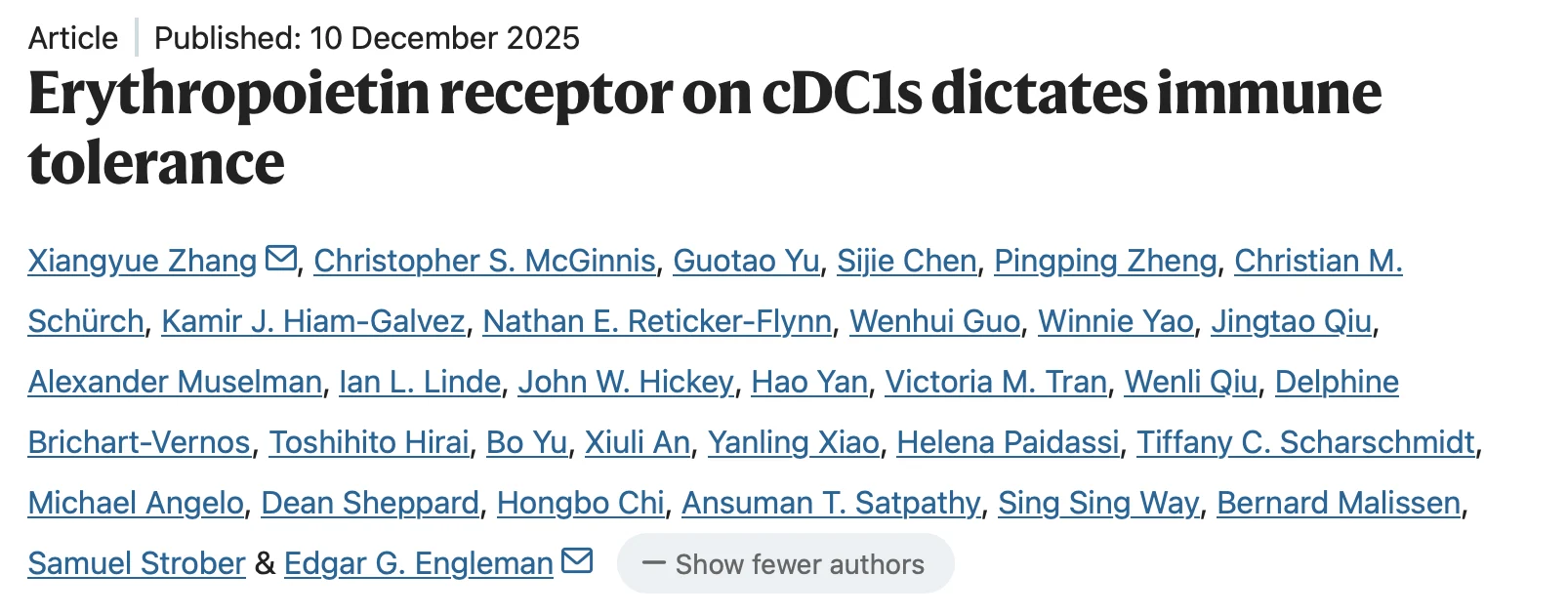
Title: Erythropoietin receptor on cDC1s dictates immune tolerance
Authors: Xiangyue Zhang, Christopher S. McGinnis, Guotao Yu, Sijie Chen, Pingping Zheng, Christian M. Schürch, Kamir J. Hiam-Galvez, Nathan E. Reticker-Flynn, Wenhui Guo, Winnie Yao, Jingtao Qiu, Alexander Muselman, Ian L. Linde, John W. Hickey, Hao Yan, Victoria M. Tran, Wenli Qiu, Delphine Brichart-Vernos, Toshihito Hirai, Bo Yu, Xiuli An, Yanling Xiao, Helena Paidassi, Tiffany C. Scharschmidt, Michael Angelo, Dean Sheppard, Hongbo Chi, Ansuman T. Satpathy, Sing Sing Way, Bernard Malissen, Samuel Strober, Edgar G. Engleman
Read the Full Article on Nature
More posts featuring Xiangyue Zhang