






Kefah Mokbel, Chair of Breast Cancer Surgery at London Breast Institute and Honorary Professor of Medicine at Cardiff University School of Medicine, shared a post on LinkedIn:
“Ultrasensitive ctDNA Detection: A New Frontier in Early Breast Cancer Monitoring.
A new study published in the Journal of Clinical Oncology evaluated ultrasensitive circulating tumor DNA (ctDNA) monitoring as a biomarker for treatment response and recurrence risk in early breast cancer treated with neoadjuvant therapy.
Study population
The prospective study enrolled 227 patients, of whom 220 were evaluable for pathological complete response (pCR).
Tumor subtypes included:
- 48% HER2-positive breast cancer (105 patients).
- 52% triple-negative breast cancer (115 patients).
Pathologic response. The overall pCR rate was 41% (91/220 patients).
By subtype:
- HER2-positive: 50% achieved pCR (52/105).
- Triple-negative breast cancer: ~41% achieved pCR.
ctDNA detection and assay sensitivity.
Using an ultrasensitive tumor-informed sequencing approach, investigators detected ctDNA in:
- 96% of baseline samples (91/95).
- Median variant allele fraction: 0.15%.
- Detection range: 0.0011% to 38.7%.
This highlights the ability of modern assays to detect extremely low tumor DNA levels in plasma.
Prognostic value of ctDNA dynamics.
ctDNA dynamics during therapy provided important prognostic information:
- Persistent ctDNA during treatment (cycle 2) was associated with a significantly higher risk of distant recurrence (P = 0.047).
- ctDNA detected recurrence before clinical or radiological relapse in 100% of cases.
- Median lead time to recurrence detection: 417 days (~14 months).
Clinical implications
These findings highlight several potential roles for ctDNA monitoring in early breast cancer:
- Early identification of minimal residual disease (MRD).
- Prediction of recurrence risk during treatment.
- Earlier detection of relapse compared with standard surveillance.
If validated in larger prospective trials, ctDNA monitoring could help guide personalized treatment strategies, including:
- Treatment escalation for patients with persistent molecular disease.
- Therapy de-escalation for patients with rapid molecular clearance.
The study adds to the growing body of evidence supporting liquid biopsy-based molecular surveillance as a complement to traditional clinical and pathological assessment in early breast cancer.”
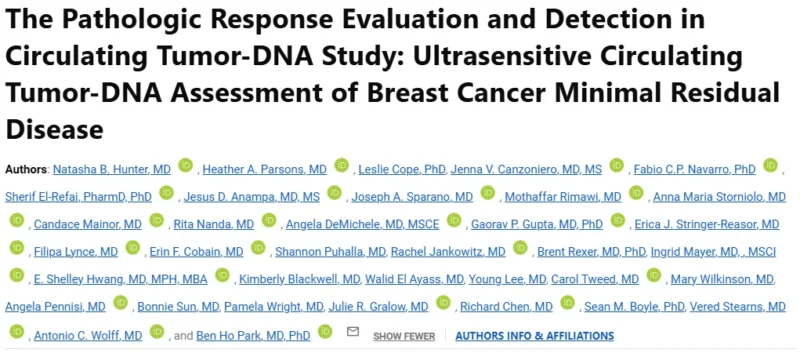
Title: The Pathologic Response Evaluation and Detection in Circulating Tumor-DNA Study: Ultrasensitive Circulating Tumor-DNA Assessment of Breast Cancer Minimal Residual Disease
Authors: Natasha B. Hunter, Heather A. Parsons, Leslie Cope, Jenna V. Canzoniero, Fabio C.P. Navarro, Sherif El-Refai, Jesus D. Anampa, Joseph A. Sparano, Mothaffar Rimawi, Anna Maria Storniolo, Candace Mainor, Rita Nanda, Angela DeMichele, Gaorav P. Gupta, Erica J. Stringer-Reasor, Filipa Lynce, Erin F. Cobain, Shannon Puhalla, Rachel Jankowitz, Brent Rexer, Ingrid Mayer, E. Shelley Hwang, Kimberly Blackwell, Walid El Ayass, Young Lee, Carol Tweed, Mary Wilkinson, Angela Pennisi, Bonnie Sun, Pamela Wright, Julie R. Gralow, Richard Chen, Sean M. Boyle, Vered Stearns, Antonio C. Wolff, Ben Ho Park
Read The Full Article
Other articles about ctDNA on OncoDaily.