





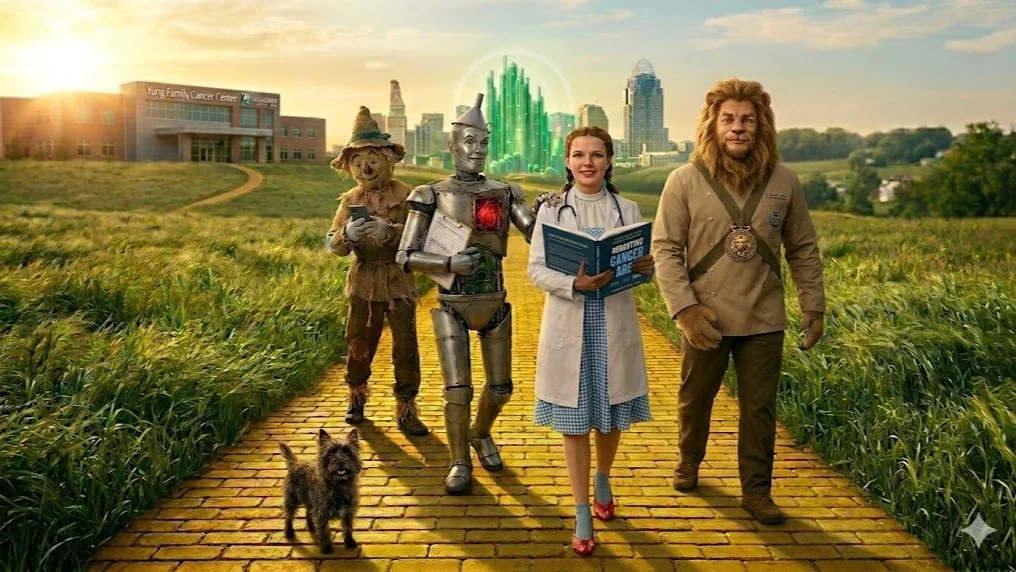
Douglas Flora, Executive Medical Director of Yung Family Cancer Center at St. Elizabeth Healthcare, President-Elect of the Association of Cancer Care Centers, and Editor in Chief of AI in Precision Oncology, shared an article on LinkedIn:
“Pay No Attention to the Algorithm Behind the Curtain: Brain, heart, courage, and the road we’re all walking now
‘Imagination has given us the steam engine, the telephone, the talking-machine, and the automobile, for these things had to be dreamed of before they became realities. So I believe that dreams – day dreams, you know, with your eyes wide open and your brain machinery whizzing – are likely to lead to the betterment of the world.’
– L. Frank Baum, introduction to The Lost Princess of Oz, 1917
In the spring of 1899, in the upper rooms of a row house on Humboldt Boulevard in Chicago, a forty-two-year-old failed shopkeeper sat at a desk and wrote, in pencil on cheap paper, the manuscript of a children’s book about a girl from Kansas swept up by a tornado. He had failed at almost everything an American man could fail at by the end of the nineteenth century. He had bred fancy chickens and gone broke. He had run a variety store in Aberdeen, South Dakota, called Baum’s Bazaar, and gone broke. He had edited a frontier newspaper that folded in 1891. He had sold china door to door across Illinois. The book that came out of that desk, The Wonderful Wizard of Oz, was published in May of 1900. By Christmas it had sold twenty-one thousand copies. L. Frank Baum, after twenty years of failure, had become the most popular children’s writer in America.
‘I am a humbug’, the Wizard says, weeping, when the curtain comes down.
We are all walking the yellow brick road right now.
Every oncologist, every patient, every nurse, every administrator, every data scientist, every person who has watched someone they love go through cancer treatment is walking, at this moment, down a road paved with promises about artificial intelligence in medicine. The road glitters. The voice from the throne is booming. Press releases arrive faster than peer review. Conferences fill with vendors. Venture capital flows. Algorithms are announced weekly that will detect cancer earlier, design drugs faster, replace radiologists, replace pathologists, replace, in the cheerier corners of the literature, me.
Some of those voices belong to real wizards doing real work. Some belong to ordinary people from Omaha working levers behind a curtain.
The work of our moment is telling the difference.
My friend Marianne Gandee shared the Wizard of Oz analogy a few days ago. The trip down this particular road, she said, will require what the travelers in Baum’s book required. A scarecrow’s brain. A tin man’s heart. A lion’s courage. I couldn’t wait to write about it-thanks, Marianne!
A scarecrow’s brain is the discipline of evidence. The willingness to ask whether the algorithm saw patients who look like ours, whether it was tested in clinics that operate like ours, whether it was validated prospectively in real practice by people who did not build it, whether the methods section is as careful as the press release is loud. A model that operates as a black box – whose internal logic cannot be inspected, whose training data cannot be audited, whose decisions cannot be explained to the patient in front of us – is itself a curtain, and explainability is the clinical requirement that lets us pull it aside. The Scarecrow has been the cleverest of the four travelers from the moment Dorothy lifts him off the pole. He does not know it yet. The standard he holds us to is the one we already apply, every Tuesday morning, in tumor board: show me the data, show me the patient, show me what you would do if this were your mother.
A tin man’s heart is the question of for whom. For the patient who gets more mornings with her grandchildren. For the patient whose three-in-the-morning emergency room visit is prevented. For the patient whose chemotherapy is calibrated to her actual symptoms rather than the population average. For the patient whose insurance status, ZIP code, and skin color do not silently degrade the performance of the algorithm meant to help her. The Tin Man weeps at small kindnesses and rusts himself shut on the road, and his friends oil him back into motion. The best of these technologies, used well, oil us back into motion. They take the keyboard scut work that has tethered American physicians to screens for two decades and they return us, even briefly, to the bedside, where the work began.
A lion’s courage is the willingness to act on what the brain has found and the heart has chosen. The courage to deploy the boring tool that works. The courage to refuse the dazzling tool that does not. The courage to admit, when asked, that we do not yet know what these systems will do, in the long term, to our patients or to our profession, and to keep asking. All three are required.
There are real wizards on this road. PAIGE’s digital pathology algorithm received the first FDA de novo authorization for AI in pathology in 2021, improving the sensitivity of pathologists reading prostate biopsies in real practice. The MASAI trial, published by Kristina Lång and her team in The Lancet Oncology in 2023, randomized eighty thousand women in Sweden to AI-supported mammography reading and found a twenty percent increase in cancers detected without an increase in the recall rate. There are also still humbugs. The Epic Sepsis Model, embedded by default in the electronic health record used by hundreds of American hospitals, detected only seven percent of sepsis cases not already identified by clinicians. Companies have been exposed selling AI-powered precision oncology platforms that are dressed-up versions of guidelines available for free. Most of the people building these tools want to build something real. The work is looking. Looking past the press release at the methods. Past the slide deck at the data. Past the curtain at the lever. The wizards we are seeking are real, and they are findable. We just need a way to look.
The Wizard’s gifts at the end of Baum’s book – the diploma, the ticking heart, the medal on a green ribbon – were forms of recognition for what the travelers had carried with them from the first chapter. We are walking this road carrying more than we know. The oncologist who reads the methods section before the press release. The nurse who knows, in her bones, when an alert does not match the patient in front of her. The patient who fills out the symptom questionnaire on a Sunday night because she trusts that someone is reading it. The data scientist who refuses to publish the model that has not been validated. The trainee who asks, in front of a roomful of impressed faces, the question everyone else was too polite to ask. We have the brain. We have the heart. We have the courage. The work is recognizing them in each other.
Somewhere right now, in a clinic in Cleveland or Charlotte or a community hospital outside Boise, a woman is sitting on an exam table waiting to hear what comes next. She is the reason for all of this. The road we are walking is her road. The wizards we are looking for are the ones who can give her more time, more mornings, more chances to hold the people she loves. The humbugs are the ones who will waste her time, or worse.
We have what we need to walk this road well. Brain. Heart. Courage. Each other. And on the day we pull back the curtain on the right tool, in the right way, for the right patient, she will walk out of clinic with what she came in hoping for. More time. More mornings. More chances to hold the people she loves.
Baum, sitting at that desk in Chicago in 1899, did not know he was writing the metaphor that medicine would need a hundred and twenty-five years later. We do.
The curtain is there to be pulled. Let’s pull it together.“
Other articles featuring Douglas Flora on OncoDaily.